Celebrate the 50th Anniversary of the Iconic Zilog Z80
What you’ll learn:
- How the Zilog Z80 improved on Intel’s 8080 architecture while maintaining software compatibility.
- Why the Z80 became one of the most widely used 8-bit processors in computing and gaming history.
- Which classic computers, game consoles, arcade machines, and calculators incorporated the iconic Z80 processor.
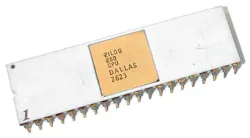
The Z80 turns 50 years old this month! (July 2026)
Any electronic engineer who remembers the golden age of video gaming most likely heard of the Zilog Z80, one of the most important 8-bit microprocessors ever produced.
Back in the late 1970s and early 1980s, microprocessors were transitioning from being used in expensive systems to more cost-effective, smaller machines that could be afforded by engineers, hobbyists, and eventually, consumers alike. Intel was quickly dominating the market with its 8080, which it used to drive that transition, but in 1976 the Zilog Z80 entered the market and would quickly become one of the most widely used 8-bit processors in history.
Federico Faggin knew all too well what it took to market a microprocessor. The time, the money, the architecture- things he learned while working at Intel in the early 1970s. Faggin was the brainchild behind the 4004 and the 8080, so he knew what it took to engineer microcontrollers, more so when it came to establishing factories to produce them. After Faggin left Intel in 1974, he grabbed his former Intel colleague Ralph Ungermann and founded Zilog, with the goal of developing microprocessors that could compete with the top processors at the time, including the top chip, Intel’s 8080.
The development team for the Z80 also included Masatoshi Shima, another colleague from Intel who was responsible for logic and transistor-level design, who, along with Faggin and Ungermann, understood what made the 8080 great, but also knew where it could be improved. Their result was the Z80, which was introduced in 1976.
Rather than developing a stand-alone architecture, the team produced the chip to be instruction-compatible with the 8080, allowing most programs that ran on Intel’s chip to run on the Z80 without modification. That was the company’s biggest advantage, producing a competitive processor that already had access to a large software ecosystem.
The Z80 also provided many improvements over the 8080, including an enhanced instruction set, an overflow flag with increased support for 8-bit and 16-bit math, a better interrupt system, a duplicate register file, built-in DRAM refresh, nonmultiplexed buses and more. Couple that software compatibility with better performance, then price the chip at around $25, and it’s easy to see why the microcontroller quickly became a favorite of manufacturers everywhere.
The Z80 was included in the Osborne 1, Radio Shack TRS-80, ColecoVision, ZX Spectrum, Sega's Master System, and the Pac-Man arcade cabinet. It was also incorporated into Sega’s Game Gear in the 1990s and the TI-8 graphing calculator. Even the early Gameboy series used a modified Z80.
Want to see when the Z80 first appeared in Electronic Design Magazine? Click here.
The chip remained in production for embedded systems until Zilog became a subsidiary of Littlefuse in 2024, when it ceased accepting orders; however, there is a community-based replacement with working silicon that’s close to being released in the original 40-pin DIP packaging, which should be identical to the original Z80 for those looking to keep the legacy going for another 50 years.
About the Author
 Cabe Atwell
Cabe Atwell
Technology Editor, Electronic Design
Cabe is a Technology Editor for Electronic Design.
Engineer, Machinist, Cartoonist, Maker, Writer. A graduate Electrical Engineer actively plying his expertise in the industry and at his company, Gunhead. When not designing/building, he creates a steady torrent of projects and content in the media world. Many of his projects and articles are online at element14 & SolidSmack, industry-focused work at EETimes & EDN, and offbeat articles at Make Magazine. Currently, you can find him hosting webinars and contributing to Electronic Design and Machine Design.
Cabe is an electrical engineer, design consultant and author with 25 years’ experience. His most recent book is “Essential 555 IC: Design, Configure, and Create Clever Circuits”
Cabe writes the Engineering Life & Engineering on Friday blog on Electronic Design.
See Cabe's cartoons & comic strips here.
Comment About the Article
To join the conversation, and become an exclusive member of Electronic Design, create an account today!
 Leaders Logo
Leaders relevant to this article: