STMicroelectronics Expands STM32 Microcontrollers and AI Tools
What you’ll learn:
- How the unified STM32 platform and STM32A family aim to support software reuse and safety-critical control.
- What STM32G5 and STM32H7P add for motor control, digital power, and edge AI inference.
- How ST’s Edge AI Suite, STM32Cube for Agentic AI, and STM32 Sidekick fit into development workflows.
At STM32 Summit 2026, STMicroelectronics showcased new developments across its STM32 ecosystem. It featured a platform for robotics, industrial, automotive, and physical AI workloads. ST also combined new silicon (STM32G5, STM3H7P, and STM3A families) with agentic-AI development support, Edge AI tools, and the Sidekick assistant. Let’s break down the announcements.
Unified STM32 Platform
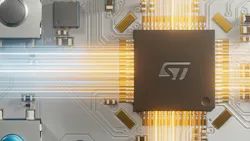
Recently, STMicroelectronics unveiled a unified STM32 Platform (Fig. 1). The company says this is for developers who want to reuse software, hardware IP, architectures, and dev tools across robotics, industrial, and automotive applications. ST’s Unified platform features Arm Cortex-M cores and the STM32Cube ecosystem.
According to ST, shared manufacturing technologies make it easier to reuse software and designs while products scale. These include 40-nm flash technology, 18-nm FD-SOI technology with embedded phase-change memory, and TSMC eNVM technologies. Overall, this platform reduces the need to redesign firmware and toolchains for each product family.
STM32A Series
With the STM32A Series, STM32 is extended into automotive and safety-critical systems, like vehicle control, robotics, and industrial automation. ST launched three variants: STM32A4, STM32A5, and STM32A9.
The STM32A4 is for entry-level automotive local control nodes, local sensors, and safety functions. It features up to 0.5 MB of memory, QM/ASIL B, and cryptography support. STM32A5 is intended for mid-range safety-critical industrial applications (robotics, energy systems, and industrial automation). It provides up to 4 MB of memory, ASIL B safety support, and a hardware security module.
Lastly, the STM32A9 is for multi-domain, safety-critical control, featuring up to 12 MB of memory, ASIL D support, HSM security, a split-lock architecture, Ethernet-oriented connectivity with RCP support, and high-performance real-time and cross-domain control. The split-lock design supports ASIL D operation. When the full ASIL D operation isn’t needed, it can be configured for high-performance operation.
STM32G5 Series
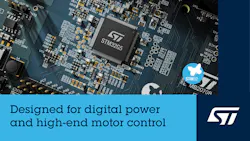
ST is also launching the STM32G5 Series, a mixed-signal MCU family for digital power, high-end motor control, and precision real-time control (Fig. 2). Currently in production, the STM32G5 is built on ST’s 40-nm process, which integrates an Arm Cortex-M33 core with TrustZone security along with a peripheral set. The processor runs at up to 280 MHz and delivers 1136 CoreMark. It has a high-resolution timer with 111 ps for advanced PWM and control, and a programmable logic array.
In terms of powering electronics and sensing, STM32G5 offers up to three 12-bit ADCs (running at up to 5 MSPS), eight comparators, eight DAC channels (including two buffered external channels), up to three operational amplifiers, and multiple motor-control PWM and general-purpose timers.
STM32H7P Series
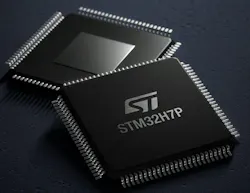
The STM32H7P Series, a high-performance MCU family (Fig. 3), is built for demanding real-time workloads like industrial edge AI, digital power, motor control, and condition monitoring. It has a Cortex-M7 CPU and a hardware signal processor for DSP-type functions.
Other STM32H7P variants include a Neural-ART NPU for AI inference. Its processor runs at up to 520 MHz, delivering 2773 CoreMark. DSP instructions, an MPU, and 32 kB of instruction cache and 32 kB of data cache are included. The Neural-ART NPU delivers up to 85 GOPS and shifts AI inference from the main processor. For memory and connectivity, it has up to 2 MB of flash, 736-kB RAM, USB, three FDCAN interfaces, four 12-bit ADCs, eight DAC channels (including two external 12-bit DAC outputs), three advanced motor-control timers, and two high-resolution timers.
ST Edge AI Suite
ST announced an updated Edge AI Suite with four tools, making it easier to transition from AI model discovery to deployment on STM32 hardware (Fig. 4). Tools include Model Explorer, Dataset Factory, Model Factory, and Model Bench.
Model Explorer has a web interface so that users can quickly find the right model. Developers can use Dataset Factory to simplify data prep for AI model development. Model Factory supports training, customization, quantization, and optimization for STM32 MCUs. Using Model Bench, developers benchmark models remotely on real ST boards. These features enable embedded AI models to be evaluated, prepared, optimized, and validated.
STM32Cube for Agentic AI
For STM32 firmware development, the new STM32Cube for Agentic AI framework makes AI coding assistants more practical (Fig. 5)_. Agents are able to access maintained STM32 documentation, validated configurations, reference examples, and ST development resources.
With the framework, agents can use optimized, verified reference code and work with STM32CubeMX, ST’s deterministic code-generation tool. Other capabilities include code review, which checks API calls, hardware interactions, and deployment flexibility. Developers still have control within familiar STM32 development workflows. It also supports GitHub Copilot, Claude, and Cursor. This speeds up code generation and preserves access to validated STM32 materials, reducing hallucination risk.
STM32 Sidekick
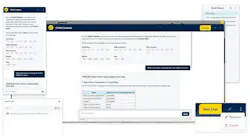
ST unveiled an AI-powered assistant called the STM32 Sidekick (Fig. 6)_. Developers input information like the STM32 series, part number, tool, or application. The assistant’s job is to answer technical questions, find documentation, explain ideas, compare devices or features, and help with debugging.
The Sidekick draws on STM32 resources, such as reference manuals, datasheets, user manuals, wikis, application notes, and community-knowledge base articles. When it answers, the assistant provides citations and links, allowing developers to verify the source material. Users can access Sidekick through st.com and the ST Community. It’s also available from STM32CubeProgrammer 2.23 and later, on Developer Zones, support pages, and STM32 product pages.
About the Author
 Cabe Atwell
Technology Editor, Electronic Design
Cabe is a Technology Editor for Electronic Design.
Engineer, Machinist, Cartoonist, Maker, Writer. A graduate Electrical Engineer actively plying his expertise in the industry and at his company, Gunhead. When not designing/building, he creates a steady torrent of projects and content in the media world. Many of his projects and articles are online at element14 & SolidSmack, industry-focused work at EETimes & EDN, and offbeat articles at Make Magazine. Currently, you can find him hosting webinars and contributing to Electronic Design and Machine Design.
Cabe is an electrical engineer, design consultant and author with 25 years’ experience. His most recent book is “Essential 555 IC: Design, Configure, and Create Clever Circuits”
Cabe writes the Engineering Life & Engineering on Friday blog on Electronic Design.
See Cabe's cartoons & comic strips here.


Comment About the Article
To join the conversation, and become an exclusive member of Electronic Design, create an account today!
 Leaders Logo
Leaders relevant to this article: