What’s the Difference Between Agentic AI, MCPs, and LLMs?
What you’ll learn:
- What is agentic AI?
- What are MCPs?
- What is OpenClaw?

Agentic artificial intelligence (AI) is the latest craze built on the large language models (LLMs) that power chatbots like ChatGPT, Perplexity, and Copilot. Chatbots typically take text prompts and respond in kind. Some can generate graphics and even videos. They also tend to be standalone systems that you can interact with, but it takes agentic AI to make things happen outside of these chat environments.
Agentic AI Ties LLMs to the World
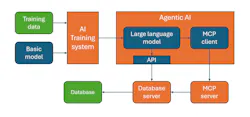
In general, agentic AI connects AI models to the rest of the world using any one of a number of interfaces and protocols (see figure). One of the main protocols currently in use is the Model Context Protocol (MCP). Developed by Anthropic, the open-source protocol has been adopted by most AI companies.
The first MCP that I ran into — the Burroughs Master Control Program (MCP) for the company’s mainframe systems — has nothing to do with AI. This MCP was just the operating system, although it was quite advanced for its time. I thought that this was a nice diversion since I worked at Burroughs many years ago and tangled with that MCP. The movie Tron also took up the MCP as its antagonist. In this case, though, it was a rogue program, albeit a very powerful one.
But back to AI.
A range of different platforms can run one or more LLMs and provide bidirectional access to third-party services via an MCP. These platforms provide a generic MCP client to the LLM, which in turn can interact with any MCP server that provides services like manipulating files or email, accessing databases, and so on. This allows an LLM to access and utilize data for future computations.
Agentic AI isn’t limited to using MCPs, especially in the embedded space. MCPs are handy when third-party services need to be employed and users don’t have control over, or want to support, the MCPs, although they may provide access to their own data such as emails.
On the other hand, embedded developers often have control over the entire system where an application programming interface (API) provides a more efficient and controlled protocol. It’s also something that can be used by other applications or provide the LLM access to those applications.
The big difference between using an API versus an MCP is the number of details involved in making something work. MCP servers offer a way for an agentic AI platform to discover its functionality, whereas a programmer must implement a driver that sits between these systems. Another difference is that APIs tend to be stateless, providing a lower latency protocol, while an MCP maintains session-level context.
Though some consider agentic AI to be self-motivated, any system must be initiated. However, it’s able to then continue on its own, which can be a good and bad thing.
Beware Agentic AI and MCPs
Chatbots, agentic AI systems. and MCPs can do some remarkable things. And many have jumped on the bandwagon, sometimes to their detriment. Agentic AI and MCPs are already complex systems, though building on them leads to even more complexity. Then add issues such as security, trust in the AI, and the imprecise nature of “prompt programming,” and you might want to be a bit more circumspect before handing over control and manipulation of your own or your company’s data and resources.
Agentic AI is a hacker’s dream. AI is being used to detect and prevent system intrusions. However, once an attacker gains access to a system, the tools that reside on the system could be used to subvert and manipulate the system. You might accidentally ask your agent to corrupt all your files, but a hacker might do that on purpose.
We will forego the discussion about the quality of the LLMs at this point. Nonetheless, issues exist with LLMs that run over long periods of time. Agentic AI systems often run for a long time or possibly indefinitely. For now, let’s assume this isn’t a major issue.
The problem with agentic AI and MCPs is that they’re usually designed first for functionality, with issues such as security and reliability being secondary. That mode of thinking is changing, but these issues are challenging by themselves. Few users consider things like permissions even when using smartphone apps, let alone allowing an agentic system to run amok through personal or company data.
Part of the challenge is that AI can manipulate data and, with the help of an MCP, move it almost anywhere. In fact, a user almost needs one agentic AI system to oversee another.
One matter that many overlook is repeatability and maintainability. Conventional applications tend to be fixed with changes occurring at set intervals. A system should continue working in the same fashion over time if there are no changes. Not so with AI systems, where the underlying agents and interfaces are changing. Rules or suggestions in the form of prompts may result in different results. That’s because they’re interpreted differently due to an underlying change in the LLM, since it’s new and improved.
Using Your Own Agentic AI
Agentic AI is cropping up in applications like Microsoft’s integration of its Copilot system into its user and system applications. At this point, using the system typically requires it to be initiated, which is a good thing.
One open-source system is called OpenClaw. It can hook into MCPs and even act as an MCP server. It can use your chat apps and even send emails. And it will work with your files if you let it.
OpenClaw, which runs on Linux, Windows, and MacOS, provides a web-based dashboard interface for control purposes and where prompts can be entered. You can create multiple agents and utilize different AI models and MCPs. There are other frameworks similar to OpenClaw, including LangChain and CrewAI Studio.
You can essentially install any of these systems on your PC. However, I highly recommend that you first try out systems like OpenClaw in a sandbox environment before you hand over too much control. Unfortunately, most people don’t know how to spin up a virtual machine and would not have an extra PC sitting around that’s isolated.
On the other hand, embedded developers are likely to have this expertise and understand the issues, including the high level of system complexity that’s easy to reach by just adding a few MCPs. Many are open source, and some closed-source solutions offer free access, too. However, for the latter, in the long term, there are costs involved that can be significant. Even free software has a cost to use it.
The push for massive AI data centers isn’t to provide free agentic AI, but rather paid AI services. If that sounds lucrative, it can also mean costly for users. You may need an LLM to determine if you can make money utilizing these systems.
Just keep an eye on issues like cost, security, and trust as you delve into agentic AI. As Elmer Fudd says, “Be vewy, vewy careful.”
About the Author
 William G. Wong
William G. Wong
Senior Content Director - Electronic Design and Microwaves & RF
I am Editor of Electronic Design focusing on embedded, software, and systems. As Senior Content Director, I also manage Microwaves & RF and I work with a great team of editors to provide engineers, programmers, developers and technical managers with interesting and useful articles and videos on a regular basis. Check out our free newsletters to see the latest content.
You can send press releases for new products for possible coverage on the website. I am also interested in receiving contributed articles for publishing on our website. Use our template and send to me along with a signed release form.
Check out my blog, AltEmbedded on Electronic Design, as well as his latest articles on this site that are listed below.
You can visit my social media via these links:
- AltEmbedded on Electronic Design
- Bill Wong on Facebook
- @AltEmbedded on Twitter
- Bill Wong on LinkedIn
I earned a Bachelor of Electrical Engineering at the Georgia Institute of Technology and a Masters in Computer Science from Rutgers University. I still do a bit of programming using everything from C and C++ to Rust and Ada/SPARK. I do a bit of PHP programming for Drupal websites. I have posted a few Drupal modules.
I still get a hand on software and electronic hardware. Some of this can be found on our Kit Close-Up video series. You can also see me on many of our TechXchange Talk videos. I am interested in a range of projects from robotics to artificial intelligence.
Comment About the Article
To join the conversation, and become an exclusive member of Electronic Design, create an account today!
 Leaders Logo
Leaders relevant to this article: