New AMD Platforms Target AI—From Robots to the Data Center
What you'll learn:
- What’s new from AMD?
- The Kria COM-HPC SOM’s focus on robotics.
- Why ROCm delivers open-source AI software.
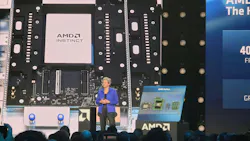
I’m at AMD’s Advancing AI 2026, courtesy of the company, along with a horde of users and vendors to find out about the latest technology announcements. They’re significant and I’m only going to touch on some of the major ones in this article. I will get back to most of these as well as others when I have the chance. Trying to do that while at the conference tends to be a tradeoff between writing and talking tech to get a better insight into all of the announcements, which range from new open-source software to AI data center platforms.
AMD’s Kria includes an FPGA SoC platform I reviewed a while ago; however, its latest Kria platform is an SoC that consists of an x86 CPU, GPU, and NPU that share a single address space (Fig. 1). The new system comes in a standard, COM-HPC form factor. The SoC is AMD’s Ryzen AI X100 family.
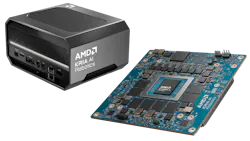
The Ryzen AI X100 (Fig. 2) extends the embedded AI CPU family that includes the P100 series. The X100 is built from three chiplets (two CPU chiplets and a GPU/NPU/IO chiplet), while the P100 is a single die. The CPU has up to 16 Zen 5 cores. The RDNA 3.5 GPU has 40 compute units that can handle AI chores, and the XDNA 2 NPU is designed for always-on operation, delivering 50 TOPS of performance.
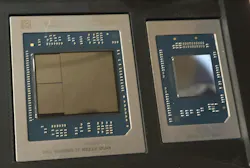
The 5.1-GHz X100 has a memory interface featuring 273 GB/s for 128 GB of unified memory. There are industrial versions with a configurable TDP from 45 to 120 W. AMD provides a 10-year lifecycle. An updated Linux implementation incorporates real-time enhancements allowing an interrupt latency under 7 µs. Virtual-machine support allows real-time operating systems like FreeRTOS to complement a deterministic Linux.
A number of other announcements focused on high-end systems, including a full system design called Helios (Fig. 3). Helios runs AMD’s “Venice” EPYC 9006 server CPU targeting agentic AI chores. This family includes general-purpose versions with up to 256 Zen 6c cores running 512 tasks in a single package, to low-power cores with fewer cores designed for “sandbox” environments that are common for agentic AI support. These all include massive amounts of HBM4 memory.
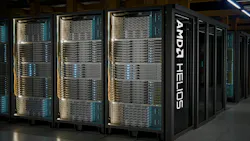
The Helios platform defines a water-cooled, full rack stack built around AMD’s latest Ethernet switches, AMD Instinct MI355 GPUs, Pensando DPUs, and more. This and the rest of AMD’s hardware is supported by ROCm.
There were a few software announcements regarding the open-source ROCm framework, too. This includes support for HIP, which provides CUDA migration capabilities to ROCm.AI. It needs a lot more description, but in general it includes features like Hyperloom that’s designed to optimize agentic-AI-assisted workloads.
I’ll soon be bringing you more detailed information on all of these and more in the near future, such as more robots and the Ryzen AI Halo developer platform. Stay tuned.
About the Author
 William G. Wong
William G. Wong
Senior Content Director - Electronic Design and Microwaves & RF
I am Editor of Electronic Design focusing on embedded, software, and systems. As Senior Content Director, I also manage Microwaves & RF and I work with a great team of editors to provide engineers, programmers, developers and technical managers with interesting and useful articles and videos on a regular basis. Check out our free newsletters to see the latest content.
You can send press releases for new products for possible coverage on the website. I am also interested in receiving contributed articles for publishing on our website. Use our template and send to me along with a signed release form.
Check out my blog, AltEmbedded on Electronic Design, as well as his latest articles on this site that are listed below.
You can visit my social media via these links:
- AltEmbedded on Electronic Design
- Bill Wong on Facebook
- @AltEmbedded on Twitter
- Bill Wong on LinkedIn
I earned a Bachelor of Electrical Engineering at the Georgia Institute of Technology and a Masters in Computer Science from Rutgers University. I still do a bit of programming using everything from C and C++ to Rust and Ada/SPARK. I do a bit of PHP programming for Drupal websites. I have posted a few Drupal modules.
I still get a hand on software and electronic hardware. Some of this can be found on our Kit Close-Up video series. You can also see me on many of our TechXchange Talk videos. I am interested in a range of projects from robotics to artificial intelligence.