AI Powers the Coralboard
What you'll learn:
- What is a Coralboard?
- How Synaptics is delivering edge AI.
- Why use an open-source MLIR-based Torq compiler?
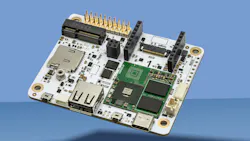
The Coralboard SL is available now (Fig. 1, see image above). It’s powered by Synaptics’ SL2619 AI SoC with an NPU based on Google’s Coral core architecture. The Astra SL2619 has a pair of 2-GHz Arm Cortex-A55 cores along with a 200-MHz Cortex-M52 with Helium support for real time chores (Fig. 2). The Synaptics Torq/Coral NPU delivers 1 TOPS.
2. The Astra SL2610 features a 1-TOPS NPU and multicore CPU and GPU. (Electronic Design)
Internally the NPU incorporates RISC-V cores. The board adds 2 GB of DDR4 DRAM, CSI/DSI imaging ports, QWICC and mikroBUS connectors, and an M.2 expansion slot for Wi-Fi and Bluetooth connectivity.
The Cortex-A55 cores can run operating systems like Yocto Linux while the Cortex-M52 is able to run an RTOS like FreeRTOS or Zephyr. With its NPU, the SL2619 can handle large language models (LLMs) locally.
The new Coralboard SR runs Synaptics’ SR250 (Fig. 3). It’s designed for even lower power operation by replacing the more powerful dual-core Cortex-A55 with an 800-MHz Cortex-M85. The NPU is also streamlined, delivering 400 GOPS. The Coralboard SR has the same set of interfaces, including NOR flash memory and a MicroSD card slot.
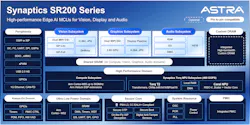
Both platforms target vision and audio AI applications. They contain the same hardware root-of-trust security subsystem.
The SR200 family includes a number of different platforms, such as the SR210 designed for very low power, always-on voice and sensing. The NPU delivers 200 GOPS. The SR230 adds vision, display, and optional audio support with 300 GOPS of performance. And the SR250 offers 400 GOPS of performance plus dual vision and display paths.
All of the platforms’ NPUs utilize Synaptics’ Torq AI engine supported by Synaptics’ SDK. The compiler is based on the open-source MLIR (Multi-Level Intermediate Representation) subproject that’s part of the LLVM project, host to the popular compiler collection.
“The MLIR project provides a modular and extensible intermediate representation (IR) framework intended to facilitate constructing domain-specific compilers and improve compiling for heterogeneous computing platforms.” Wikipedia)
The MLIR project supports a variety of AI compiler ecosystems, including runtimes like TensorFlow.
About the Author
 William G. Wong
Senior Content Director - Electronic Design and Microwaves & RF
I am Editor of Electronic Design focusing on embedded, software, and systems. As Senior Content Director, I also manage Microwaves & RF and I work with a great team of editors to provide engineers, programmers, developers and technical managers with interesting and useful articles and videos on a regular basis. Check out our free newsletters to see the latest content.
You can send press releases for new products for possible coverage on the website. I am also interested in receiving contributed articles for publishing on our website. Use our template and send to me along with a signed release form.
Check out my blog, AltEmbedded on Electronic Design, as well as his latest articles on this site that are listed below.
You can visit my social media via these links:
- AltEmbedded on Electronic Design
- Bill Wong on Facebook
- @AltEmbedded on Twitter
- Bill Wong on LinkedIn
I earned a Bachelor of Electrical Engineering at the Georgia Institute of Technology and a Masters in Computer Science from Rutgers University. I still do a bit of programming using everything from C and C++ to Rust and Ada/SPARK. I do a bit of PHP programming for Drupal websites. I have posted a few Drupal modules.
I still get a hand on software and electronic hardware. Some of this can be found on our Kit Close-Up video series. You can also see me on many of our TechXchange Talk videos. I am interested in a range of projects from robotics to artificial intelligence.