APU Adds NPU to Target Robotics
What you’ll learn:
- What does the X100 development platform look like?
- Why is this using the industry-standard COM-HPC form factor?
AMD’s Ryzen AI Embedded X100 processor (APU) targets applications that require AI support and real-time capabilities, such as robotics. I talked with Rob Bauer, Senior Manager in the Embedded Business Unit, about the new processor and the Kria AI Robotics platform (Fig. 1). Inside is a COM-HPC standard module.
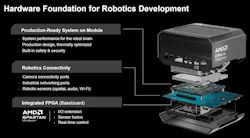
The development system includes PC-style connections on one side, including USB and Ethernet connections, while the other end focuses on peripheral connectivity like camera interfaces.
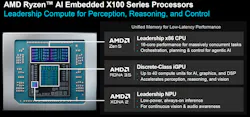
The AMD Kria AI platform is built around the AMD X100, which is based on TSMC’s 4-nm technology (Fig. 2). The CPU complex includes 16 Zen 5 cores with AVX-512 support and simultaneous multithreading, while the integrated RDMA 3.5 GPU includes 40 compute units. The neural processing unit (NPU), based on AMD’s XDMA 2 architecture, is designed for low-power, always-on operation. The low-power NPU can deliver 50 TOPS of performance.
AMD’s software support is based on the open-source ROCm.AI (Fig. 3). This includes the robotics core SDK with ROS 2 support. The company has its own rocLibrary runtime and it supports the HIP (Heterogeneous-compute Interface for Portability) API. HIP is a thin interface layer for rocLibrary. The HIPIFY tool assists in the conversion of CUDA code to HIP code.
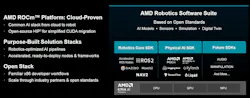
The AI and robotics software target any of the processing complexes from CPU to NPU. This allows the NPU to handle some AI models using minimal power, and the GPU can be utilized when there’s a need for more computational power.
The COM-HPC module is available separately, enabling prototypes to be quickly transferred to production. Supporting up to 128 GB of LPDDR5x memory, it’s designed for an industrial temperature range of −40 to +85°C. Schematics and support documents for the open-source AMD Kria AI platform’s carrier board are available to developers.
About the Author
 William G. Wong
William G. Wong
Senior Content Director - Electronic Design and Microwaves & RF
I am Editor of Electronic Design focusing on embedded, software, and systems. As Senior Content Director, I also manage Microwaves & RF and I work with a great team of editors to provide engineers, programmers, developers and technical managers with interesting and useful articles and videos on a regular basis. Check out our free newsletters to see the latest content.
You can send press releases for new products for possible coverage on the website. I am also interested in receiving contributed articles for publishing on our website. Use our template and send to me along with a signed release form.
Check out my blog, AltEmbedded on Electronic Design, as well as his latest articles on this site that are listed below.
You can visit my social media via these links:
- AltEmbedded on Electronic Design
- Bill Wong on Facebook
- @AltEmbedded on Twitter
- Bill Wong on LinkedIn
I earned a Bachelor of Electrical Engineering at the Georgia Institute of Technology and a Masters in Computer Science from Rutgers University. I still do a bit of programming using everything from C and C++ to Rust and Ada/SPARK. I do a bit of PHP programming for Drupal websites. I have posted a few Drupal modules.
I still get a hand on software and electronic hardware. Some of this can be found on our Kit Close-Up video series. You can also see me on many of our TechXchange Talk videos. I am interested in a range of projects from robotics to artificial intelligence.