5 Data-Center-Specific SSDs for the Cloud, AI, and More
What you'll learn:
- Insight into how today's data center SSDs are being designed for AI, cloud, and hyperscale workloads.
- How new features separate modern PCIe Gen5 data center SSDs from previous enterprise storage solutions.
- How manufacturers are increasing capacity, performance, and efficiency for next-generation servers.
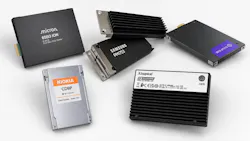
Today’s data centers have to support everything from cloud computing and virtualization to AI training, analytics, and high-performance computing. As workloads continue to increase, data-center-specific SSDs are rising to meet those workloads with faster PCIe Gen5 interfaces, higher capacities, and improved endurance to keep up with increasing storage demands.
Below are five data center SSDs designed to deliver the performance, reliability, and scalability needed for today's modern data centers.
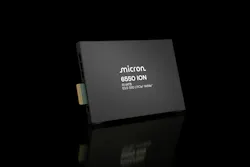
Micron's 6550 ION SSD is an ideal choice for data centers as it's designed for dense-cloud, AI, and data-lake storage. The drive’s QLC NAND allows it to reach capacities up to 60 TB with a focus on storage density and power efficiency. According to Micron, a 1U server populated with 20 6550 ION drives can provide more than 1.2 PB of flash storage, allowing data centers to reduce the number of servers and drives needed for large deployments.
Product: 6550 ION SSD
Company: Micron
Interface: PCIe 5.0 x4
Protocol: NVMe 2.0
Form Factors: U.2 (15 mm), E1.L (9.5 mm), E3.S (7.5 mm)
Capacity: 30.72 TB, 61.44 TB
NAND: Micron G9 QLC 3D NAND
Sequential Read: Up to 14,000 MB/s
Sequential Write: Up to 7,000 MB/s
Random Read: Up to 2 million IOPS
Random Write: Up to 70K IOPS
Endurance: 1 DWPD (5 years)
Features: OCP NVMe SSD 2.5 compliant, power-loss protection, SPDM 1.2 authentication, TCG Opal 2.02 self-encrypting drive (SED) support, FIPS 140-3 certifiable models, optimized for AI data lakes and hyperscale storage.
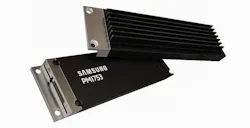
The PM1753, a PCIe Gen5 enterprise SSD developed by Samsung, features V9 NAND TLC technology, suiting it for data centers utilizing AI infrastructure, virtualization, OLTP databases, and large-scale analytics. The SSD also supports modern security features, including TCG Opal encryption, SPDM, and power-loss protection while still providing high random read performance.
Product: PM1753
Company: Samsung
Interface: PCIe 5.0 x4
Protocol: NVMe 2.0
Form Factors: U.2, E1.S, E3.S
Capacity: 3.84 TB, 7.68 TB, 15.36 TB, 30.72 TB
Sequential Read: Up to 14,500 MB/s
Sequential Write: Up to 10,000 MB/s
Random Read: Up to 3.3 million IOPS
Random Write: Up to 650K IOPS
Endurance: 1 DWPD (5 years)
Features: Power-loss protection, AES-XTS 256 encryption, OCP compliance, AI workload optimization
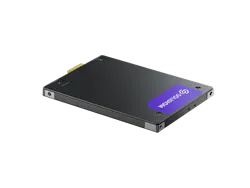
Solidigm's D7-PS1030 is designed for mixed and write-intensive enterprise workloads such as cloud infrastructure, AI applications, HPC, logging servers, and transactional databases. Solidigm optimized the drive for PCIe Gen5 performance under real-world workloads rather than peak benchmark numbers. The D7-PS1030 is also touted for its consistent performance with up to 10-GB/s write speeds and 14-GB/s read speeds.
Product: D7-PS1030
Company: Solidigm
Interface: PCIe 5.0 x4
Protocol: NVMe
Form Factors: U.2 15 mm, E3.S 7.5 mm
Capacity: 1.6 TB, 3.2 TB, 6.4 TB, 12.8 TB
NAND: 3D TLC NAND
Sequential Read: Up to approximately 14 GB/s
Sequential Write: Up to approximately 10 GB/s
Endurance: Mid-endurance enterprise class
Features: OCP support, optimized QoS, power-loss protection
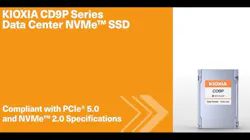
KIOXIA’s CD9P-V Series consists of mixed-use data center NVMe SSDs designed for hyperscale cloud deployments. They’re available in both mixed-use and read-intensive models. The drives come with the company’s BiCS FLASH generation 8 TLC flash memory, in a CD9P-V E3.S form factor. They provide 3 DWPD (Drive Writes Per Day) of endurance and storage capacities up to 12.8 TB.
Product: CD9P-V Series
Company: KIOXIA
Interface: PCIe 5.0
Protocol: NVMe 2.0
Form Factors: 2.5-in. U.2 and E3.S
Capacity: Up to 12.8 TB
Endurance: 1 DWPD (read-intensive), 3 DWPD (mixed-use)
NAND: BiCS Flash 3D NAND
Features: Flexible endurance options, OCP compatibility, enterprise security, dual-port support (selected models)
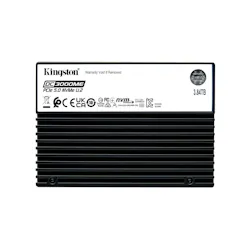
The DC3000ME is touted by Kingston as an enterprise PCIe Gen5 NVMe SSD that’s designed for AI servers, cloud computing, HPC, and edge deployments. The data center SSD incorporates 3D eTLC NAND, takes advantage of the PCIe 5.0 interface, and is backward-compatible with PCIe 4.0 servers and backplanes. The DC3000ME also offers on-board power-loss protection and AES 256-bit encryption for increased data security.
Product: DC3000ME
Company: Kingston
Interface: PCIe 5.0 x4
Protocol: NVMe 2.0
Form Factor: U.2 (15 mm)
Capacity: 3.84 TB, 7.68 TB, 15.36 TB
NAND: 3D eTLC NAND
Sequential Read: Up to 14,000 MB/s
Sequential Write: Up to 10,000 MB/s
Random Read: Up to 2.8 million IOPS
Random Write: Up to 500K IOPS
Endurance: 1 DWPD (5 years)
Features: Power-loss protection, AES 256-bit encryption, TCG Opal 2.0 support, end-to-end data-path protection, enterprise QoS.
Final Thought
With data centers increasing support for AI infrastructure, cloud storage, and enterprise databases, today's data center SSDs are taking speed, performance, and capacity to new levels. With PCIe Gen5 fast becoming the standard and drive capacities continuing to grow, these SSDs provide data centers with more options for building faster, denser, and more efficient storage infrastructures.
More on SSDs

>>Check out our coverage of the Future of Memory and Storage 2026 conference
About the Author
 Cabe Atwell
Cabe Atwell
Technology Editor, Electronic Design
Cabe is a Technology Editor for Electronic Design.
Engineer, Machinist, Cartoonist, Maker, Writer. A graduate Electrical Engineer actively plying his expertise in the industry and at his company, Gunhead. When not designing/building, he creates a steady torrent of projects and content in the media world. Many of his projects and articles are online at element14 & SolidSmack, industry-focused work at EETimes & EDN, and offbeat articles at Make Magazine. Currently, you can find him hosting webinars and contributing to Electronic Design and Machine Design.
Cabe is an electrical engineer, design consultant and author with 25 years’ experience. His most recent book is “Essential 555 IC: Design, Configure, and Create Clever Circuits”
Cabe writes the Engineering Life & Engineering on Friday blog on Electronic Design.
See Cabe's cartoons & comic strips here.