Advancing Augmented-Reality Glasses
What you'll learn:
- What’s inside XReal’s latest pair of smart glasses, the 1S.
- Where the 1S fits into the augmented-reality (AR) landscape.
- What is a “birdbath lens,” and how it differs from a waveguide.
XReal recently introduced the XReal 1S, a new pair of entry-level augmented-reality (AR) glasses with 3D spatial display technology that can project ultra-wide virtual screens on top of the real world.
The new device joins the company’s One Series, replacing the XReal One glasses released in late 2024, representing “a new standard for premium wearable displays.” Unlike other smart glasses that overlay digital images on top of the real world without fully blocking it from view, the XReal 1S is more of a mixed-reality device. It acts as a semi-transparent second screen that sits between the user’s eyes and the real world beyond, creating a cinematic, immersive experience that’s slightly more virtual reality (VR) than AR.
XReal is one of several companies arguing that smart glasses stand a better chance of reaching the mass market than the large, bulky AR headsets such as Apple’s Vision Pro, Microsoft’s HoloLens, or Lenovo’s ThinkReality VNX. The 1S can connect to nearly any device such as a smartphone, laptop, or game console — anything with video — over USB-C and mirror it. As a result, users are able to access to virtual displays to scroll through apps, watch video, play games, and even utilize productivity and communications tools for work.
In that way, the 1S differs from other AR devices like Meta’s newer Ray-Ban Display glasses, which have a high-resolution, full-color in-lens display for notifications, navigation, and real-time information. But instead of filling up the broader field of vision, the smart glasses project digital content on a single lens.
Larger, More Customizable Spatial Displays
XReal said the 1S upgrades the core specs of its predecessor to create spatial displays that are larger, more stable, more customizable, with faster refresh rates and higher resolution from edge to edge. It improves the viewing experience from any angle by increasing the resolution of the virtual displays from 1,080 to 1,200 pixels for each eye.
Brightness jumps from 600 to 700 nits, and the 1S maintains the same smooth 120-Hz maximum refresh rate as the One. It also comes with a wider field of view of 52 degrees compared to 50 degrees in the One.
In the video above, Ralph Jodice, general manager at XReal, chats with Electronic Design about what’s inside the 1S, which is built around a custom design comprised of the company's optical engine and in-house X1 co-processor.
The custom-designed X1 spatial computing co-processor in the 1S can create a spatial display of nearly any device and for anything seen by the wearer. XReal said the new smart glasses, which are based on micro-OLED display technology, can create large cinematic screens on top of the user’s vision. They also give the user the ability to adjust the scale of a spatial display at the touch of a button, allowing users to create ultra-wide 21:9 or 32:9 screens.
Users can drag and drop virtual displays anywhere in their vision and then anchor them anywhere they choose in three-dimensional space with the press of a button, or they can create ultra-wide displays that will always stay in front of them. XReal said the smart glasses is able to project a single spatial display that appears as much as 500 inches wide. With the “side view” mode, users can also pin a smaller screen to a corner of their view, such as top-right or bottom-right, enabling users to multitask while getting a clear view of their surroundings.
3DoF Displays
According to the company, the X1 chip creates spatial displays with three degrees of freedom (3DoF). That means the smart glasses can track the user’s head movement in three directions — looking up or down (“pitch”), left or right (“yaw”), tilting side-to-side (“roll”) — and then adapt to the motion to improve image stability and clarity. As a result, the spatial displays pinned in one corner of the scene will not move when the user turns their head, and ultra-wide screens will not blur when the user moves their head or looks around at their surroundings.
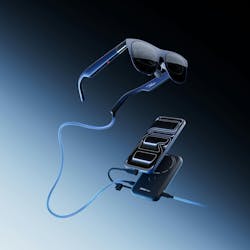
By running three-degrees-of-freedom spatial computing locally on the X1 — rather than relying on software executing on a smartphone, laptop, or other external device — XReal said the 1S significantly reduces latency when monitoring head movements. The ability to adapt to head movement as fast as possible is important when smart glasses are used as wearable displays, as even small delays can cause visual blur or image lag. The local processing helps deliver a smooth, stable spatial display at all times.
The company also reengineered the proprietary optical engine within the XReal 1S to improve the resolution, brightness, and other qualities of its virtual displays and broaden the field of view without sacrificing the ultra-smooth refresh rate of its predecessor. Furthermore, when moving between indoors and outdoors, the new device will change its display settings using electrochromic dimming to adapt to lighting conditions.
Leveraging Birdbath Lens Technology
One of the main components is its “birdbath lens” technology, said Jodice. The technology uses a curved lens that sits further from the eye than waveguides, which employ thin, light-transmitting plates that resemble the lenses in regular glasses.
While these birdbaths can result in thicker, front-heavy glasses that block more light from the real world, they can deliver sharper resolution, higher brightness, more vibrant colors, and a wider field of view. For these reasons, the technology is widely used by XReal and other companies working on more “VR-like” smart glasses that prioritize image quality.
XReal is focused on smart glasses that function as high-quality wearable displays capable of mirroring screens on other devices and creating a more cinematic, immersive experience. In contrast, Meta and many other companies are rolling out all-day, wear-everywhere smart glasses, applying waveguides that gives users the ability to see the world around them with minimal obstruction. These devices are designed to overlay information such as directions or text onto the user’s view without blocking the real world, even if that means sacrificing image quality.
In many cases, they use waveguides — thin, transparent pieces of glass that carry light from the display to the user’s eyes — in place of regular lenses. This results in hardware that’s lighter, slimmer, and more transparent than birdbath designs.
XReal said it crammed all of the capabilities of the 1S into a lightweight 82-gram frame (or relatively lightweight, since the smart glasses weigh around 40% more than Meta’s Ray-Ban smart glasses, which weigh approximately 50 grams). The smart glasses also include Bose technology to deliver high-fidelity audio close to the ear, eliminating the need for headphones or earbuds.
The price of the 1S is lower than its predecessor, the XReal One, dropping from $499 to $449, making it more affordable for entry-level consumers. “Every XReal One Series product has raised the bar for what wearable displays can achieve,” said XReal chief executive and co-founder Chi Xu. “With XReal 1S, we’re not only lowering the cost of entry, we’re doing so while boosting specs and performance, and improving optics.”
Backed by Chinese e-commerce giant Alibaba, XReal is trying to tap into the rising demand for smart AR glasses, a trend that was on full display at the Consumer Electronics Show (CES) in Las Vegas earlier this month. The 1S, along with many of the other smart glasses unveiled at the event, underscored how fast the technology is moving into the mainstream, driven by big partnerships, technical innovations, and a broader user base.
What’s next for the company? XReal is collaborating with Google on a new pair of AR smart glasses code-named Project Aura, which will run on the Android XR operating system and be powered by Gemini, Google’s AI assistant.
Check Out More CES 2026 Articles
 CES at Las Vegas Convention Center West Hall
About the Author
 William G. Wong
William G. Wong
Senior Content Director - Electronic Design and Microwaves & RF
I am Editor of Electronic Design focusing on embedded, software, and systems. As Senior Content Director, I also manage Microwaves & RF and I work with a great team of editors to provide engineers, programmers, developers and technical managers with interesting and useful articles and videos on a regular basis. Check out our free newsletters to see the latest content.
You can send press releases for new products for possible coverage on the website. I am also interested in receiving contributed articles for publishing on our website. Use our template and send to me along with a signed release form.
Check out my blog, AltEmbedded on Electronic Design, as well as his latest articles on this site that are listed below.
You can visit my social media via these links:
- AltEmbedded on Electronic Design
- Bill Wong on Facebook
- @AltEmbedded on Twitter
- Bill Wong on LinkedIn
I earned a Bachelor of Electrical Engineering at the Georgia Institute of Technology and a Masters in Computer Science from Rutgers University. I still do a bit of programming using everything from C and C++ to Rust and Ada/SPARK. I do a bit of PHP programming for Drupal websites. I have posted a few Drupal modules.
I still get a hand on software and electronic hardware. Some of this can be found on our Kit Close-Up video series. You can also see me on many of our TechXchange Talk videos. I am interested in a range of projects from robotics to artificial intelligence.
 James Morra
James Morra
Senior Editor
James Morra is the senior editor for Electronic Design, covering the semiconductor industry and new technology trends, with a focus on power electronics and power management. He also reports on the business behind electrical engineering, including the electronics supply chain. He joined Electronic Design in 2015 and is based in Chicago, Illinois.