Haptics Adds Touch to Augmented Reality
What you'll learn:
- What limits augmented-reality glasses and other extended-reality devices and how haptics can recreate the sense of physically interacting with digital objects.
- Inside TDK’s PowerHap technology and how a prototype haptic glove uses the piezo actuators to mimic different tactile sensations from smooth surfaces to coarse textures.
- How haptics can be used to enhance everything from workforce training to virtual prototyping with more realistic and responsive interactions.
Augmented-reality (AR) devices are becoming more accessible. Everything from Lenovo’s ThinkReality VRX headset to XReal’s One Series and Meta’s Ray-Ban Display smart glasses are able to overlay digital content onto the physical world without fully blocking it from view. But most of these platforms remain largely visual. Creating the sense of interacting with virtual objects requires more than high-resolution displays and accurate eye- and hand-tracking.
Haptics is becoming a key technology to bring more natural interactions in augmented-, mixed- and other extended-reality (XR) devices, said Guido Gioioso, CEO of Weart, which showed a prototype haptic glove at CES 2026. The device, called TouchDiver, can reproduce a complete range of tactile sensations, combining pressure, texture, and temperature feedback to make digital objects feel tangible rather than just visible (see the demo in the video above).
Co-developed with TDK, the device is equipped with high-accuracy sensors that track hand and finger movements in real-time, and fast-response actuators that can keep up with the visual system. These actuators, based on TDK’s PowerHap technology, create subtle vibrations that mimic the feel of tactile sensations — from smooth surfaces to coarse textures — while maintaining low latency, enabling more seamless interactions with digital objects.
“We develop haptic gloves that are able to both track movements of the user’s hand during an interaction within virtual-, extended-, or mixed-reality environments,” said Gioioso. “But, most importantly, we can provide haptic feedback during the interaction. So, when you grasp a digital object or when you touch a surface in the virtual environment, you can feel the object or the surface in terms of the forces, textures, and temperature.”
Fast-Response, Wide-Bandwidth Piezo Actuators
TouchDriver uses compact servo motors to apply pressure to the user's fingertips, primarily to reproduce the resistance of hard or soft materials or replicate the sensation of the edges and undulations of different shapes. The system can render forces up to 5 N with a resolution of 0.02 N. This allows users to feel variations in the stiffness of virtual objects and perceive the three-dimensional shapes on the surface of objects, like the ridges on a screw.
According to Gioioso, the prototype device also recreates hot and cold sensations on the skin. This is important so that individuals can tell the difference between materials; for instance, metal objects that feel cooler to the touch due to their higher thermal conductivity.
But one of the core building blocks of the device is TDK’s PowerHap technology. PowerHap is a compact “piezo” ceramic actuator that creates precise, local vibrations leading to more realistic sensations than the servo motors. They range from subtle vibrations required to mimic the feel of pressing a physical button or even more subtle textures of different materials such as plastic or metal. Featuring faster response times and a wider frequency range than other technologies, TDK said it can deliver crisp, sharp haptic feedback.
PowerHap and other piezo actuators convert electrical signals into subtle physical displacements. Just as the human ear perceives certain frequency sounds to be louder than others, a person’s fingertips perceive vibrations differently depending on their intensity. By fine-tuning the frequency and amplitude of the vibration produced by the PowerHap actuator, TDK acknowledged that it’s possible to create different haptic sensations.
PowerHap technology is based on multilayer piezo plates with copper inner electrodes that can be driven at voltages in the 0- to 120-V range. The components use steel bows on both sides to amplify the contraction caused by the piezoelectric effect, increasing its tactile impact (see figure). PowerHap is driven by haptic driver ICs, which are specifically designed to apply vibration patterns to the actuator so that it can create accurate tactile sensations such as clicks, vibrations, and textures.
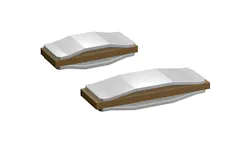
TDK said PowerHap has faster response times and delivers force more accurately than traditional haptics technologies like eccentric rotary motors (ERMs) and linear resonant actuators (LRAs). Thus, it can create higher-resolution haptic sensations — and generate a wider range of them. The company noted that a single PowerHap actuator can operate over a wide frequency bandwidth of 1 to 1,000 Hz, allowing it to deliver distinct tactile sensations, including different textures.
The other advantage of PowerHap is the ability to create vibrations with a significant amplitude. It’s a critical factor when recreating distinct tactile sensations on the same portion of the user’s hand or spread out over different fingers.
TDK said PowerHaps are embedded into all of the main contact points on the hands and fingers of the glove. The actuators are compact enough that they can physically fit into the area of the average human fingertip to enhance haptic feedback. To enable the fast, closed-loop control required to recreate the sensation of touch, the prototype haptics glove is equipped with inertial and other sensors to accurately track hand speed and finger movements.
High-Definition Haptics for Real-Feel Augmented Reality
TouchDriver is positioned as a tool for training and simulation. Paired with augmented- or mixed-reality glasses, the haptics glove could allow technicians to rehearse maintenance tasks on industrial equipment or enable medical trainees to practice procedures in controlled, digital spaces. In the demo, the device is used in a training simulation, recreating the vibrations from a power drill and the resistance of the screws being drilled into a metal plate.
The device can also mimic the amount of heat produced by the drill or equipment being repaired. “This is typically used, for instance, in safety training or in industrial training when you need to know that a particular part of the system can't be touched because it's too hot,” said Gioioso.
Besides training, the approach could also be adopted by designers for virtual prototyping, where 3D models can be manipulated and evaluated in virtual environments without the need for physical hardware.
While PowerHap is used in this case to mimic the sensation of interacting with physical objects, TDK is positioning it more broadly as a high-performance actuator for anything requiring fast-accelerating, wide-bandwidth, and low-power haptics in compact form factors. For example, PowerHap can be integrated into dashboard displays, steering wheels, and other interfaces to replace mechanical buttons and knobs. The result is high-definition haptic feedback that mimics the feel of physical controls in cars.
TDK said PowerHap could also be used in gaming peripherals such as controllers and wristbands, as well as consumer-electronic accessories like rings that are becoming popular to enable gesture control for smart glasses.
>>Check out more of our CES 2026 coverage, and the TechXchange for similary themed articles and videos
 CES at Las Vegas Convention Center West Hall
About the Author
 William G. Wong
William G. Wong
Senior Content Director - Electronic Design and Microwaves & RF
I am Editor of Electronic Design focusing on embedded, software, and systems. As Senior Content Director, I also manage Microwaves & RF and I work with a great team of editors to provide engineers, programmers, developers and technical managers with interesting and useful articles and videos on a regular basis. Check out our free newsletters to see the latest content.
You can send press releases for new products for possible coverage on the website. I am also interested in receiving contributed articles for publishing on our website. Use our template and send to me along with a signed release form.
Check out my blog, AltEmbedded on Electronic Design, as well as his latest articles on this site that are listed below.
You can visit my social media via these links:
- AltEmbedded on Electronic Design
- Bill Wong on Facebook
- @AltEmbedded on Twitter
- Bill Wong on LinkedIn
I earned a Bachelor of Electrical Engineering at the Georgia Institute of Technology and a Masters in Computer Science from Rutgers University. I still do a bit of programming using everything from C and C++ to Rust and Ada/SPARK. I do a bit of PHP programming for Drupal websites. I have posted a few Drupal modules.
I still get a hand on software and electronic hardware. Some of this can be found on our Kit Close-Up video series. You can also see me on many of our TechXchange Talk videos. I am interested in a range of projects from robotics to artificial intelligence.
 James Morra
James Morra
Senior Editor
James Morra is the senior editor for Electronic Design, covering the semiconductor industry and new technology trends, with a focus on power electronics and power management. He also reports on the business behind electrical engineering, including the electronics supply chain. He joined Electronic Design in 2015 and is based in Chicago, Illinois.