Multimaterial 3D Printer Creates Entire Electric Motor “On the Spot”
What you'll learn:
- How additive manufacturing can “build” a fully functioning linear motor.
- The special AM machine that was devised to handle the diverse materials needed for the motor build.
- The assembly and performance of this printed motor.
We’re familiar with the amazing advances in additive manufacturing (3D printing), where a long list of materials can be used to create small and large objects. Some of these are pieces that replicate existing ones as needed. Others are objects that could not be created with any standard manufacturing processes, such as forging, machining, molding, casting, extrusion, chemical etching, or more.
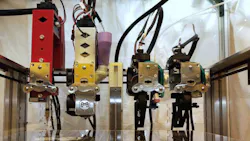
A team of MIT researchers has now developed a multimaterial 3D-printing platform that could be used to fully print electric machines in a single step (Fig. 1).
The needed components were combined through straightforward assembly to demonstrate what they say is the first fully 3D-printed electric motor: a linear actuator (more formally, a solenoid-magnet linear actuator) composed of five distinct functional materials: dielectric, electrically conductive, soft magnetic, hard magnetic, and flexible. Each one of these was researched and optimized for use in the additive-manufacturing process they were planning.
Motor Fabrication in 3 Hours
They fabricated the motor in about three hours and only needed to magnetize the hard magnetic materials after printing to enable full functionality. The researchers estimate total material costs would be about 50 cents per device.
They designed their system to process multiple functional materials, including electrically conductive materials and magnetic materials, using four extrusion tools that can handle varied forms of printable material. The printer switches between extruders, which deposit material by squeezing it through a nozzle as it fabricates a device one layer at a time.
For the electric motor, they needed to be able to switch between multiple materials with substantially different attributes. For instance, the device would need an electrically conductive material for the current-carrying “wires” and hard magnetic materials to generate magnetic fields.
A 3D Printer that Handles Multiple Materials
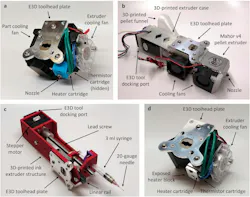
Existing multimaterial-extrusion 3D-printing systems can only switch between two materials that come in the same form, such as filament or pellets, so the researchers had to design their own. To accomplish this, they retrofitted an existing printer with four extruders that can each handle a different form of feedstock (Fig. 2). The final system was capable of processing feedstock in the form of filament, pellets, and ink, enabling the combined use of high-performance functional materials.
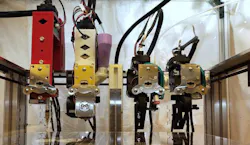
This isn’t a trivial exercise. They carefully designed each extruder to balance the requirements and limitations of the material. For instance, the electrically conductive material must be able to harden without the use of too much heat or UV light, because this can degrade the dielectric material. At the same time, the best-performing electrically conductive materials come in the form of inks that are extruded using a pressure system. This process has vastly different requirements than standard extruders using heated nozzles to squirt melted filament or pellets.
Strategically placed sensors and a novel control framework enables each tool to be picked up and put down consistently by the platform’s robotic arms, so that each nozzle moves precisely and predictably. This ensured that each layer of material lined up properly, as even a slight misalignment can derail the performance of the finished motor.
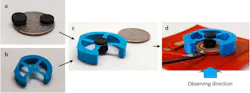
The resultant solenoids (Fig. 3) produced up to 2.03-mT magnetic fields, the magnets generated up to 71-mT magnetic fields, and the linear actuator achieved a maximum displacement of 318 μm at its resonant frequency (41.6 Hz).
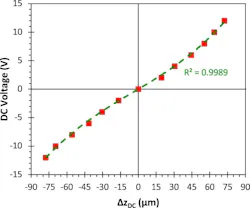
The force acting on the 3D-printed biaxial spring is linear with the bias voltage (V DC), as the magnetic force is linear with the DC current (I DC) of the coil (Fig. 4). This behavior agrees with the theoretical, quasi-static mechanical performance of a fixed-fixed beam loaded at its center by a vertical point force when the deflection is large — the deflection is roughly comparable to the height of the beam. In this case, the force acting on the beam is proportional to the cube of the deflection of the beam’s midpoint.
The work is detailed in a lengthy (26 page), yet fascinating and readable paper, “Fully 3D-Printed electric motor manufactured via multi-modal, multi-material extrusion” published in Virtual and Physical Prototyping. As an MIT project, their paper goes beyond just reporting what they did and why they did it. It also includes in-depth analysis of forces, flux density, materials, and more. (Surprisingly, they did not post any videos of this very video-friendly project.) They note that they’re also exploring extending the linear motor fabrication scheme to fabrication of a rotary motor.
About the Author
 Bill Schweber
Bill Schweber
Contributing Editor
Bill Schweber is an electronics engineer who has written three textbooks on electronic communications systems, as well as hundreds of technical articles, opinion columns, and product features. In past roles, he worked as a technical website manager for multiple topic-specific sites for EE Times, as well as both the Executive Editor and Analog Editor at EDN.
At Analog Devices Inc., Bill was in marketing communications (public relations). As a result, he has been on both sides of the technical PR function, presenting company products, stories, and messages to the media and also as the recipient of these.
Prior to the MarCom role at Analog, Bill was associate editor of their respected technical journal and worked in their product marketing and applications engineering groups. Before those roles, he was at Instron Corp., doing hands-on analog- and power-circuit design and systems integration for materials-testing machine controls.
Bill has an MSEE (Univ. of Mass) and BSEE (Columbia Univ.), is a Registered Professional Engineer, and holds an Advanced Class amateur radio license. He has also planned, written, and presented online courses on a variety of engineering topics, including MOSFET basics, ADC selection, and driving LEDs.
Comment About the Article
To join the conversation, and become an exclusive member of Electronic Design, create an account today!
 Leaders Logo
Leaders relevant to this article: