Solder-Free and Scaling Up: Occam Process vs. Conventional Soldering in PCB Assembly
What you'll learn:
- The unique methodology behind the Occam Process.
- For decades, the industry has accepted the waste associated with the soldering process.
- Half of the assembly industry is dedicated to making solder work.
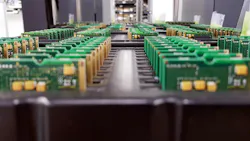
For decades, the printed-circuit-board assembly (PCBA) process has been anchored to solder — a eutectic or lead-free alloy that mechanically and electrically joins components to a substrate. Reflow ovens and solder-paste stencils are fixtures of virtually every contract manufacturer on the planet.
However, a fundamentally different approach, known as the Occam Process, challenges that orthodoxy at its root, eliminating solder entirely. For engineers designing next-generation electronics — particularly in aerospace, medical, automotive, and high-reliability IoT applications — understanding how Occam stacks up against conventional soldering is no longer academic. It's a potential competitive differentiator.
The Conventional Soldering Paradigm
Modern surface-mount technology (SMT) assembly follows a well-understood sequence:
- Solder paste is stencil-printed onto bare PCB pads
- Components are positioned using high speed pick-and-place machines
- The assembly passes through a reflow oven where the paste becomes molten and solidifies into solder joints that interconnect the terminations to the PCB.
Through-hole components may additionally be wave-soldered or hand-soldered.
The process is mature, widely supported by EDA toolchains, and backed by a global ecosystem of materials suppliers and contract manufacturers. IPC standards — IPC-A-610, IPC-7711/7721, and others — define acceptance criteria in granular detail. Engineers can reliably specify joint geometry, inspection criteria, and rework procedures. Automated optical inspection (AOI) and X-ray imaging have made solder joint quality verification highly automated.
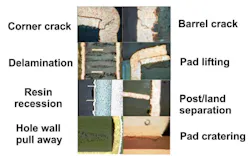
Yet for all its maturity, solder-based assembly carries intrinsic liabilities (Fig. 1). Each solder joint is a potential failure point: fatigue cracking under thermal cycling, intermetallic compound growth over time, voiding from entrapped flux gases, and cold joints from insufficient heat or contamination.
Compounding the problem, nearly 80 lead-free alloys now contend for position following the lead-free mandate issued by RoHS in most markets. In general, these alloys typically require higher reflow temperatures that stress both components and laminates, and they generally exhibit inferior ductility compared to tin-lead systems.
The process also demands tight process control: paste viscosity, stencil aperture geometry, pick-and-place accuracy, and oven profile all interact in ways that can produce subtle but field-relevant defects.
The Occam Process: Assembly Inverted
The Occam Process takes a diametrically opposite approach. Rather than mounting components onto a prefabricated PCB using solder, Occam builds the interconnect structure around and onto the components themselves. The process flow inverts conventional assembly logic entirely (Fig. 2).
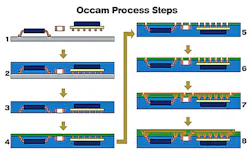
In Occam, bare, tested components — ICs, passives, connectors — are first placed face-down onto a temporary carrier in their final X-Y positions. An encapsulant is then applied, embedding the components in a polymer matrix. Once cured, the carrier is removed and the component termination pads are exposed.
A PCB-like interconnect structure of copper traces, vias, and planes is then built up directly on the exposed pad surfaces using additive PCB fabrication processes such as electroless copper deposition and photolithography. The result is a completed assembly where the interconnect is grown onto the components rather than soldered to them.
There are no solder joints. There’s no paste printing, no reflow oven, and no flux chemistry. The interconnect-to-component interface is a direct copper-to-termination metallurgical bond formed during the additive fabrication process.
Head-to-Head: Key Engineering Tradeoffs
Reliability and Interconnect Integrity
The elimination of solder joints removes the dominant failure mode in most electronic assemblies. Thermal cycling studies on conventionally soldered BGAs and QFNs consistently show fatigue-driven crack initiation at solder-copper interfaces, especially at package corners where CTE mismatch stress concentrates.
Occam's direct copper-to-pad bond, combined with the encapsulant providing mechanical constraint, distributes thermal stress more uniformly across the component termination area. For applications requiring extended service life under temperature cycling — avionics, downhole oil and gas electronics, under-hood automotive modules — this architectural advantage is significant.
Form Factor and Assembly Density
Because the interconnect is built up directly on the component array, Occam enables extremely thin assemblies. The traditional PCB substrate, typically 0.8 to 3.2 mm thick depending on layer count, is replaced by a built-up structure that can be substantially thinner. There are no component-to-pad standoff gaps, no solder mask, and no paste-related geometric constraints on pad design.
For wearables, implantable medical devices, and compact aerospace modules where Z-height is a critical constraint, this represents a meaningful architectural advantage over conventional SMT.
Design and EDA Toolchain Compatibility
Here, conventional soldering retains a commanding lead. Every major ECAD platform — Altium Designer, Cadence Allegro, Zuken CR-8000, KiCad — is built around the premise of component placement on a PCB with defined land patterns and solder-joint geometry. IPC-7351 land pattern standards, design rule checks, and DFM tools all assume solder-based interconnect.
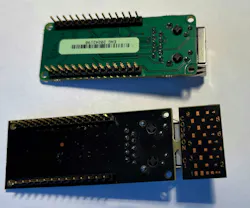
Designing for the Occam process requires a fundamentally different design flow, different DFM rules, and close collaboration with a fabricator qualified in the process. As of now, that fabricator ecosystem is narrow compared to the global SMT supply chain. Still, Occam assemblies have been designed and fabricated using conventional design tools (Fig. 3). Modifying design tools for Occam will bring even greater efficiencies going forward.
Rework and Repairability
Conventional SMT, while not trivial to rework at fine pitches, has well-established techniques. BGA reballing, component removal with hot air or infrared rework stations, and pad restoration are supported by a mature rework tooling and materials industry. IPC-7711/7721 provides comprehensive rework guidelines.
Occam components are tested before encapsulation. And since the assembly isn’t subjected to the thermal excursions like that of traditional soldering, a low-temp, solderless assembly greatly reduces the possibility of failure due to temperature stresses placed on both the component and the PCB.
Environmental and Process Chemistry
Conventional soldering, even with no-clean flux chemistries, involves an array of process chemicals — flux activators, paste solvents, cleaning agents — with associated handling, storage, and disposal requirements. Lead-free solder alloys, while compliant, aren’t without environmental impact.
Occam's solder-free process eliminates this chemistry set almost entirely, reducing process waste streams and simplifying materials compliance documentation for RoHS and REACH purposes.
The Bottom Line for Design Engineers
The Occam Process isn’t a drop-in replacement for conventional SMT assembly. It demands a fundamentally different design-for-manufacturing mindset. But for engineers targeting reliability, miniaturized form factors, or simplified regulatory chemistry compliance, in addition to cost reductions, it represents a technically credible and relevant alternative architecture.
Conventional soldering will remain the dominant assembly paradigm for the foreseeable future, sustained by its mature toolchain, global supply chain, and decades of process refinement. But as interconnect densities rise and reliability demands intensify across automotive, aerospace, and medical markets, the Occam Process deserves a place in the design engineer's toolkit — not as a curiosity, but as a serious option when the application demands it.
The right assembly technology isn't the most familiar one. It's the one that best serves the end application.
>>Check out this TechXchange for similarly themed articles and videos
 Pcb Ed Promo Electronic Hardware Ruslan Gilyazov Dreamstime L 114824249 612e53db98b31
About the Author
 Ray Rasmussen
Ray Rasmussen
Managing Partner, The Occam Group
Ray Rasmussen is the managing partner with The Occam Group. He’s been a defining voice in the PCB industry since 1978, when he began his career working with several PCB fabricators. In 1987, he founded CircuiTree Magazine, building it into the industry’s leading trade journal in the field.
Ray went on to launch the I-Connect007 media family in 2004 — which included SMT Magazine, PCB Magazine, and PCB Design007 — and partnered with IPC to produce the Real-Time with… interview series, conducting over 1,000 industry conversations at trade shows and conferences around the world. He sold his interest in I-Connect007 in 2015; the company has since been acquired by IPC.
Comment About the Article
To join the conversation, and become an exclusive member of Electronic Design, create an account today!
 Leaders Logo
Leaders relevant to this article: