5 Development Boards for Innovative New Projects
What you'll learn:
- Details about, and specs for, the latest development boards.
- Potential applications for these boards.
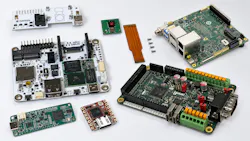
As embedded systems continue to evolve, development boards are becoming increasingly specialized. They provide engineers and makers with purpose-built platforms for everything from edge AI and automotive electronics to FPGA design and next-gen wireless connectivity. In this roundup, we look at five recently released development boards that offer unique capabilities for prototyping innovative new projects.
Synaptics Coral Dev Board
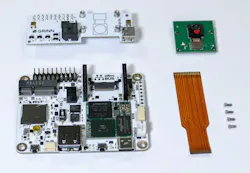
Synaptics’ Coral Dev Board, which incorporates Astra’s SL2610 product line that features a 1-TOPS Torq NPU (derived from Google’s Coral NPU), is designed for AI applications such as wearables, automation hubs, industrial control systems, robotics, and more. The board’s SL2610 SoC packs a pair of Cortex-A55 cores, a single Cortex-M52 core, 2 GB of DDR4 RAM and up to 64 GB of flash storage. The development board also integrates a MIPI camera and display interfaces, microSD card slot, USB ports, mikroBUS and Qwiic connectors, as well as Wi-Fi and Bluetooth connectivity options.
Product: Coral Dev Board
Company: Synaptics
SoC: Astra SL2610
CPU: Cortex-A55 and Cortex-M52 cores
NPU: Torq 1 TOPS
Memory: 2 GB of DDR4 RAM
Storage: Up to 64 GB of flash, microSD card slot
Communication: Optional Wi-Fi and Bluetooth via M.2 module
Expansion: M.2 E-key or E+A key slot, I3C connector, Qwiic Connect System for I2C, mikroBUS connector, 2x microphones, 20-pin header GPIO header
USB: USB-A host port, USB-C port for power and data
Audio interfaces: I2S2 and I2S3 audio connectors
AAEON UP Squared Pro TWL AI Dev Kit
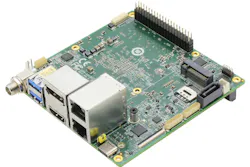
AAEON’s UP Squared Pro TWL AI Dev Kit combines the company’s Palm+ size development board with an integrated AI accelerator that provides up to 25 TOPS of AI inferencing power. The Up Squared Pro TWL can be combined with several add-on modules to boost that AI inferencing power up to 214 TOPS via the Axelera Metis AI acceleration module that boosts performance for edge AI applications. The board itself has an Intel N150 processor, Intel UHD Graphics, 8 GB of memory, and up to 64GB of eMMC Flash for storage.
Product: Up Squared Pro TWL AI Dev Kit
Company: AAEON
CPU: Intel N150 Processor
GPU: Intel UHD Graphics
VPU: Hailo-8L M.2 2230 AI Module, DEEPX DX-M1 Module, or Axelera Metis AI Module
Memory: 8 GB
Storage: 64-GB eMMC
Communication: 2x 2.5GbE, Wi-Fi, Bluetooth, LTE, 4G, and 5G via expansion modules
Expansion: 1x M.2 2280 M-key (PCIe Gen 3 x2, USB2.0), 1x M.2 2230 E-key (CNVI , PCIe Gen 3 x1, USB 2.0) taken by Hailo-8L M.2 2230 AI Module, 1x M.2 3052 B=Key (USB 3.2 Gen 2 only) with Nano SIM slot
USB: 2x USB 2.0 via 10-pin wafer, 2x USB 3.2 Gen 2 Type A, 1x USB 3.2 Type C
Connections: 1x UART via 10-pin wafer, 2x RS-232/422/485 10-pin header
Mercedes-Benz ARDEP V2
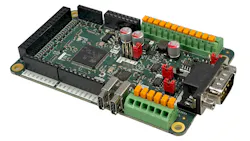
Mercedes-Benz is set to release its ARDEP V2 development board designed in tandem with Frickly Systems. The Automotive Rapid Development Platform (ARDEP) is an open-source board designed specifically for automotive development platforms and comes equipped with a STMicroelectronics STM32G474VE Arm Cortex-M4F microcontroller tasked for motor control. It also incorporates CORDIC and FMAC hardware math accelerators, and features CAN-FD and LIN transceivers. In addition, a PowerIO Shield provides 6x outputs and 6x inputs that support up to 48 V and 3 A per channel.
Product: ARDEP V2
Company: Mercedes-Benz
CPU: STM32G474VE Arm Cortex-M4F microcontroller
Memory: 128-kB SRAM
Storage: 256-kB flash
Transceivers: 2x CAN-FD capable transceivers, each with a common-mode choke, ESD protection, and hardware-configurable 120-Ω termination, 1x LIN transceiver
Connections: DB-9 connector, 12-pole spring contact terminal for CAN-A and LIN, 6-pole spring contact terminal with 2x UART, Arduino-compatible headers, 6-pin header with 6x analog input, SPI interfaces, 8- and 10-pin headers for digital inputs, USART, SPI, I2C, 32-pin header with GPIOs, LPUART, SPI, DAC, I2C, USART
BrisbaneSilicon ELM11-Feather FPGA Development Board
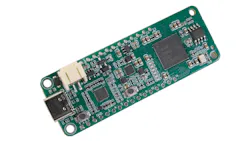
BrisbaneSilicon’s ELM11-Feather FPGA Development Board, based on Gowin’s GW1NR FPGA, comes in an Adafruit Feather form factor. The FPGA-based board allows users to program the application, driver, and hardware layers in Lua, C, and VHDL/SystemVerilog. The board is outfitted with GPIO headers, built-in debugger, a USB-C port for power and programming, and a 2-pin header for a LiPo battery.
Product: ELM11-Feather FPGA Development Board
Company: BrisbaneSilicon
Form Factor: Adafruit Feather
CPU: Gowin GW1NR-LV9 FPGA
Memory: 17,280 bits of shadow SRAM (SSRAM), 486-kb block SRAM (BSRAM), 64-Mb (8 MB) PSRAM
Storage: 608-kb flash
Connections: 16-pin + 11-pin headers for GPIO, PWM, UART, SPI, I2C
M5Stack Stamp-C5 Development Board
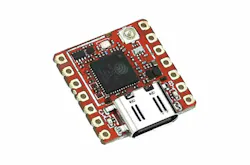
The M5Stack Stamp-C5 development board is a tiny wireless IoT USB-C module that’s populated with Espressif’s ESP32-C5 RISC-V microcontroller and equipped with dual-band Wi-Fi 6, Bluetooth LE, and 802.15.4 (Zigbee/Thread). While the module is small, it does feature up to 19 GPIO pins, with 11 of those on standard pitch headers and holes, and eight on an FPC extension connector.
Product: M5Stack Stamp-C5 Development Board
Company: M5Stack
Form Factor: Module
CPU: ESP32-C5 RISC-V microcontroller
Memory: 384-kB SRAM
Storage: 320-kB ROM, 4-MB SPI flash
Communication: Dual-band (2.4/5 GHz) 802.11ax Wi-Fi 6, 802.11b/g/n Wi-Fi 4 backward-compatibility, Bluetooth 5.0 Low Energy (LE) with Mesh support, 802.15.4 radio for Zigbee 3.0, Thread 1.3, and Matter
Antenna: IPEX-1 antenna connector with LFD182G45DCHD481 dual-band diplexer for 2.4/5 GHz
Connections: 2x 7-pin headers (through holes and castellated holes) with up to 11x GPIO, 5 V (VUSB), 3.3 V, VBAT, and GND, 12-pin FPC connector with up to 8x GPIO, UART, 3.3 V, GND
About the Author
 Cabe Atwell
Cabe Atwell
Technology Editor, Electronic Design
Cabe is a Technology Editor for Electronic Design.
Engineer, Machinist, Cartoonist, Maker, Writer. A graduate Electrical Engineer actively plying his expertise in the industry and at his company, Gunhead. When not designing/building, he creates a steady torrent of projects and content in the media world. Many of his projects and articles are online at element14 & SolidSmack, industry-focused work at EETimes & EDN, and offbeat articles at Make Magazine. Currently, you can find him hosting webinars and contributing to Electronic Design and Machine Design.
Cabe is an electrical engineer, design consultant and author with 25 years’ experience. His most recent book is “Essential 555 IC: Design, Configure, and Create Clever Circuits”
Cabe writes the Engineering Life & Engineering on Friday blog on Electronic Design.
See Cabe's cartoons & comic strips here.