Embedded World 2026: Boards and Modules (Part 2)
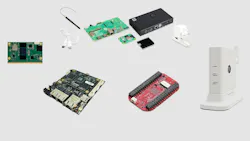
What you’ll learn:
- Five SBC platforms that target IoT, industrial control, robotics, and edge AI workloads.
- How their processors, connectivity, memory, and expansion options differ.
- Where each board fits best, from long-range wireless gateways to rapid prototyping and local inference.
Part 1 covered some of the top rugged single-board computers (SBCs) at this year’s Embedded World. Part 2 highlights more SBCs that turned heads at the show, particularly those focused on advanced communication for a range of applications.
- Morse Micro HaLowLink 2
- Gateworks Catalina SBC Family
- Raspberry Pi Compute Module 5 + CM5 Development Kit
- PocketBeagle 2 Industrial
- SECO Modular Vision Genio700
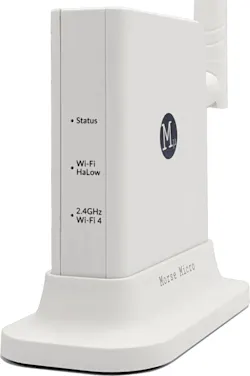
Morse Micro’s HaLowLink 2 is a multipurpose Wi-Fi HaLow gateway, serving as a router, access point, or extender. It leverages sub-1-GHz Wi-Fi HaLow (IEEE 802.11ab) to provide long-range, low-power connectivity for IoT and IoT 2.0 applications.
HaLowLink 2 runs on the MM8108 8MHz chipset with 26-dBm TX power. It features dual-band support with 2.4-GHz Wi-Fi 4 (MediaTek MT7603E 2x2 802.11n), 256-MB DRAM, 32-MB NAND flash storage, a MediaTek MT7621 CPU, and two Gigabit Ethernet ports. HaLowLink 2 also uses internal antennas with an AzureWave AW-HM677 HaLow module.
This device ships with OpenWrt 23.05, providing a flexible firmware base with a browser dashboard, SSH/CLI access, setup wizards, and OTA updates. It’s administered like a standard Wi-Fi router through a web interface, so it doesn’t require specialized setup skills.
Gateworks Catalina SBC Family
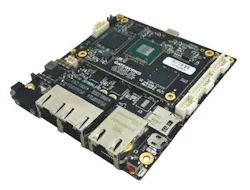
The Catalina SBC family, developed by Gateworks, is a versatile platform of single-board computers (GW9200/GW9400) for industrial IoT gateways, robotics, predictive maintenance, and autonomous systems. It delivers carrier-grade reliability, modular expansions, and low-power efficiency without bulky dev kits.
Each Arm-based single-board computer (SBC) is powered by the i.MX 95 with six Cortex-A55 cores at 1.8 GHz and an eIQ Neutron NPU for AI acceleration, plus 4 to 16 GB of LPDDR5 RAM and 8 to 64 GB of eMMC storage. They also include multiple UART, I2C, and SPI buses via expansion connectors.
The GW9200 features 10GbE and 2x GbE ports; M.2/mini-PCIe expansion for 5G, Wi-Fi, and CAN; USB 3.1; HDMI; and industrial I/O. Meanwhile, the GW9400 incorporates SFP+ 10GbE and 5x GbE switched ports with four expansion sockets. These boards run Linux with Yocto support.
Raspberry Pi Compute Module 5 + CM5 Development Kit
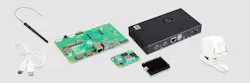
Raspberry Pi’s CM5 board and development kit is designed for rapid prototyping of custom embedded solutions, including industrial controllers, digital signage, and AI edge devices. The CM5 module has a quad-core Arm Cortex-A76 processor running at 2.4 GHz, a VideoCore VII GPU, and 2/4/8/16 GB of LPDDR4X-4267 RAM with ECC. Users can choose 0/16/32/64 GB of eMMC storage. Wireless variants include 2.4- and 5-GHz IEEE 802.11 b/g/n/ac plus Bluetooth 5.0.
The development-kit I/O board exposes dual 4Kp60 HDMI, Gigabit Ethernet with PoE+, 2x USB 3.0, 1x PCIe Gen 3 for NVMe SSDs, 2x MIPI DSI/CSI-2 camera/display interfaces, a microSD slot, fan header, and a 40-pin HAT GPIO with 30 GPIOs supporting five UART, five I2C, five SPI, and four PWM channels. For designers moving toward deployment, the Raspberry Pi Compute Module format remains a flexible path from development to ruggedized systems.
PocketBeagle 2 Industrial
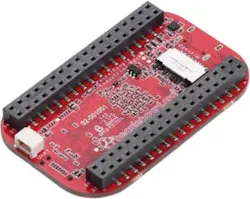
The PocketBeagle 2 Industrial, from BeagleBoard.org Foundation, is a compact SBC for embedded applications in HMIs, industrial equipment, automation, and IoT. It contains a Texas Instruments AM6254 SoC with quad-core, 64-bit Arm Cortex-A53 processors at 1.4 GHz, a Cortex-M4F real-time core at 400 MHz, dual-core PRUSS at 333 MHz, and a dedicated MSPM0L1105 Cortex-M0+ MCU for ADC tasks.
This SBC also features 1 GB of DDR4-3200 RAM, 64 GB of eMMC flash, USB-C power/data, a microSD slot, 72 GPIO pins with 52 digital I/O and eight analog inputs, JST-SH UART debug, JTAG support, and a TPS6521903 PMIC.
SECO Modular Vision Genio700
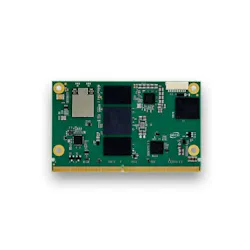
SECO introduced the ready-to-deploy Modular Vision Genio700, designed for local edge AI inference that supports voice commands, face recognition, and visual inspection without cloud latency. It’s intended for harsh industrial and medical settings.
The Modular Vision Genio700 runs on the MediaTek Genio 700 SoC with 2x Arm Cortex-A78 cores at 2.2 GHz, 6x Cortex-A55 cores at 2.0 GHz, a Mali-G57 MC3 GPU, and a Cadence Tensilica VP6 AI accelerator with MediaTek APU 3.0. It comes with up to 8 GB of LPDDR4X RAM, 64 GB of eMMC storage, 4K60 video decode/encode, MIPI-CSI camera inputs, LVDS/eDP/HDMI/DP outputs, Gigabit Ethernet, USB 3.1, and CAN.
In addition, there are multiple UART, I2C, and SPI interfaces, as well as optional Wi-Fi and Bluetooth 5.3. The system runs on the Clea operating system and adds secure boot, OTA updates, device monitoring, and Docker support.
>>Check out more of our Embedded World 2026 coverage
 Embedded World entrance
About the Author
 Cabe Atwell
Cabe Atwell
Technology Editor, Electronic Design
Cabe is a Technology Editor for Electronic Design.
Engineer, Machinist, Cartoonist, Maker, Writer. A graduate Electrical Engineer actively plying his expertise in the industry and at his company, Gunhead. When not designing/building, he creates a steady torrent of projects and content in the media world. Many of his projects and articles are online at element14 & SolidSmack, industry-focused work at EETimes & EDN, and offbeat articles at Make Magazine. Currently, you can find him hosting webinars and contributing to Electronic Design and Machine Design.
Cabe is an electrical engineer, design consultant and author with 25 years’ experience. His most recent book is “Essential 555 IC: Design, Configure, and Create Clever Circuits”
Cabe writes the Engineering Life & Engineering on Friday blog on Electronic Design.
See Cabe's cartoons & comic strips here.