Examining Solar Panels, Power Density, and Weather Resilience
What you'll learn:
- Why higher-efficiency solar panels result in a greater power density.
- How solar panels are affected by climate change.
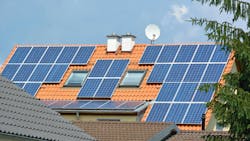
How well do solar panels work for home and industry? Do readers wonder if it’s worth installing solar panels or solar water heating in their homes? Can solar panels generate enough energy to take you off the grid? This article looks to answer those questions.
Typically, power density with respect to solar panels is shown in power per area as in W/m2. Power density can be determined by obtaining the output of the panels and the area they cover via one of the many online calculators. It can vary depending on a range of factors, including the technology employed in building the panels. Designers need to trade off cell efficiencies with manufacturing costs.
Examining Solar-Panel Efficiency and Power Density in 2025
Solar-panel efficiency is defined as the amount of sunlight or solar irradiance falling upon a solar-panel surface. Thanks to technical advances in photovoltaic technology over the last decade, an average solar-panel conversion efficiency increased from 15% to more than 24%. As a result, the power rating of a standard residential solar panel has now increased from 250 W to over 450 W.
Solar-panel efficiency is determined by two main factors:
- Photovoltaic (PV) cell efficiency, which is based on the solar-cell design and the type of silicon used.
- Total panel efficiency, which is based on the cell layout, configuration, and panel size. Increasing the panel size can improve efficiency by creating a larger surface area to capture sunlight, with the most powerful solar panels now achieving power ratings of over 700 W.
The table lists the most efficient solar panels in 2025. Residential panels typically come in 54 to 66 cells (108-HC, 120-HC, or 132-HC) and 96/104 cell formats. The table doesn’t include commercial panels greater than 2.0 m in length.
Solar-cell efficiency is determined by the cell structure and type of substrate being used. This is usually either P- or N-type silicon, with N-type cells being the most efficient. Efficiency is calculated by the fill factor (FF), which is the maximum conversion efficiency of a PV cell at the optimum operating voltage and current.
Solar-cell design plays a key role in the solar-panel efficiency. Main features include the type of base silicon substrate, passivation type, and the busbar configuration. Panels built using back-contact (IBC) cells are currently the most efficient, up to 24.8%, due to a high-purity N-type Silicon substrate with no losses from busbar shading. However, panels developed using the latest N-Type TOPCon and advanced heterojunction (HJT) cells have achieved efficiencies above 23%.
So, Why Don’t We See Solar Panels on Every Roof?
Many homeowners have a “wait-and-see” attitude regarding solar power on their roof. Solar power is actually a low-cost, carbon-neutral source of renewable energy. There are a variety of reasons why many homeowners are waiting, often related to the payback period for installing and maintaining solar panels.
>>Download the PDF of this article
 dreamstime_sergej57_73433375
Nonetheless, the growth of solar-panel technology has accelerated in recent years because of the overall benefits it offers. And traditional energy sources, such as fossil fuels, are projected to decline in the coming decades with the increasing demand for renewable energy.
Solar power is emission-free and will generate electricity, heat water, and power electric vehicles. The International Energy Agency (IEA) estimates that solar will provide more than 27% of global electricity by 2050.
Since 2010, the solar industry has grown 68% due to advances in PV technology, falling costs, and state government incentives that make solar investments a solid move for U.S. homeowners. Unfortunately, the current government support for solar technology has changed.
Solar Panels and Climate Change
Large ground-mounted solar-panel arrays and roof-mounted arrays are susceptible to damage during intense tropical hurricanes, cyclones and storms that are becoming more frequent. The Solar Under Storm III report highlights the robustness of existing systems to withstand harsh weather damage.
Prior reports, Solar Under Storm (2018) and Solar Under Storm II (2020), identified robust design and construction choices that helped some solar systems survive Category 5 hurricanes, such as Irma and Maria, while other designs failed. Now, the latest edition incorporates lessons from Hurricane Beryl, which was the earliest Category 5 hurricane ever recorded in the Atlantic. This hurricane devastated areas of the Grenadines in the Eastern Caribbean in July 2024.
After some in-depth field investigations of three ground-mounted systems that were hit directly by Hurricane Beryl, Solar Under Storm III exposed the stark contrast between vulnerable and resilient ground-mount installations. This report updated technological recommendations based upon real-world damage adjustments, including:
- Heightening proven practices like post and pier foundations
- A through bolting method of fastening two or more components together by passing a bolt completely through them while securing it with a nut on the opposite side
- Horizontal lateral racking support
- Vibration-resistant connections
The report also identifies some common failure points, such as inadequate load design, low-cycle fatigue of module frames, and using self-tapping screws and top-down clamps.
Adding to engineering specifications, this report stressed the importance of industry collaboration for strengthening resilience standards. Moreover, it encouraged shared testing protocols, material certification, and an ongoing information exchange, which is supported by the PV Resiliency Working Group on the online Caribbean Renewable Energy Community (CAREC).
As solar PV becomes central to energy generation in coastal and island regions, Solar Under Storm III offers timely, actionable guidance to ensure these systems endure when they’re needed most.
>>Download the PDF of this article
dreamstime_sergej57_73433375About the Author
 Steve Taranovich
Steve Taranovich
Freelance Technical Writer, Phoenix Information Communication LLC
Steve is a contributing editor to Electronic Design.
Author of the non-fiction “Guardians of the Right Stuff,” a true story of the Apollo program as told by NASA and Grumman Corp. engineers, an astronaut, and technicians.
Experienced Editor-In-Chief of EETimes/Planet Analog and Senior Technical Editor at EDN running the Analog and Power Management Design Centers from 2012 to 2019.
A demonstrated history in electronic circuit design and applications for 40 years, and nine years of technical writing and editing in industry. Skilled in Analog Electronics, Space-related Electronics, Audio, RF & Communications, Power Management, Electrical Engineering, and Integrated Circuits (IC).
1972 to 1988 worked as a circuit design engineer in audio (8 years) and microwave (8 years). Then was Corporate Account Manager/applications engineer for Burr-Brown from 1988 to 2000 when TI purchased Burr-Brown. Worked for TI from 2000 to 2011.
Strong media and communication professional with a BEEE from NYU Engineering in 1972 and an MSEE from Polytechnic University in 1989. Senior Lifetime member of IEEE. Former IEEE Long Island, NY Director of Educational Activities. Eta Kappa Nu EE honor society member since 1970.
Comment About the Article
To join the conversation, and become an exclusive member of Electronic Design, create an account today!
 Leaders Logo
Leaders relevant to this article: