Multilayer Device Delivers Solar and Raindrop Energy Harvesting
What you'll learn:
- How perovskite was used to create a hybrid solar/droplet energy harvester.
- The challenge of maintaining long-term perovskite performance and how it was addressed.
- The results that were achieved from solar and water drop harvesting.

Let’s face it: Energy harvesting of all types generates significant interest and attention, as it has that aura of getting a little bit of something – electrical energy – for almost nothing in cost. Usually, it functions silently and endlessly (in most cases). Moreover, it can eliminate the need for a product to include its own fixed-life source or charge one from an outside energy source. What’s not to like?
Reality is that many of these harvesting schemes turn out to be impractical for various reasons, including very low harvested-energy density as judged by various metrics. Further, most harvesting schemes can only extract energy from a single physical phenomenon such as light, vibration, friction, airflow, or ambient RF, to cite some well-known options.
Perovskite Plus Triboelectric Nanogenerators
Now, a research team at the Institute of Materials Science of Seville (ICMS), a joint center of the Spanish National Research Council (CSIC) and the University of Seville (US), have created a single hybrid-function device that can generate energy from both sunlight and rainfall (Fig. 1). Their energy-harvesting system, which combines perovskite solar cells (PSCs) with drop-driven triboelectric nanogenerators (D-TENGs), offers an interesting approach to more effective power harvesting under diverse conditions.
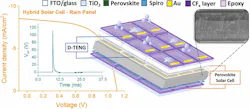
Key to the harvester operation is its patented thin film that protects perovskite solar cells and improves their durability, even in harsh weather. These fluorinated polymer (CFₓ) films function as multifunctional encapsulation layers that simultaneously provide water resistance, triboelectric functionality, and optical transparency (>90 %). The same film nanogenerators also produce more than 100 V — admittedly at very low current — from the impact of a single raindrop.
What’s a Perovskite?
Perovskites are a naturally occurring and versatile class of materials featuring a specific crystalline structure. They’re being investigated by many researchers across multiple disciplines for possible applications related to solar cells, electro-optics, catalysts, and sensors due to their tunable bandgaps, high absorption, and low-cost production.
While silicon remains the dominant material in solar technology, perovskites are considered a promising alternative because they combine high performance with lower production costs. They offer high solar efficiency (up to 26% in some tests) but also have stability issues due to moisture and heat sensitivity, alongside toxicity.
One major challenge with perovskite cells is their tendency to degrade under environmental stress; this has been a limitation to their expanded use. To address this limitation, the ICMS team used plasma technology to deposit a protective coating about 100 nm thick onto the cells.
This coating serves two key roles. It acts as a protective layer that shields the material chemically while also enhancing its ability to absorb light. At the same time, it has a triboelectric surface (which generates electrical charge through friction or contact) that converts the energy of falling raindrops into usable electricity.
Test and Evaluation of the Harvester and Its Coating
The team performed a list of ruggedness tests on the coating with impressive results. They also ran tests and compiled data on solar- and raindrop-driven harvesting performance (Fig. 2).
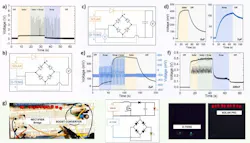
They also built a self-charging prototype with a custom boost converter to drive an LED array and demonstrate the practicality of this multisource energy harvesting for low-power electronics. It delivered open-circuit voltage peaks up to 110 V and a maximum power density of ~4 mW/cm2 under rainwater droplets, while retaining over 85% of its initial output after more than 17,000 droplet impacts.
The hybrid PSC/D-TENG device achieved short-circuit current densities of 11.6 mA/cm2 under 0.5 sun illumination and peak voltages of 12 V per raindrop, enabling simultaneous solar and rain energy harvesting.
The device maintained 80% of its initial performance after 300 hours of continuous illumination under humid conditions and demonstrated stability under continuous dripping and illumination for more than five hours. This drop-driven triboelectric nanogenerator offers an intriguing solution for continuous power generation under diverse weather conditions.
Now if they also combined it with a nighttime radiant-energy harvester, they would have a triple-threat device.
Details of their work, including setup, implementation, materials, test arrangements, and results are in their lengthy paper “Water-resistant hybrid perovskite solar cell - drop triboelectric energy harvester” published in Nano Energy.
>>Check out this TechXchange for similarly themed articles and other content

About the Author
 Bill Schweber
Bill Schweber
Contributing Editor
Bill Schweber is an electronics engineer who has written three textbooks on electronic communications systems, as well as hundreds of technical articles, opinion columns, and product features. In past roles, he worked as a technical website manager for multiple topic-specific sites for EE Times, as well as both the Executive Editor and Analog Editor at EDN.
At Analog Devices Inc., Bill was in marketing communications (public relations). As a result, he has been on both sides of the technical PR function, presenting company products, stories, and messages to the media and also as the recipient of these.
Prior to the MarCom role at Analog, Bill was associate editor of their respected technical journal and worked in their product marketing and applications engineering groups. Before those roles, he was at Instron Corp., doing hands-on analog- and power-circuit design and systems integration for materials-testing machine controls.
Bill has an MSEE (Univ. of Mass) and BSEE (Columbia Univ.), is a Registered Professional Engineer, and holds an Advanced Class amateur radio license. He has also planned, written, and presented online courses on a variety of engineering topics, including MOSFET basics, ADC selection, and driving LEDs.
Comment About the Article
To join the conversation, and become an exclusive member of Electronic Design, create an account today!
 Leaders Logo
Leaders relevant to this article: