Rugged, Resilient Nylon Withstands Abuse While Energy Harvesting
What you'll learn:
- How the piezoelectric effect can be used with a special nylon for energy harvesting.
- How the nylon was modified during fabrication to greatly enhance its harvesting performance.
- How the nylon was also made extremely rugged, in contrast to conventional nylon.

It often seems as if there are few limits on the materials that can be adapted or modified for use in energy harvesting, and with widely varying degrees of effectiveness. It’s a topic that’s always of interest because it has the dual glow of offering both “virtue” (using something that would otherwise go to waste, in most cases) and “free” (and who doesn’t like that?).
However, many such energy-harvesting schemes, attractive as they may seem at first, have two limitations:
- They often offer very low energy density as measured by metrics like volume, area, or mass.
- They’re often relatively fragile or short-lived in the real, harsh world.
On this front, a team at Melbourne’s Royal Melbourne Institute of Technology (RMIT) developed a flexible nylon-film device that leverages the piezoelectric effect to generate electricity from compression and keeps working even after being run over by a car multiple times. Possible applications include self-powered roadway sensors (Fig. 1).


Leveraging Nylon-11
Conventional consumer nylon by itself doesn’t convert movement into electricity efficiently, thereby limiting its potential in powering everyday devices. To overcome this limitation, they used a durable industrial plastic called nylon‑11 that, unlike common nylons, can generate electricity from pressure when its molecules are carefully aligned.
Nylon-11 was a promising non-fluorinated, piezoelectric polymer given its mechanical strength, chemical stability, and elasticity. Nevertheless, it typically possesses low piezoelectric performance, which severely limits its use for energy-generation applications.
>>Check out this TechXchange for similarly themed articles and videos

Turning that tough industrial nylon into a resilient, ruggedized power‑generating film wasn’t trivial. They reengineered the material at a molecular level, using high-frequency sound vibrations while applying an electric field as the nylon solidified. This “encouraged” the molecules to form a more ordered structure, and it enabled the nylon device to generate electricity each time it was bent, squeezed, or tapped (Fig. 2).
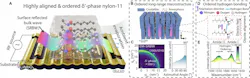
To gain insight on the mechanism that underpins the effect of the acoustoelectric coupling on the crystallization process, they carried out the synthesis using surface reflected bulk waves (SRBWs). SRBWs are the hybrid counterpart to surface acoustic waves (SAWs) but additionally possess a bulk wave component. They did this under three distinct conditions:
- The full electromechanical coupling arising from the SRBW (EM-SRBW)
- Pure mechanical vibration (M-SRBW) obtained by attenuating the evanescent electric field in the liquid phase with a gold screening layer atop the substrate
- Conventional solvent casting at 60°C as the control.
What About Its Performance?
The resultant nylon films were flexible, tough, and reliable, while retaining their ability to turn movement into power. The thin-film devices are so robust that they can be folded, stretched, even run over by a car, yet continue to harvest power.
In addition to “conventional” analysis of the electrical performance (voltage, current), the team performed detailed analysis at the molecular-structure level. This included direct probing using time-resolved synchrotron grazing-incidence wide-angle X-ray scattering and high-resolution infrared spectroscopy while the material was in use (usually described as operando).
Any energy-harvesting material and arrangement can be tested under a wide variety of conditions (Fig. 3). Comparisons of the peak-to-peak voltage corroborate the enhanced piezoelectric efficiency of the EM-SRBW films. At 4 GΩ, the solvent-cast control, M-SRBW, and EM-SRBW nylon-11 films produced voltages of approximately 0.005, 0.03, and 0.65 V, respectively.
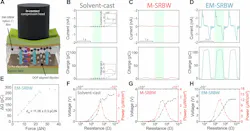
In addition, the power density increased from 0.002 μW/cm3 for the solvent-cast control (Fig. 3F) to 0.03 μW/cm3 for the M-SRBW samples (Fig. 3G). Notably, EM-SRBW films yielded a power density of 12.5 μW/cm3 – an impressive 400-fold enhancement over the M-SRBW film (Fig. 3H).
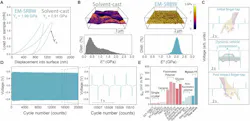
Their range of tests showed a piezoelectric voltage coefficient (g33) of 427 × 10−3 volt-meter/newton; they maintain this surpasses the performance of all piezoelectric polymers reported to date.
Further, the film’s exceptional mechanical resilience was demonstrated by its stable performance over 20,000 compression cycles at 50 newtons and its ability to withstand vehicular loads (Fig. 4).
Details on their energy-harvesting project, including materials, fabrication, rationale, tests, and more, can be found in their paper “Electroacoustic alignment of robust and highly piezoelectric nylon-11 films” published in Nature Communications. Note: The bulk of the paper is about the underlying deep-physics materials science of nylons including their dipole alignment. That brings a very different perspective with many terms and symbols than those of the solid-state physics world with which electronic engineers are more familiar, but likely one that is comfortable for mechanical and materials engineers.
>>Check out this TechXchange for similarly themed articles and videos
About the Author
 Bill Schweber
Bill Schweber
Contributing Editor
Bill Schweber is an electronics engineer who has written three textbooks on electronic communications systems, as well as hundreds of technical articles, opinion columns, and product features. In past roles, he worked as a technical website manager for multiple topic-specific sites for EE Times, as well as both the Executive Editor and Analog Editor at EDN.
At Analog Devices Inc., Bill was in marketing communications (public relations). As a result, he has been on both sides of the technical PR function, presenting company products, stories, and messages to the media and also as the recipient of these.
Prior to the MarCom role at Analog, Bill was associate editor of their respected technical journal and worked in their product marketing and applications engineering groups. Before those roles, he was at Instron Corp., doing hands-on analog- and power-circuit design and systems integration for materials-testing machine controls.
Bill has an MSEE (Univ. of Mass) and BSEE (Columbia Univ.), is a Registered Professional Engineer, and holds an Advanced Class amateur radio license. He has also planned, written, and presented online courses on a variety of engineering topics, including MOSFET basics, ADC selection, and driving LEDs.
Comment About the Article
To join the conversation, and become an exclusive member of Electronic Design, create an account today!
 Leaders Logo
Leaders relevant to this article: