Powerful Union Between Intelligent Low-power Design and Ultra-long-life Batteries
What you’ll learn
- How to choose the right battery chemisty
- How to choose the right battery
- How to choose the right low-power communications protocol
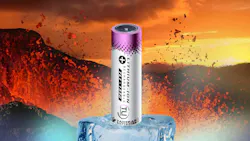
The intelligent application of low-power design combined with the ideal power supply can lead to improved operational and financial performance for battery-powered remote wireless devices. The potential benefits are numerous, including: simplified installation without the need for complex wiring; unlimited scalability to enhance data capture; extended operating life to minimize the need for battery replacements; minimizing e-waste; providing reliable and continuous data connectivity; and providing access to actionable data intelligence that drives better decision-making.
This article focuses on the majority of low-power remote wireless devices that draw average current measurable in micro-Amps with pulses in the multi-Amp range. These devices are typically powered by primary lithium batteries. Low-power devices that draw higher amounts of average current measurable in milli-Amps with pulses in the multi-Amp range, enough to prematurely exhaust a primary battery, may require the use of an energy harvesting device in combination with an industrial grade Li-ion battery.
This discussion is split into two parts. The first section highlights low-power design fundamentals that serve to maximize battery longevity, reduce maintenance costs, improve user experiences, provide wireless connectivity for data transfer used for monitoring and analytics, and more. The second section summarizes the various of primary (non-rechargeable) battery chemistries available, then highlights the unique performance characteristics of lithium thionyl chloride (LiSOCl2) cells that are overwhelmingly preferred for long-term deployments in harsh environments.
For illustrative purposes, a case history has been included, highlighting Powercast Lifetime Power wireless sensors that monitor and control HVAC and lighting systems in commercial buildings: a 25-year solution that utilizes advanced data intelligence to reduce electrical bills by up to 29% while optimizing energy efficiency and comfort (Fig. 1).

Intelligent Product Design
Battery-powered devices offer a cost-effective alternative to hard-wired equipment. A prime example is Powercast Lifetime Power wireless sensors that eliminate the costly expense of having to re-wire an entire building in order to modernize its HVAC and lighting.
Similar applications are cropping up all across the Industrial Internet of Things (IIoT), with battery-powered remote wireless devices being deployed in harsh environments and remote locations where battery replacement is either prohibitively expensive or impossible.
Each application has unique power and performance requirements, so due diligence is required to ensure that the ideal power management solution is being specified. In situations where the battery is easily accessible, the operating environment is moderate, and a temporary downtime is acceptable, the greatest “bang from the buck” may come from using inexpensive consumer grade alkaline or Li-ion batteries. Trade-offs are involved, as these cells have shorter operating lives and cannot perform reliably at extreme temperatures, making them unacceptable for many industrial applications.
For example, Lifetime Power wireless sensors offer a 25-year solution for upgrading to modernized HVAC and lighting control system, involving the deployment of hundreds to thousands of sensors that can be easily installed throughout an office building. Once installed, these devices are designed to operate maintenance-free for decades without the need for costly battery replacement, thus requiring an ultra-long-life industrial grade lithium battery. Similarly, a large-scale municipal water and gas utility metering system serving thousands of homes and businesses could be devastated by an unplanned system-wide battery failure that causes havoc by disrupting automated billing systems and disabling remote shut-off capabilities. Such unplanned events could overwhelm field service crews due to the sheer volume of battery replacements required, demanding power management solutions capable of operating maintenance-free for decades.
Critical applications such as these require comprehensive solutions that integrate all aspects of intelligent low-power design: solutions that encompass the system architecture, the choice of low-power communications protocol, the use of energy-saving components and chip sets, and reliably powered by an ultra-long-life battery.
Three Types of Low-power Devices
Low-power remote wireless devices generally fall into three main categories: those that operate on primary (non-rechargeable) batteries; those that utilize some form of energy harvesting in combination with a rechargeable battery or capacitor to store the harvested energy; and those that require a hybrid solution to satisfy both low-power and high-pulse requirements.
Lifetime Power® wireless sensors utilize a PulsesPlus hybrid battery consisting of a bobbin-type lithium thionyl chloride (LiSOCl2) cell that delivers low level background current during ‘stand-by’ mode in combination with a patented hybrid layer capacitor (HLC) that generates the high pulses required to power bi-directional wireless communications. Similar power requirements are shared by many low-power devices, including the need to:
- Maintain strong and reliable network connectivity
- Utilize the right low-power communications protocol (open-source or proprietary)
- Minimize energy consumption by effectively managing data rates, duty cycles, and the amount of time spent in ‘stand-by’, ‘start-up/shut-down’ and ‘active’ modes
- Integrate hardware and embedded firmware to optimize long-term performance
- Save energy through the use of low-power chip sets and components
- Maintain a sufficient amount of available capacity to exceed low voltage thresholds
Maintaining Strong and Reliable Network Connectivity
In order for a wireless device to perform optimally and provide reliable network connectivity, the power management solution must address a variety of technical requirements, including: supplying a sufficient amount of energy while in stand-by, wake-up, or active mode; the spreading factor; the adaptive data rate of the network; and the size and frequency of the required data streams. Often, a delicate balance is required between achieving reliable connectivity and maximizing power efficiency without compromising battery longevity.
Choose the Right Low-power Communications Protocol
Numerous open-sourced low-power communication protocols are available, including WirelessHART, ZigBee and LoRaWAN, to name a few. As a wireless developer, Powercast found it advantageous to develop its own proprietary communications protocol designed to maximize power efficiency and limit energy consumption.
Selecting the ideal low-power communications protocol can affect the size of messaging payloads, impact product longevity, prevent intermittent and unreliable transmissions, and reduce the risk of poor quality of service (QoS).
Employ a Variety of Energy-saving Techniques
Carefully controlling the rate and frequency of energy consumption is critical to extending battery life, which is achieved several ways: through the design of the sensor configuration and system architecture; through the use of power-saving hardware and embedded firmware; and by effectively managing data transmission cycles.
Energy savings can also be achieved through the efficient use of algorithms; by minimizing or eliminating unnecessary background tasks; by optimizing code execution; and by dynamically adjusting power levels based on network conditions. Energy can be further conserved through the right choice of peripheral devices used during ‘standby’ mode, from chip sets and components that feature low leakage current, and by optimizing data processing and filtering algorithms.
Data Rate and Duty Cycle
Minimizing the frequency and duration of each data transmission requires the careful integration of data rates, duty cycles, and transmission times to match application-specific requirements. One common strategy is to adjust ‘standby’ intervals and ‘wake up’ procedures to minimize energy consumption during extended periods of inactivity. Matching the transmission power to the broadcast range also serves to extend battery life.
Another important consideration is the operating environment, as prolonged exposure to extreme temperatures can negatively impact a battery’s voltage stability and accelerate its self-discharge rate. These effects can be mitigated by specifying an industrial grade battery with a broad temperature range that is ideally suited for the particular operating environment.
Choosing the Right Battery
For applications that call for a primary (non-rechargeable) battery, seeking out ways to reduce energy consumption is an important first step towards maximizing the total return on investment. The next step is to specify the ideal battery that best satisfies the overall performance requirements in the most efficient and cost-effective manner possible and with acceptable trade-offs. Choosing the right battery is especially important for IIoT-connected applications such as building automation, asset tracking, SCADA, AMR/AMI metering, tank level and flow monitoring, environmental monitoring, M2M, AI, and wireless mesh networks, to name a few.
Numerous primary (non-rechargeable) battery chemistries are available, each offering performance characteristics with unique strengths and weaknesses in terms of shelf-life, self-discharge rate, voltage, energy density, temperature range, high pulse capabilities, and more (see the table).
| LiSOCL2 | LiSOCL2 | Li Metal Oxide | Li Metal Oxide | LiFeS2 | LiMnO2 | |
| Type | Bobbin-type with Hybrid Layer Capacitor | Bobbin-type | Modified for high capacity | Modified for high power | Lithium Iron Disulfate (AA-size) | Lithium Manganese Oxide |
| Energy Density (Wh/Kg) | 700 | 730 | 370 | 185 | 335 | 330 |
| Power | Very High | Low | Very High | Very High | High | Moderate |
| Voltage | 3.6 to 3.9 V | 3.6 V | 4.1 V | 4.1 V | 1.5 V | 3.0 V |
| Pulse Amplitude | Excellent | Small | High | Very High | Moderate | Moderate |
| Passivation | None | High | Very Low | None | Fair | Moderate |
| Performance at Elevated Temp. | Excellent | Fair | Excellent | Excellent | Moderate | Fair |
| Performance at Low Temp. | Excellent | Fair | Moderate | Excellent | Moderate | Poor |
| Operating life | Excellent | Excellent | Excellent | Excellent | Moderate | Fair |
| Self-Discharge Rate | Very Low | Very Low | Very Low | Very Low | Moderate | High |
| Operating Temp. | -55°C to 85°C, can be extended to 105°C for a short time | -80°C to 150°C | -45°C to 85°C | -45°C to 85°C | -20°C to 60°C | 0°C to 60°C |
Bobbin-type LiSOCl2 batteries are predominantly chosen for low-power remote wireless applications that draw micro-Amps of average current with pulses in the multi-Amp range. Applications that draw higher amounts of average current in the milli-Amp range with pulses in the multi-Amp range will often utilize some form of energy harvesting device coupled with a rechargeable Li-ion battery or capacitor to store the harvested energy. While more expensive and less reliable, energy harvesting solutions may be necessary if the average current being drawn is high enough to prematurely exhaust a primary cell.
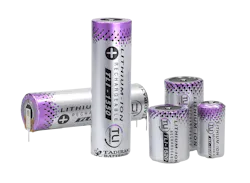
Industrial grade rechargeable Li-ion batteries are available that operate far longer than consumer grade Li-ion batteries, which have a limited lifespan (5 years), a restricted number of full recharge cycles (500), and are unable to be recharged or discharged at very low temperatures. By contrast, industrial grade Tadiran TLI Series rechargeable Li-ion batteries can operate for up to 25 years and 5,000 full recharge cycles, delivering up to 15 A pulses to support wireless communications, and capable of being recharged and discharged at extremely low temperatures (Fig. 2).
All Batteries are Not Created Equal
With numerous options available among primary battery chemistries, design engineers run the risk of specifying the wrong battery, leading to sub-optimal performance and a higher long-term cost of ownership since the cost of replacing a battery is far higher than its initial expense. With long-term deployments, it pays never to be “penny wise and pound foolish” by specifying an inferior grade battery. A highly experienced applications engineer can assist you in identifying the ideal power management solution.
The Advantages of Lithium-based Chemistries
The least expensive battery is the ubiquitous consumer grade alkaline cell. While capable of delivering high rates of continuous current (i.e. powering a flashlight or a toy), alkaline chemistry is typically unsuited for long-term industrial deployments due to serious limitations, including: a self-discharge rate of up to 60% per year; very low capacity and low energy density, which often requires the use of additional cells that add size, weight and expense; and the use of a non-aqueous chemistry, which is susceptible to freezing.
Lithium-based chemistries are generally preferred for industrial applications. As the lightest non-gaseous metal, lithium offers an intrinsic negative potential that exceeds all other metals, resulting in the highest specific energy (energy per unit weight), highest energy density (energy per unit volume), and higher voltage (OCV) ranging from 2.7 to 3.6V. Lithium-based chemistries are also non-aqueous, thus less prone to freezing than alkaline cells.
Of the various lithium-based chemistries available, bobbin-type lithium thionyl chloride (LiSOCl2) batteries are predominantly chosen for ultra-long-life deployments. Bobbin-type LiSOCl2 chemistry (Fig. 3) stands apart for delivering the highest capacity, highest energy density, and widest temperature range of all (-80°C to +150°C).
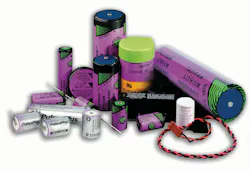
Superior quality bobbin-type LiSOCl2 cells feature a self-discharge rate of just 0.7% per year, enabling them to last up to 40 years. LiSOCl2 batteries can also be manufactured with a spiral wound construction that permits a higher rate of energy flow with the trade-off being a higher annual self-discharge rate.
The advantages of bobbin-type LiSOCl2 chemistry include:
- longer operating life of up to 40 years to lower the cost of ownership
- A wider temperature range of -80°C to +150°C to survive extreme environments
- High energy density and capacity which may permit the use of fewer or smaller batteries
- Higher voltage which may permit the use of fewer batteries
- Harsh Environments Impact Battery Performance
A battery’s potential lifespan is dictated by its storage capacity, which is measured in Ampere-hours or Amp-hours (Ah). The cell’s maximum run time is based on the average current being drawn. For example, a device consuming 1mA of average current with a storage capacity of 1,200 mAh can have a maximum run time of 1,200 hours. However, theoretical battery life is often not reflected by reality, as actual battery performance can be negatively impacted by prolonged exposure to extreme temperatures during storage and/or deployment, which can cause voltage delays and voltage drops as well as the depletion of electro-chemical constituents to accelerate the cell’s annual self-discharge rate.
Battery self-discharge results from chemical reactions that occur even when the cell is disconnected or not in use. In many cases, a low-power device will consume more energy resulting from self-discharge than is required to operate the device. Other variables can also impact a battery’s self-discharge rate, including the peak current, consumption profile, temperature range, age of the cell, and the leakage current drawn by individual components within the device, to name a few.
Passivation Pays Dividends
Bobbin-type LiSOCl2 batteries deliver the lowest possible self-discharge rate principally due to their unique ability to harness the passivation effect.
In essence, passivation involves the formation of a thin film of lithium chloride (LiCl) on the surface of the anode, which then acts as a separation barrier from the electrode to limit the chemical reactions that lead to self-discharge. Whenever a continuous current load is applied, the passivation layer initially causes higher resistance and a drop in voltage until the continuous discharge reaction causes the passivation layer to begin dissipating. Once a battery becomes inactive for an extended time the passivation layer returns, requiring another round of de-passivation.
The level of passivation varies based on several factors, including the cell’s construction, its current discharge capacity, the length of time in storage, the storage and discharge temperature, and prior discharge conditions, such as partially discharging a cell and then removing the load. While passivation is ideal for extending battery life, it must be carefully managed to avoid any over-restriction of energy flow.
Experienced battery manufacturers can harness the passivation effect through proprietary cell construction techniques and the use of higher quality raw materials. As a result, the highest quality bobbin-type LiSOCl2 batteries can feature a self-discharge rate of just 0.7% per year, able to retain 70% of their original capacity after 40 years. Conversely, lower quality bobbin-type LiSOCl2 cells can have a self-discharge rate of up to 3% per year, exhausting roughly 30% of their available capacity every 10 years from self-discharge. Lifetime Power wireless sensors could not operate for 25 years on inferior quality batteries since nearly 3/4 of the cell’s total capacity would be exhausted by self-discharge over that period of time.
Wireless Communication Draws High Pulses
Another important consideration is the cell’s ability to generate high pulses of up to 15 A to power bi-directional wireless communications. Standard bobbin-type LiSOCl2 cells cannot deliver such high pulses due to their low-rate design. This challenge was addressed by incorporating a patented hybrid layer capacitor (HLC). Utilizing this hybrid approach, the standard bobbin-type LiSOCl2 cell delivers low-level base current during ‘standby’ mode while the HLC delivers periodic high pulses during ‘active’ mode.
Supercapacitors perform a similar role for consumer electronic devices, but are typically ill-suited for industrial applications due to numerous drawbacks, including short-duration power, linear discharge qualities that do not allow for the use of all available energy, low capacity, low energy density, and very high self-discharge rates (leakage current). When supercapacitors are linked in series, they require the use of expensive cell-balancing circuits that add bulk while draining additional current to further reduce their operating life. In certain instances, supercapacitors may be paired with bobbin-type LiSOCL2 cells to enhance voltage response.
Do Your Due Diligence
When ultra-long battery life is essential, it pays to invest in a superior quality battery that can reduce or eliminate the need for costly battery replacements over the expected lifetime of the device. While bobbin-type LiSOCl2 batteries are marginally more expensive, the added investment is often worthwhile based upon the potential long-term savings.
Unfortunately, it can be difficult to differentiate between a superior grade battery and a lesser quality cell based on short-term test results, which tend to be highly inaccurate since the long-term effects of a higher self-discharge rate can take years to become fully measurable. Short-term test results can also be hindered by relatively small sample sizes that underestimate the passivation effect as well as the impact of prolonged exposure to extreme temperatures.
When extended battery life is essential, the promotional claims of battery manufacturers must be verified through due diligence. To properly evaluate competing battery brands, you need to receive fully documented and verifiable test reports. For validation, you should also obtain long-term performance data from actual batteries in the field operating under equivalent loads and environmental conditions, both during storage and deployment. Contacting the battery manufacturer’s customers offers another point of reference.
Since short-term test data can be highly inaccurate, Tadiran has amassed a large and continually expanding database from monitoring long-term battery performance over decades under laboratory conditions. Tadiran also performs tests on customer-supplied samples from the field, representing the full spectrum of power requirements and environmental conditions. As an added benchmark, Tadiran performs long-term testing on competing battery brands.
Case History
Powercast Lifetime Power wireless sensors remotely monitor and control HVAC and lighting systems in commercial buildings, reducing energy bills up to 29%
With energy costs on the rise, there is a growing need for advanced building automation solutions that utilize simple-to install remote wireless technology.
Powercast Lifetime Power sensor-control devices deliver a highly cost-effective solution for remotely monitoring and controlling HVAC systems and lighting in commercial buildings. Lifetime Power offers a flexible and scalable solution that is robust, simple and inexpensive to install, LEED-certified, and provides valuable data and insight that allows commercial buildings to remain comfortable without being wasteful.
Lifetime Power devices can reduce electrical bills by up to 29% while eliminating the need for complex wiring, thereby reducing installation costs by 40-50% versus traditional hard-wired sensor and building automation systems. These sensors feature a proprietary low-power communications protocol operating at 915MHz frequency to permit long-range transmissions of up to 300 ft. with increasing spacial diversity, including coverage across concrete-rich environments.
Powercast’s fully integrated solution incorporates web/mobile interfaces, proxy servers, with LAN/gateway access to BACnet to support a wide variety of remote monitoring functions, monitoring temperature, humidity, CO2, DP, and the intensity of luminaire-controlled lighting. This simple-to-install solution offers unlimited scalability to optimize energy efficiency and comfort, and the data provided gives building management greater control and insight, including pattern recognition, to identify potential waste and maintenance problems.
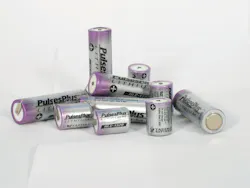
Use of a Tadiran PulsesPlus ultra-long-life hybrid LiSOCl2 battery enabled Powercast to minimize long-term maintenance costs with a proven power supply capable of far exceeding the device’s rated operating life of 25 years (Fig. 4).
According to Dr. Charles Greene, CEO of Powercast, “Buildings equipped with Lifetime Power devices gain 24/7 access to a valuable technology that pays substantial long-term dividends to occupants by cutting energy costs up to 29% and providing greater insight and control. Our customers are making a long-term investment in their HVAC and lighting systems, so they deserve the advantages of an ultra-long-life battery pack with a self-discharge rate of less than 1% per year. The result is more reliable connectivity without the need for future battery replacements, which reflects positively on our brand.”
Powercast Lifetime Power devices utilize a power management solution that pairs a Tadiran TL-4903/P ultra-long-life bobbin-type LiSOCl2 battery with a Tadiran HLC-1020P6/T hybrid layer capacitor (HLC) to create a PulsesPlus hybrid cell capable of serving both low-power and high pulse requirements. This PulsesPlus hybrid battery can operate maintenance-free for up to 4 decades, eliminating the need for ‘truck and roll’ battery replacements. PulsesPlus batteries also contain non-toxic materials, eliminating any e-waste concerns if battery disposal is required.
Conclusion
Identifying the ideal battery is an application-specific decision. For example, if 2-5 years of battery life is sufficient, then numerous lithium-based chemistries could be acceptable. However, if the application calls for an ultra-long-life power supply that can operate reliably for decades, then your choice of battery may be limited to bobbin-type LiSOCl2 chemistry or an industrial grade rechargeable Li-ion battery.
Remember, every application has unique performance characteristics, so it pays to consult with a highly qualified applications engineers who fully understands low-power design and the available power management solutions to determine the best fit.
About the Author
Vitaly Milner
Product Marketing Manager @ Tadiran Batteries
Vitaly Milner, Ph.D is product marketing manager at Tadiran Batteries. He has more than 22 years of experience in industrial roles, including 16 years in the battery sector. Milner specializes in innovative battery applications for IIoT, transportation, oil & gas, telecom, utilities, and more. He has a Doctor of Philosophy degree in physics and mathematics from Lomonosov Moscow State University.



Comment About the Article
To join the conversation, and become an exclusive member of Electronic Design, create an account today!
 Leaders Logo
Leaders relevant to this article: