Power-Management IC Squeezes into Automotive Cameras

The "S-19560B Series" is ABLIC’s first power-management IC (PMIC) to integrate two step-down DC-DC converter channels and one LDO regulator channel into an ultra-compact HSNT-8(2030) package (2.0 × 3.0 × t0.5 mm).
Intended for use in space-constrained automotive applications, such as cameras used in autonomous driving/advanced driver-assistance systems (AD/ADAS) systems, the new PMIC enables designers to create extremely compact camera modules. These can be easily placed behind rear view mirrors, tailgate mounts, and streamlined external peripheral monitors.
The S-19560B Series PMIC integrates a single 16-V input and three independently configurable power output channels. This is especially useful in applications using multiple makes and models of cameras, where the PMIC’s outputs can be configured to deliver the necessary output voltages and power-up sequences to meet the requirements of each device.
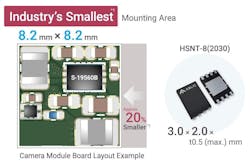
It can be combined with ABLIC's small, high-PSRR LDO regulator (S-19255) to create a four-channel power-supply circuit that has a mounting roughly 20% smaller than competing four-channel PMIC solutions. The solution’s external LDO regulator was deliberately chosen to provide improved heat dispersion, which contributes to the module’s space savings and thermal efficiency.
Targeted primarily at automotive applications, S-19560-B devices are subjected to stringent temperature testing. Work is underway to comply with AEC-Q100 reliability and quality standards. Additional applications for the PMICs include drive recorders, driver monitoring dystems (DMS), engine & transmission controls, and smart suspension & braking systems.
Next in This Edition of PowerBites


More PowerBites

 powerbites_promo
About the Author
 Lee Goldberg
Lee Goldberg
Contributing Editor
Lee is the author of the popular PowerBites series.
Lee Goldberg is a self-identified “Recovering Engineer,” Maker/Hacker, Green-Tech Maven, Aviator, Gadfly, and Geek Dad. He spent the first 18 years of his career helping design microprocessors, embedded systems, renewable energy applications, and the occasional interplanetary spacecraft. After trading his ‘scope and soldering iron for a keyboard and a second career as a tech journalist, he’s spent the next two decades at several print and online engineering publications.
Lee’s current focus is power electronics, especially the technologies involved with energy efficiency, energy management, and renewable energy. This dovetails with his coverage of sustainable technologies and various environmental and social issues within the engineering community that he began in 1996. Lee also covers 3D printers, open-source hardware, and other Maker/Hacker technologies.
Lee holds a BSEE in Electrical Engineering from Thomas Edison College, and participated in a colloquium on technology, society, and the environment at Goddard College’s Institute for Social Ecology. His book, “Green Electronics/Green Bottom Line - A Commonsense Guide To Environmentally Responsible Engineering and Management,” was published by Newnes Press.
Lee, his wife Catherine, and his daughter Anwyn currently reside in the outskirts of Princeton N.J., where they masquerade as a typical suburban family.