Energy-Harvesting PMIC Brings Hybrid PV Cells to Indoor, Outdoor Lighting
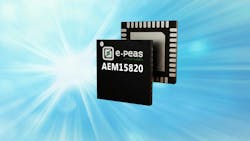
The AEM15820 energy-harvesting PMIC developed by e-peas is designed to unlock the full potential of hybrid photovoltaic (PV) cells in both small portable devices and larger static systems. It accommodates the wider power generation range that hybrid PV cells can provide in both indoor and outdoor environments, which varies from microwatts under indoor lighting to several watts in direct sunlight.
The PMIC’s wide dynamic range enables hybrid PV cells to be deployed across a broad spectrum of consumer devices, including self-charging headphones and charging cases, e-readers, and sports or hiking computers. Additional markets include remote security cameras, smart glasses, and power banks.
The AEM15820 integrates both a low-power and high-power boost converter, switching automatically between them to achieve high efficiency across varying power levels. A 5-V DC input is also included for fast battery charging from mains sources.
Optimized for use with both batteries and lithium-ion capacitors (LiCs), the PMIC features an ultra-low-power cold start of 5 µW at 275 mV. It provides an output voltage of 0.6 to 3.3 V, up to 100 mA, and integrates a configurable source regulation mode.
The device can be fully configured via GPIO or I2C for storage element protection thresholds, source voltage regulation, thermal protection, load output, and more. The AEM15820 is available in a 5- × 5-mm QFN40 package, with evaluation boards available immediately.
Next in This Edition of PowerBites
 adas_dreamstime_l_140582302
 tvpowersupply_dreamstime_l_239773457
More PowerBites
 powerbites_promo
About the Author
 Lee Goldberg
Lee Goldberg
Contributing Editor
Lee is the author of the popular PowerBites series.
Lee Goldberg is a self-identified “Recovering Engineer,” Maker/Hacker, Green-Tech Maven, Aviator, Gadfly, and Geek Dad. He spent the first 18 years of his career helping design microprocessors, embedded systems, renewable energy applications, and the occasional interplanetary spacecraft. After trading his ‘scope and soldering iron for a keyboard and a second career as a tech journalist, he’s spent the next two decades at several print and online engineering publications.
Lee’s current focus is power electronics, especially the technologies involved with energy efficiency, energy management, and renewable energy. This dovetails with his coverage of sustainable technologies and various environmental and social issues within the engineering community that he began in 1996. Lee also covers 3D printers, open-source hardware, and other Maker/Hacker technologies.
Lee holds a BSEE in Electrical Engineering from Thomas Edison College, and participated in a colloquium on technology, society, and the environment at Goddard College’s Institute for Social Ecology. His book, “Green Electronics/Green Bottom Line - A Commonsense Guide To Environmentally Responsible Engineering and Management,” was published by Newnes Press.
Lee, his wife Catherine, and his daughter Anwyn currently reside in the outskirts of Princeton N.J., where they masquerade as a typical suburban family.