SiC Merged-PiN Schottky Diodes Elevate Efficiency in Next-Gen Power Systems

RIR Power Electronics Limited said its silicon-carbide (SiC) merged-PiN Schottky (MPS) diodes offer significant advantages in efficiency without compromising reliability for next-generation electric vehicles (EVs), industrial power systems, and energy infrastructure.
According to the company, MPS diodes overcome the long-standing tradeoffs between efficiency, high-voltage blocking, and ruggedness designers faced with conventional SiC Schottky barrier diodes (SBDs). They integrate Schottky and PiN structures into a single, monolithic device that delivers superior efficiency, power density, and long-term reliability.
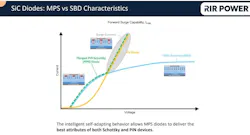
RIR’s diodes leverage SiC technology that enables higher operating voltages, faster switching speeds, and improved thermal performance than traditional silicon devices. Key advantages include:
- High surge current capability: Enhanced tolerance to inrush currents, short circuits, and grid disturbances
- Low leakage at elevated temperatures: Stable performance under high-temperature operation
- Improved avalanche and blocking robustness: Reliable operation in high-voltage DC-link and grid-tied systems
- Near-zero reverse recovery: Ultra-fast switching with minimal losses
- Higher system reliability: Reduced need for over-design, snubbers, and excessive derating
Next in This Edition of PowerBites
 dreamstime_davidebonaldo_444289282_promo
 260204_prodmod_alphaomega_600v_mosfet
More PowerBites

 powerbites_promo
About the Author
 Lee Goldberg
Lee Goldberg
Contributing Editor
Lee is the author of the popular PowerBites series.
Lee Goldberg is a self-identified “Recovering Engineer,” Maker/Hacker, Green-Tech Maven, Aviator, Gadfly, and Geek Dad. He spent the first 18 years of his career helping design microprocessors, embedded systems, renewable energy applications, and the occasional interplanetary spacecraft. After trading his ‘scope and soldering iron for a keyboard and a second career as a tech journalist, he’s spent the next two decades at several print and online engineering publications.
Lee’s current focus is power electronics, especially the technologies involved with energy efficiency, energy management, and renewable energy. This dovetails with his coverage of sustainable technologies and various environmental and social issues within the engineering community that he began in 1996. Lee also covers 3D printers, open-source hardware, and other Maker/Hacker technologies.
Lee holds a BSEE in Electrical Engineering from Thomas Edison College, and participated in a colloquium on technology, society, and the environment at Goddard College’s Institute for Social Ecology. His book, “Green Electronics/Green Bottom Line - A Commonsense Guide To Environmentally Responsible Engineering and Management,” was published by Newnes Press.
Lee, his wife Catherine, and his daughter Anwyn currently reside in the outskirts of Princeton N.J., where they masquerade as a typical suburban family.