40-V eGaN Transistor Offers Si-Beating On-Resistance, Switching Losses
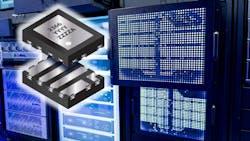
Volume production has commenced for Efficient Power Conversion’s (EPC) EPC2366, the first of its seventh-generation (Gen 7) eGaN family of power transistors. Devices produced on the new process platform deliver up to 3X more performance than equivalent silicon MOSFETs, according to the company.
With a typical on-resistance (RDS(on)) of 0.8 mΩ and a highly optimized RDS(on) × QG (QG = gate charge) figure of merit (FOM) < 12 mΩ × nC, it simultaneously cuts conduction and switching losses while improving thermal performance. Engineered for high-efficiency, high-density-power systems, the device excels in synchronous rectification, high-density DC-DC conversion, AI server power supplies, and advanced motor drives.
The EPC2366 supports drain-to-source voltages up to 40 V and transient voltages up to 48 V, with continuous drain currents up to 88 A and pulsed currents of 360 A. The compact 3.3- × 2.6-mm PQFN package has a junction/case thermal resistance of 0.6°C/W.
The eGaN FET, now in volume production, costs $1.56 each in 3,000-unit reels.
EPC also offers the EPC90167 half-bridge evaluation board. Priced at $211.65, the board integrates two EPC2366 transistors in a low-parasitic layout with support for standard PWM drive signals and flexible input modes. In addition, there’s a cross-reference tool to help designers who wish to explore replacing the silicon MOSFETs in their existing designs with a gallium-nitride (GaN) solution.
>>Check out our coverage of APEC 2026
 dreamstime_dmytroskrypnykov_245154580_promo
Next in This Edition of PowerBites
 dreamstime_oskariporkka_100144878_promo
More PowerBites

 powerbites_promo
About the Author
 Lee Goldberg
Lee Goldberg
Contributing Editor
Lee is the author of the popular PowerBites series.
Lee Goldberg is a self-identified “Recovering Engineer,” Maker/Hacker, Green-Tech Maven, Aviator, Gadfly, and Geek Dad. He spent the first 18 years of his career helping design microprocessors, embedded systems, renewable energy applications, and the occasional interplanetary spacecraft. After trading his ‘scope and soldering iron for a keyboard and a second career as a tech journalist, he’s spent the next two decades at several print and online engineering publications.
Lee’s current focus is power electronics, especially the technologies involved with energy efficiency, energy management, and renewable energy. This dovetails with his coverage of sustainable technologies and various environmental and social issues within the engineering community that he began in 1996. Lee also covers 3D printers, open-source hardware, and other Maker/Hacker technologies.
Lee holds a BSEE in Electrical Engineering from Thomas Edison College, and participated in a colloquium on technology, society, and the environment at Goddard College’s Institute for Social Ecology. His book, “Green Electronics/Green Bottom Line - A Commonsense Guide To Environmentally Responsible Engineering and Management,” was published by Newnes Press.
Lee, his wife Catherine, and his daughter Anwyn currently reside in the outskirts of Princeton N.J., where they masquerade as a typical suburban family.