Liquid-Cooled Busbars Turn Down the Heat in Power Distribution

What you'll learn:
- Why rising rack power densities are pushing companies to extend liquid cooling into power-distribution busbars.
- How Molex’s multi-channel liquid-cooling approach improves heat removal compared to single-channel designs.
- The tradeoffs between liquid-cooled busbars and high-voltage DC architectures for delivering power to AI server racks.
As AI chips consume ever-larger amounts of power, traditional air cooling is struggling to deal with the heat they generate. Liquid cooling is largely replacing fan-based cooling at the chip level, but it’s now also becoming necessary to extend it into the power backbone for more uniform heat extraction.
"Direct-to-chip cooling is now standard for compute, but for AI to truly scale, we must also address the thermal challenges of the power path,” said Kevin Alberts, VP and GM of Molex’s power and signal business unit.
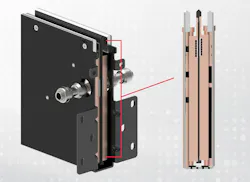
Now, Molex is bringing liquid cooling into the power-distribution layer of the data center with its latest “multi-channel” liquid-cooled busbars. In general, busbars are used to transfer power from one rack to the next and up and down the racks themselves between the servers. Thus, keeping them cool is key to reducing thermal stress in the rack and improving system performance. Molex said its liquid-cooled busbars can handle currents of up to 15,000 A, with future generations planned to support as much as 25,000 A.
According to Molex, the technology targets a growing problem in AI data centers: rapidly rising rack power densities. In the current generation of data centers, a typical rack consumes between 40 kW and 120 kW, with busbars used to ferry power between power shelves, busways, and compute racks. But as thousands of power-hungry GPUs pile into AI data centers, rack-level power requirements as high as 600 kW are around the corner, pushing traditional cooling and power-distribution architectures to their limits.
The liquid-cooled busbars can be deployed in ultra-dense AI server racks as well as power “sidecar” racks, said Molex technology manager Babu Rao Ponangi and engineering supervisor Jacob Peterson. The multi-channel solution is designed primarily for 48- and 54-V architectures, and it can enable rack power levels of up to 750 kW compared with a limit of 140 kW for air-cooled systems, they told Electronic Design. That allows system designers to add more computing power to the rack without drastically increasing the size.
Unlike conventional liquid-cooled designs using a single-channel fluid path, Molex engineered a unique multi-channel architecture that divides the coolant path into as many as seven separate channels. This approach enables more uniform heat extraction from the busbar, reducing hot spots and thermal stress while improving stability at high current levels. Given all that, the company said its liquid-cooled busbars can limit temperature rise (T-rise) to 15°C while carrying 15,000 A.
Can Liquid-Cooled Busbars Fit into High-Voltage DC Power Designs?
Liquid-cooled busbars aren’t the only approach to addressing the increasingly hot conditions in data centers. High-voltage DC (HVDC) power architectures are emerging as another potential solution to the issue.
Today, AC-DC power supplies are typically housed within the same rack as all of the compute, storage, and networking hardware used to run computationally heavy workloads such as AI training and inferencing. They convert power into a 48- or 54-V DC bus that distributes power to servers up and down the rack. However, next-generation architecture introduces the concept of a sidecar, which is basically a separate power-distribution rack connected to the compute rack using busbars.
By pulling the power supplies outside the compute rack, everything — including the core GPUs and CPUs — can be more closely packed. That ultimately improves utilization of valuable rack space for AI training and inference workloads.
But instead of using the same 48- or 54-V DC bus used inside the rack, the likes of Google, Microsoft, and NVIDIA are pushing to adopt DC bus voltages of ±400 or +800V DC to carry power from the sidecar to the IT rack more efficiently. To supply 600 kW of power to server racks at 48 V, it would take around 12,500 A of current. At those levels, busbars become extremely large, weighing close to 200 pounds. They would also likely need liquid cooling to manage the transmission (I2R) losses, which can increase cost and complexity.
At 800 V DC, by contrast, the same 600-kW rack would require only 750 A. That reduction in current would allow air cooling to be used while cutting busbar weight by more than half.
While high-voltage DC power can ease thermal stress and shrink busbars in the short term, Ponangi and Peterson said liquid cooling will be key to solving the long-term thermal challenges of AI. They added, “Rising system power and density — especially in AI workloads — continue to drive significant cooling needs. Liquid-cooled busbars remain a scalable solution, supporting compact, high-density power delivery and extending deeper into systems as power transitions from HVDC distribution to chip-level voltages.”
Using 48- or 54-V architectures also offers practical advantages, including the ability to leverage existing power components. Doing that avoids many of the engineering challenges associated with high-voltage DC systems, too, including safety, insulation, and spacing requirements.
Bringing Liquid Cooling into Power Distribution
According to simulations conducted by Molex, using the maximum number of liquid-cooling channels yields up to 20% more efficient cooling compared to single-channel designs. By maximizing heat extraction without increasing the physical size of the busbar, engineers can increase the power capacity of the rack without giving up valuable space, said Molex. The busbars are compatible with both dielectric and non-dielectric coolants, simplifying their integration into existing liquid-cooling loops.
Molex stated that its liquid-cooled busbars are designed primarily for 48- and 54-V deployments, and they come with a modular architecture that enables customers to customize dimensions as well as coolant inlet and outlet points to accommodate tight layouts. Combined with a plug-and-play interface and compatibility with industry-standard busbar form factors, the design allows for the adoption of liquid cooling without requiring a redesign of the overall rack.
What that means is hyperscalers and other AI-focused companies can pre-install high-capacity power infrastructure needed long term, eliminating costly "rip and replace" redesigns down the road.
According to Ponangi and Peterson, the multi-channel liquid-cooled busbars can also be made compatible with 400- and 800-V architectures to handle “mega-scale compute systems” by appropriately resizing them.
About the Author
 James Morra
James Morra
Senior Editor
James Morra is the senior editor for Electronic Design, covering the semiconductor industry and new technology trends, with a focus on power electronics and power management. He also reports on the business behind electrical engineering, including the electronics supply chain. He joined Electronic Design in 2015 and is based in Chicago, Illinois.