Low-Side 9-A Gate Driver Has Separate Source and Sink Outputs
What you'll learn:
- How a gate driver that complements the power device yields optimum switching performance.
- How this AEC-Q100-qualified driver offers basic driver functions plus associated functions.
- Why the availability of both source and sink outputs results in superior switching-device performance.
Given the justified interest these days in power devices of all types — silicon MOSFETs, silicon-carbide (SiC) MOSFETs, and IGBTs — it’s important to remember that a power device is only as good as its driver. Depending on the design of the circuitry, the driver has multiple roles beyond sourcing current to the power device to turn it on, or sinking current to turn it off.
Both turn-on and turn-off must be done “crisply” with suitable rise and fall times despite gate capacitance and without overshoot or other artifacts. Doing this is often difficult, and it’s especially challenging in the automotive environment with its wide temperature swings that cause significant changes in critical electrical characteristics and associated performance.
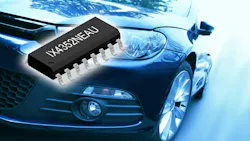
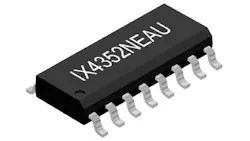
Addressing these needs is the Littelfuse IX4352NEAU 9-A low-side gate driver for SiC MOSFETs and IGBTs (Fig. 1). This driver is rated to AEC-Q100 Grade 1 for an operational ambient temperature range of −40 to +125°C, along with an operating voltage range VDD-VSS up to 35 V. It’s also rated for human body model (HBM) ESD Classification 2 (±2 kV).
The separate source and sink outputs allow for tailored turn-on and turn-off timing while minimizing switching losses. An internal negative-charge regulator provides a user-selectable negative gate-drive bias for high dV/dt immunity and faster turn-off (Fig. 2).
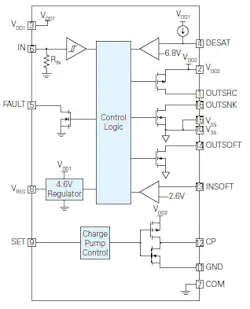
The IX4352NEAU has three gate-drive outputs. Two power outputs, OUTSRC and OUTSNK, are each rated for a maximum peak current of 9 A while the third output, OUTSOFT, is rated for a typical peak current of 900 mA.
Separate source and sink high-current outputs enable independent adjustment of the discrete power SiC MOSFET or IGBT turn-on and turn-off transactions by means of a single resistor for each output. An internal non-adjustable dead time prevents cross conduction between the source and sink outputs (Fig. 3).
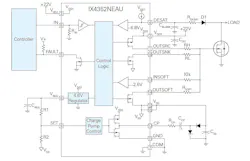
Desaturation detection circuitry senses an overcurrent condition of the SiC MOSFET and initiates a soft turn off, thus preventing a potentially damaging dV/dt event. The non-inverting logic input, IN, is TTL- and CMOS-compatible; internal level shifters provide the necessary bias to accommodate negative gate-drive bias voltages.
Additional protection features include UVLO detection and thermal shutdown. An open-drain FAULT output signals a fault condition to the microcontroller. On-state propagation delay (tON) is 70 ns while off-state propagation delay (tOFF) is 65 ns.
The IX4352NEAU comes in a narrow SOIC-16 with a bottom-side pad. Its 16-page datasheet provides a full range of static and dynamic characteristics as well as tables and graphs showing performance vs. temperature and other operating points, including supply voltage, frequency, and load capacitance.
About the Author
 Bill Schweber
Bill Schweber
Contributing Editor
Bill Schweber is an electronics engineer who has written three textbooks on electronic communications systems, as well as hundreds of technical articles, opinion columns, and product features. In past roles, he worked as a technical website manager for multiple topic-specific sites for EE Times, as well as both the Executive Editor and Analog Editor at EDN.
At Analog Devices Inc., Bill was in marketing communications (public relations). As a result, he has been on both sides of the technical PR function, presenting company products, stories, and messages to the media and also as the recipient of these.
Prior to the MarCom role at Analog, Bill was associate editor of their respected technical journal and worked in their product marketing and applications engineering groups. Before those roles, he was at Instron Corp., doing hands-on analog- and power-circuit design and systems integration for materials-testing machine controls.
Bill has an MSEE (Univ. of Mass) and BSEE (Columbia Univ.), is a Registered Professional Engineer, and holds an Advanced Class amateur radio license. He has also planned, written, and presented online courses on a variety of engineering topics, including MOSFET basics, ADC selection, and driving LEDs.