Pressure Sensors Propel Liquid Cooling in EVs and AI Data Centers
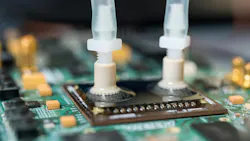
A new series of pressure sensors can detect subtle pressure changes in gases and liquids, allowing them to accurately monitor coolant pressure in EV battery thermal-management and liquid-cooling systems for AI data centers.
As these systems grow increasingly power-dense, cooling systems are critical to performance and reliability, said Karel Claesen, product line director at Melexis, which developed the new line of low-pressure sensors. In applications such as EV battery cooling and liquid-cooled data center racks, pressure measurements help verify correct coolant circulation while supporting diagnostics. By detecting faults that could otherwise go undetected, pressure sensors help prevent costly downtime and guard high-value components against irreversible damage.
Liquid-cooling systems coiling through EV inverters, battery energy storage systems (BESS), and AI racks operate at relatively low pressures, usually between 2 and 4 bar. The challenge comes down to accurately detecting very small pressure changes under these conditions. According to Melexis, conventional MEMS pressure sensors struggle to deliver robust pressure measurements for gases, liquids, and fluids that may freeze, such as water-glycol and other coolant mixtures used in electronics cooling.
The new MLX90830, MLX90833, and MLX90834 are all specifically designed to detect these subtle changes in pressure, targeting the thermal-management loops in EVs and liquid-cooled data-center racks. Belonging to Melexis’ broader Triphibian pressure sensor family, which can uniquely measure both gas and liquid pressures, the automotive-grade devices deliver ±0.5% of accuracy over their full operating lives.
The chips combine a suspended-cantilever MEMS pressure sensor with digital signal processing, signal conditioning, and output driver in a compact, factory-calibrated SOIC16 wide-body package. The package-level integration enables the chips to be used in standalone pressure sensors or directly integrated into larger systems such as pumps or coolant distribution units. As a result, pressure can be measured closer to where it matters, said Melexis.
The devices, which come with analog or digital outputs (among several other options), are designed for direct contact with gas, liquid, and other coolants, which cuts down on the complexities of integrating them into servers and other densely packed systems. Due out with SPI and I2C outputs in 2027, the digital-output devices support on-chip temperature sensing and the option to connect an external NTC temperature sensor when heat must be monitored along with pressure.
“Whether driving next-generation automotive systems or powering AI data centers, Triphibian technology delivers the critical monitoring required to ensure continuous hardware operation,” added Claesen.
About the Author
 James Morra
James Morra
Senior Editor
James Morra is the senior editor for Electronic Design, covering the semiconductor industry and new technology trends, with a focus on power electronics and power management. He also reports on the business behind electrical engineering, including the electronics supply chain. He joined Electronic Design in 2015 and is based in Chicago, Illinois.