Automotive Resistive Dividers Go to the “Extreme”
What you'll learn:
- Why these “extreme” components are needed in EVs.
- The performance achieved due to advanced materials and fabrication processes.
- The range of available resistance ratios offered.
You normally associate voltage dividers that blend high-voltage, high-resistance, and precision specifications with scientific, high-energy physics, or medical applications. They’re used to step-down extreme voltages so that they can be measured by “normal” circuitry. Now, as all cars (ICE, BEV, and EV) increasingly become highly sophisticated systems on wheels, these “extreme” resistors are needed; in this case, to assess high voltages in electric vehicles.
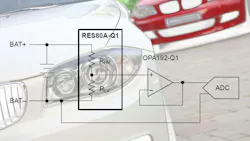
To meet these needs, Texas Instruments introduced the RES80A-Q1, an AEC-Q200 automotive-qualified matched-resistive divider (a classic voltage-divider arrangement) implemented in thin-film silicon chromium (SiCr) using the company’s modern, high-performance, analog wafer process (Fig. 1).
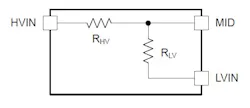
It’s typically used to divide down a high potential to be within the input full-scale range of an ADC or op amp, as seen in a typical voltage-divider circuit (Fig. 2). Galvanic (ohmic) isolation isn’t included but can be implemented in several ways if needed.
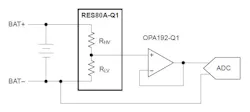
The device, with a nominal high-voltage input resistance of 50 MΩ, is available in several nominal high- to low-resistance ratios (RHV:RLV) to meet a wide array of system needs. Eight ratios span from 145:1 all the way to 1000:1.
Ratio-Matching Precision
With voltage dividers, ratio matching is as important as absolute accuracy. The RES80A-Q1 series features high ratio-matching precision, with the measured ratio of each divider within ±0.1% (maximum) of the nominal value. This precision is maintained over the specified temperature range and despite aging, it has a cumulative drift of only ±0.2% (max).
As a result, the lifetime tolerance of an uncalibrated RES80A-Q1 remains within a ±0.3% (max) envelope. A high-quality silicon-dioxide (SiO2) insulative layer encapsulates the resistors and enables use at extremely high voltages up to 2,000 V DC for sustained operation, or 4,000 V DC for HiPOT testing (60-second rating).
The thin-film analog wafer process used for the RES80A-Q1 has been intrinsically qualified for sustained high-voltage operation through time-dependent dielectric breakdown (TDDB) testing. This testing is performed by stressing dedicated test structures at a constant high AC or DC voltage for a long duration, until the devices wear out and fail by electrical short.
By testing TDDB at multiple voltages, the process lifetime at a given working voltage is determined by extrapolation using the Weibull method. TDDB testing has shown that the two different biasing conditions of unipolar signals and bipolar signals result in differing operational lifetimes for the process.
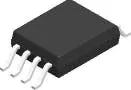
The RES80A-Q1 is automotive-qualified under AEC-Q200 temperature grade 1, with a specified temperature range from –40 to +125°C. The device comes in an 8-pin DWV SOIC package, with nominal body size of 7.5 × 5.85 mm, and features creepage and clearance distances of at least 8.5 mm between the high- and low-voltage pins (Fig. 3). (Creepage and clearance parameters are critical to its use in high-voltage designs and subsequent regulatory approval.)
Despite its conceptual simplicity, users of passive components for extreme conditions, even “just” a resistive divider, appreciate technical insight. For this reason, this device is supported by a detailed 23-page datasheet that includes electrical data, thermal information, layout and packing insight, ordering information, and more.
About the Author
 Bill Schweber
Contributing Editor
Bill Schweber is an electronics engineer who has written three textbooks on electronic communications systems, as well as hundreds of technical articles, opinion columns, and product features. In past roles, he worked as a technical website manager for multiple topic-specific sites for EE Times, as well as both the Executive Editor and Analog Editor at EDN.
At Analog Devices Inc., Bill was in marketing communications (public relations). As a result, he has been on both sides of the technical PR function, presenting company products, stories, and messages to the media and also as the recipient of these.
Prior to the MarCom role at Analog, Bill was associate editor of their respected technical journal and worked in their product marketing and applications engineering groups. Before those roles, he was at Instron Corp., doing hands-on analog- and power-circuit design and systems integration for materials-testing machine controls.
Bill has an MSEE (Univ. of Mass) and BSEE (Columbia Univ.), is a Registered Professional Engineer, and holds an Advanced Class amateur radio license. He has also planned, written, and presented online courses on a variety of engineering topics, including MOSFET basics, ADC selection, and driving LEDs.