
Most people, including homeowners, facilities managers, and consumers, recognize the compute cloud by way of the Internet of Things (IoT) that connect to it—for example, smart thermostats, smart paper-towel dispensers, and even wireless playing cards, all of which have garnered recent attention. Certainly, these edge devices, often with fog computing capability, offer significant business opportunities.
There are drawbacks, however. Addressing the Burn-in and Test Strategies (BiTS) Workshop in March in Mesa, AZ, Risto Puhakka, president of VLSIresearch, said the IoT offers high growth yet low cost—and low profits, at least at the semiconductor level. He described IoT devices as low-cost data generators. All that generated data must go somewhere—namely, the data center, which along with connectivity is the physical implantation of the cloud.
Consequently, many companies—test and measurement companies included—are looking to the data center for business opportunities, emphasizing both hardware and software. Some recent examples of IoT implementations provide an indication of the breadth of “things” that can be connected and the challenges imposed from the edge to the data center. Design and test companies are stepping forward to provide assistance.
Cloud-connected playing cards
A cloud-connected playing-card project got its start back in November 2014 when Holst Centre, imec, and Cartamundi NV—a producer of playing cards, promotional cards, casino cards, collector card games, and board games—announced a collaborative effort to develop ultrathin flexible near-field-communication (NFC) tags. The plan was to use metal-oxide (IGZO) thin-film transistor (TFT) technology on plastic film to integrate flexible chips into game cards as part of Cartamundi’s strategy of developing game cards for the connected generation. Implementing the NFC tags using chips based on IGZO TFT technology on plastic film promised to keep manufacturing cost low while enabling paper-embedded NFC applications.
Then in April of this year, the organizations announced they had won a “Best Product” award at Printed Electronics Europe for successfully integrating the technology into Cartamundi’s playing cards (Figure 1), noting that the award jury recognized the “game-changer” potential of the technology for the gaming industry and for other printed-electronics applications in the IoT domain.

Courtesy of imec
On announcing the award, Paul Heremans, department director of thin-film electronics at imec and technology director at the Holst Centre, commented on the TOLAE (thin, oxide and large-area electronics) technology enabling the cards. “Our prototype thin-film RFID is thinner than paper—so thin that it can be invisibly embedded in paper products such as playing cards,” he said. “This key enabling technology will bring the cards and traditional games of our customer in direct connection with the cloud. This achievement also opens up new applications in the IoT domain that we are exploring, to bring more data and possibilities to applications such as smart packaging, security paper, and maybe even banknotes.”
Facilities management in the cloud
Among other cloud applications receiving recent attention, in April IBM announced that the Professional division of Kimberly-Clark had adopted IBM Cloud to create a new intelligent facilities-management app that helps clients monitor and manage restrooms remotely, lowering costs and improving consumer experiences.
Kimberly-Clark Professional’s new Intelligent Restroom app (Figure 2) was built using the IBM Bluemix development platform and is hosted on the IBM Cloud. IBM said Kimberly-Clark Professional learned of the value of Bluemix and IoT when it participated last year in an IBM Design Thinking Workshop that featured the IBM Bluemix Garage Method, which is designed to help clients innovate and rapidly develop apps as a start-up would.

Courtesy of Kimberly-Clark Professional
Through the use of the IBM Internet of Things Foundation service, facilities managers using the Kimberly-Clark app collect data and alerts from sensors integrated into restroom amenities, from soap dispensers to air fresheners, as well as nonamenities like entrance doors. All the data is managed and monitored through a central dashboard that can be viewed on desktops or mobile devices remotely. In pilot tests of the Intelligent Restroom, Kimberly-Clark Professional said it has been able to reduce the amount of supplies used in the restroom by up to 20%.
Bryan Semkuley, vice president of global innovation at Kimberly-Clark Professional, commented on the importance of restroom and supplies management to maintaining a business. “We wanted to help our clients reduce tenant churn, lower costs, and improve the customers’ experience along the way,” he said in a press release. “That’s when we turned to innovations in the cloud and IoT from IBM that can be operated from facilities managers’ smartphones.”
IoT platforms
Note that IBM isn’t looking to make money selling sensors for bathrooms—its business model is based on the software platform that allows others to deploy sensors and build apps that handle the resulting data. In addition to IBM, Amazon.com, General Electric, Microsoft, Cisco Systems, and Salesforce.com offer IoT platforms.1
A recent entrant to the IoT platform business is Hewlett Packard Enterprise (HPE), which in May at Internet of Things World 2016 introduced the HPE Universal IoT Platform. The company describes it as a scalable, modular, client-agnostic solution that enables customers to monetize the data that connected devices generate.
HPE is looking to profit from anticipated IoT market growth. According to Gartner, “Endpoints of the IoT will grow at a 31.7% CAGR from 2013 through 2020, reaching an installed base of 20.8 billion units.”2 The market-research firm predicts 6.6 billion “things” will ship in 2020, with about two-thirds serving consumer applications and with hardware spending on networked end points reaching $3 trillion.
“The value of the IoT lies in enriching data collected from devices with analytics and exposing it to applications that enable organizations to derive business value,” said Nigel Upton, director and general manager, IoT, HPE, in a press release. “The HPE Universal IoT Platform dramatically simplifies integrating diverse devices with different communications protocols, enabling customers to realize tremendous benefits from their IoT data, and is designed to scale to billions of transactions tried and tested in rigorous large-scale global telco and enterprise environments in a variety of smart ecosystems.”
The HPE Universal IoT Platform is aligned with the oneM2M industry standard and supports long-range, low-power connectivity via LoRa and SIGFOX deployments alongside other connectivity protocols, including cellular, Wi-Fi, and Bluetooth.
HPE said Objenious, a subsidiary of Bouygues Telecom, a French provider of mobile, fixed, TV, Internet, and cloud services, is using the HPE Universal IoT Platform and the LoRa network to deliver IoT services that address IoT use cases including vehicle fleet management, remote meter reading, predictive maintenance, and geolocation.
The data center
Of course, software cloud platforms need processors to run on. To that end, in April Intel announced a restructuring initiative to accelerate its evolution from a PC company to one that powers the cloud and the IoT. The company said the data center and IoT businesses are Intel’s primary growth engines, with FPGA technology (obtained through the Altera acquisition) and memory offering opportunities. These growth businesses, Intel said, delivered $2.2 billion in revenue growth last year and made up 40% of the total revenue and the majority of the operating profit, which largely offset the decline in the PC market segment.
Intel chief executive Brian Krzanich says that Intel will leverage Rack Scale Architecture, 3D XPoint memory, FPGAs, and silicon-photonics technology to revolutionize the data-center infrastructure. In addition, he says, Intel will pursue opportunities in 5G—from modems to base stations. Krzanich cites five core beliefs. First, “The cloud is the most important trend shaping the future of the smart, connected world—and thus Intel’s future.”3 Analytics, big data, high-performance computing, and machine learning are keys to unlocking cloud and data-center value, he adds. As for the other four core beliefs, “things” become more valuable when connected to the cloud, memory and FPGAs will enable new classes of products, 5G will be the key cloud-access technology, and Moore’s Law will continue to progress.
From design to test
Building your own IoT implementation—whether at the edge or the data center or somewhere in between—will present significant design-and-test challenges. To help point you in the right direction, at the Internet of Things World 2016 in May, Avnet introduced the Avnet MicroZed Industrial IoT Starter Kit, an out-of-the-box system incorporating technology from IBM, Wind River, and Xilinx. The kit is designed to simplify customers’ prototype and development efforts while providing a quick transition to production.
The kit includes the necessary building blocks for developing a production-ready, IoT-enabled, industrial-processing system. The platform is based on Avnet’s MicroZed system-on-module with a Zynq-7000 all-programmable SoC from Xilinx and pluggable sensors, including a motion and environmental sensor board from STMicroelectronics and a thermocouple-to-digital Pmod sensor module from Maxim Integrated.
Data-center test
Numerous vendors are pursuing test applications for cloud and IoT implementations. The cloud and data center are key targets for the M8000 Series BERT (Figure 3) introduced in May by Keysight Technologies, according to Ellen Spindler, product manager for BERTs at Keysight’s Digital & Photonic Test Division. An emphasis, she said in a phone interview, is on PAM-4 and other challenges of 400G data-center interconnect, with development having begun in 2014 and deployment slated for 2018.
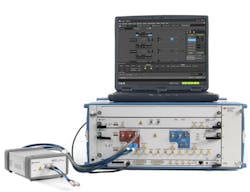
Courtesy of Keysight Technologies
The new BERT features from one to four 16-/32-Gb/s channels with interactive link training and automated in situ calibration. She noted that as the data-center build-out progresses toward 400 Gb/s Ethernet (400GbE), PAM-4 and NRZ will coexist as will electrical and optical interconnects. In addition, support for four to 16 lanes (25GbE, 50GbE, and 200GbE) will be necessary.
The new BERT, she said, will support fast test setups requiring few reconnections, provide repeatable and accurate results, and scale to meet future needs.
Edge device production test
Mike Frazier, senior director, global business development, Xcerra, addresses edge-device production-test requirements in a SEMICON Southeast Asia paper.4 An edge device, he writes, includes a sensor, processing capability, and wireless communication functionality. As a device under test, its stimulus isn’t electronic but rather pressure, inertia, sound, a radar signal, or a chemical (gas). A test handler will need to stimulate the device appropriately, and the tester itself will need to apply transaction-based (protocol-aware) test patterns and be capable of mixed-signal and RF concurrent test capabilities. In addition, high-multisite capability will be necessary to keep test costs low.
Frazier’s comments echo those of Laurie Wright, director of business development at Xcerra, at the March BiTS Workshop. She noted that IoT devices will include memory and, for applications such as automotive, power circuitry. She also emphasized the importance of multisite but noted as well requirements for site-dependent data such as MAC addresses and calibration information.
Anthony Lum, business development manager at Advantest, also at the BiTS Workshop addressed IoT devices, which he divided into three categories: small (personal and medical sensors, for example), medium (cell phones and automotive devices), and large (communications infrastructure and server components). He agreed with Wright that test cost is critical for small devices. Medium devices will have more cores as well as sensors, RF capabilities, and security features. He said scan depths are expected to double every three years. For infrastructure devices, he added, stacked-memory test methods are under development, and it will be necessary to develop optical signaling tests and fixturing.
Conclusion
There will be many twists and turns in the road to a connected future. Writing in Vox, Timothy B. Lee comments that smart-thermostat maker Nest, acquired by Google in 2014, has been struggling. Lee notes that we just don’t interact much with connected lightbulbs, crock pots, and smoke detectors, and “… there is only so much a better thermostat can do to improve our lives.”5
Nevertheless, the onslaught of data—whether it comes from thermostats or not—will continue. Advantest’s Lum commented at BiTS that Internet traffic will exceed 88.4 EB per month in 2016 and double by 2019. “IoT test challenges require IoT-specific solutions,” he concluded. “Many challenges have been solved—some remain. We’re working hard on those.”
References
- Clark, D., “HP Enterprise Joins Internet of Things Platform Wars,” The Wall Street Journal, May 10, 2016.
- “Forecast: Internet of Things—Endpoints and Associated Services, Worldwide, 2015,” Gartner, Oct. 29, 2015.
- Krzanich, B., “Our Strategy and the Future of Intel,” Editorial, Intel, April 26, 2016.
- Frazier, M., “How Internet of Things Will Change Back End Processing,” SEMICON Southeast Asia, April 2016.
- Lee, T. B., “Nest was supposed to lead the next computing revolution. It’s looking like a bust.” Vox, April 7, 2016.
Intel Security report reveals critical need for improved trust to advance cloud adoption
Intel Security has released a global report titled “Blue Skies Ahead? The State of Cloud Adoption.”1 The report is based on a survey, conducted by Vanson Bourne, of 1,200 IT decision makers with influence over their organization’s cloud security in Australia, Brazil, Canada, France, Germany, Australia, Spain, the United Kingdom, and the United States.
The report advocates the need for technology vendors to help businesses, governments, and consumers understand the implications surrounding the growing adoption of the cloud. With a majority (77%) of participants noting that their organizations trust cloud computing more than a year ago, just 13% completely trust public cloud providers to secure sensitive data. These findings highlight improved trust and security and are critical to encouraging continued adoption of the cloud.
Intel Security, which now includes McAfee and its McAfee Global Threat Intelligence service, said the survey underscores the increasing use of the cloud. In the next 16 months, 80% of respondent IT budgets will be dedicated to cloud computing.
Here are some key highlights from the report:
- A majority of organizations—81%—are planning on investing in infrastructure-as-a-service (IaaS), closely followed by security-as-a-service at 79%, platform-as-a-service at 69%, and software-as-a-service (SaaS) at 60%.
- A majority of respondents (72%) list compliance as the primary concern across all types of cloud deployments, and only 13% of respondents noted knowing whether or not their organizations stored sensitive data in the cloud.
- More than one in five respondents said their main concern around using SaaS is having a data security incident, and correspondingly, data breaches were a top concern for IaaS and private clouds. In contrast, results found that less than a quarter (23%) of the enterprises are aware of data breaches with their cloud service providers.
- High-profile data breaches with major financial and reputational consequences have made data security a top-of-mind concern for C-level executives. However, many respondents feel there still is a need for more education and increased awareness and understanding of risks associated with storing sensitive data in the cloud. Only one-third (34%) of respondents feel senior management in their organization fully understands the security implications of the cloud.
- Despite IT departments’ efforts to cull shadow IT activity, 52% of the lines of business still expect IT to secure their unauthorized department-sourced cloud services. This lack of visibility into cloud usage due to shadow IT appears to be causing IT departments concern when it comes to security, with a majority (58%) of respondents to one survey2 noting that shadow IT has a negative impact on their capability to keep cloud services secure.
Cloud security investment varies in priorities across the different types of cloud deployment, with the top security technologies leveraged by respondents being email protection (43%), web protection (41%), antimalware (38%), firewall (37%), encryption and key management (34%), and data loss prevention (31%).
“This is a new era for cloud providers,” said Raj Samani, chief technology officer, Intel Security EMEA, in a press release. “We are at the tipping point of investment and adoption, expanding rapidly as trust in cloud computing and cloud providers grows. As we enter a phase of wide-scale adoption of cloud computing to support critical applications and services, the question of trust within the cloud becomes imperative. This will become integral into realizing the benefits that cloud computing can truly offer.”
“The cloud is the future for businesses, governments, and consumers,” added Jim Reavis, chief executive officer of the Cloud Security Alliance. “Security vendors and cloud providers must arm customers with education and tools and cultivate strong relationships built on trust in order to continue the adoption of cloud computing platforms. Only then can we completely benefit from the advantages of the cloud.” The Cloud Security Alliance is dedicated to defining and raising awareness of best practices to help ensure a secure cloud computing environment.
References
- “Blue Skies Ahead? The State of Cloud Adoption,” Intel Security, April 14, 2016.
- Shackleford, D., “Orchestrating Security in the Cloud,” SANS Institute, InfoSec Reading Room, September 2015.
About the Author

Rick Nelson
Contributing Editor
Rick is currently Contributing Technical Editor. He was Executive Editor for EE in 2011-2018. Previously he served on several publications, including EDN and Vision Systems Design, and has received awards for signed editorials from the American Society of Business Publication Editors. He began as a design engineer at General Electric and Litton Industries and earned a BSEE degree from Penn State.