Programmable splitters offer up to three outputs for signal conditioning

Wixom, MI. Acromag announced that its new uBSP signal splitter/duplicator acts as a carrier for the company’s microBlox line of plug-in signal-conditioning modules to drive two scalable 4- to 20-mA or 0- to 10-V control outputs and an auxiliary 5-V third output from a single input. Users can select from more than ten miniature signal conditioning modules to process inputs from RTDs, thermocouples, and 2-wire transmitters as well as a variety of current, millivolt, or voltage sources. The interchangeable input modules snap into the uBSP carrier, which provides input and output terminal blocks plus a USB port for easy software configuration from a Windows PC or Android mobile device.
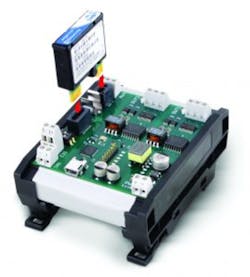
The configuration software is free, and a common mini-B USB port eliminates the need for expensive proprietary cables or adapters to connect with your PC, smartphone, or tablet.
With the plug-in microBlox modules, users can change the input type quickly and inexpensively as requirements change. 1,500-V isolation safely separates the input from each output circuit to prevent damage to other instruments from surges. Two-wire transmitter input modules provide field excitation for the transmitter. RTD input modules support 2, 3, or 4-wire sensors with excitation, linearization, lead-wire compensation, and break-detection functions.
Thermocouple input modules support types J, K, R, S, T, and E with linear or nonlinear output.
To ensure reliable performance, units are highly immune to electrical noise and operate from 40 to 75°C. Power sources from 6 to 32 VDC are supported to simplify battery and solar-powered applications. Units mount securely on a DIN rails with 25g shock and 4g vibration resistance. Hazardous location approvals are pending for UL/cUL Class 1 Div 2 and ATEX/IECex Zone 2 standards.
About the Author
RN (editor)
Comment About the Article
To join the conversation, and become an exclusive member of Electronic Design, create an account today!
 Leaders Logo
Leaders relevant to this article: