Classic Temperature Sensor Stabilizes Photonic Laser Cavity
What you'll learn:
- The detrimental impact of temperature-induced drift in photonic devices.
- How a research team took advantage of a temperature-sensitive structure already in the device.
- The results achieved with their innovative approach and its possible technical and design impact.
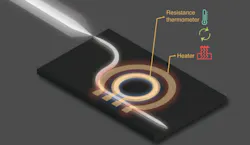
Electro-optical and photonic devices have made great progress in their level of integration and performance. However, they do have one troublesome characteristic (as do their all-electronic counterparts): Their frequency stability is very sensitive to temperature variations and shifts. This is especially challenging when their wavelength (frequency) stability must be maintained to a few nanometers and smaller.
Among the solutions are external optical sensing via probing or the use of a Peltier heater/cooler to maintain temperature consistency, among other techniques. Of course, an integrated, self-stabilizing or drift-cancelling approach would be preferred.
Double-Duty Platinum Resistor
Now, a team at Columbia University has come up with a clever scheme to leverage an already available structure on a photonic device for dual use. For over a decade, many such devices have incorporated a thin film of platinum into their fabricated design. The platinum acts as a resistor — controlling the voltage applied to the resistor changes the resonance wavelength within the photonic structure.
This on-board, thin-film metallic resistor is routinely used to thermally tune photonic devices to the desired resonance frequency. But it can also measure temperature and in turn help “close the loop” for temperature stability. This simple, admittedly somewhat obvious idea, which has apparently been overlooked until now, may eliminate the need for bulky and costly external temperature sensors.
By frequency locking a commercial distributed feedback (DFB) laser to such a cavity, the team demonstrated a crucial component of optical communication networks that require compact light sources. They were able to keep the laser within a picometer of the desired wavelength for over two days.
Resistor Acts as an Integrated Resistance Thermometer
Their approach relied on a thin-film metallic resistor placed directly above the microcavity acting as an integrated resistance thermometer, thus enabling unique mapping of the cavity’s absolute resonance wavelength to the thermometer’s electrical resistance (Fig. 1). (For some reason, the researchers never use the term platinum RTD — resistance temperature detector — a widely used, highly sensitive, and accurate alternative to the thermocouple.)
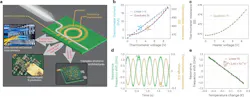
The thin-film platinum resistor was designed to exhibit a strong temperature-dependent electrical resistance. It was used as an integrated resistance thermometer to measure a microcavity’s temperature without the need for any photodetection or other integrated nonlinear electronic elements, such as diodes and transistors.
Due to the low heat capacity and thermal mass of the thin-film resistor, small heat fluxes translate into large and observable changes in its temperature. An important but not-obvious consideration is that platinum’s chemical stability against basic chip-cleaning reagents and atmospheric humidity ensures device longevity and long-term repeatability.
Test Results
A second, nearly identical resistor was used as a heater to perform active stabilization solely employing the platinum resistance thermometer for its data measurement, thereby eliminating the need for optical probing for stabilization. Following a one-time calibration, they were able to accurately and repeatedly tune the microresonator to a desired absolute resonance wavelength using thermometry alone, with a root-mean-squared wavelength error of <0.8 picometers over a time span of days (Fig. 2).
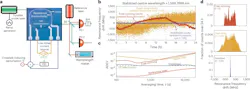
They frequency-locked a DFB laser to the microresonator and demonstrated a 48X reduction in its frequency drift. This resulted in its center wavelength staying within ±0.5 picometers of the mean over a duration of 50 hours in the presence of substantial ambient fluctuations. They maintain that the arrangement outperformed many commercial DFB and wavelength-locked-based laser systems.
The work represents a potentially major step forward in devising more cost-effective, easier-to-use electro-optical photonic devices. Their readable 12-page paper “Frequency-stable nanophotonic microcavities via integrated thermometry,” published in Nature Photonics, provides full details on principle, design, fabrication, methods, and results.
About the Author
 Bill Schweber
Bill Schweber
Contributing Editor
Bill Schweber is an electronics engineer who has written three textbooks on electronic communications systems, as well as hundreds of technical articles, opinion columns, and product features. In past roles, he worked as a technical website manager for multiple topic-specific sites for EE Times, as well as both the Executive Editor and Analog Editor at EDN.
At Analog Devices Inc., Bill was in marketing communications (public relations). As a result, he has been on both sides of the technical PR function, presenting company products, stories, and messages to the media and also as the recipient of these.
Prior to the MarCom role at Analog, Bill was associate editor of their respected technical journal and worked in their product marketing and applications engineering groups. Before those roles, he was at Instron Corp., doing hands-on analog- and power-circuit design and systems integration for materials-testing machine controls.
Bill has an MSEE (Univ. of Mass) and BSEE (Columbia Univ.), is a Registered Professional Engineer, and holds an Advanced Class amateur radio license. He has also planned, written, and presented online courses on a variety of engineering topics, including MOSFET basics, ADC selection, and driving LEDs.
Comment About the Article
To join the conversation, and become an exclusive member of Electronic Design, create an account today!
 Leaders Logo
Leaders relevant to this article: