
Smart-Chassis Systems Leverage Motor-Control, Sensing, and Power-Management Tech
Members can download this article in PDF format.
For more than a century, typical automobiles have employed mechanical linkages, hydraulic fluids, and steel springs for steering, braking, and suspension. Now, though, automakers are increasingly adopting intelligent chassis, in which electrical components replace or augment mechanical ones.
Sponsored Resources:
- The silent upgrade that’s changing how cars move
- Build smarter chassis systems with TI
- How by-wire technology is reshaping chassis design
With steering, for example, a driver still turns a steering wheel. However, electronic sensors capture the driver’s intent, and processors interpret the sensor output and drive motors at the tires to ensure the car moves in the appropriate direction.
X by Wire
According to Mark Ng, director of automotive systems at Texas Instruments, “We’re moving away from the mechanical system into what we call ‘x by wire’: steer by wire, brake by wire, or throttle by wire.”
The transition is happening rapidly. TI cites a forecast from Grand View Research that the x-by-wire systems market will grow from $25.88 billion in 2024 to $57.99 billion by 2030.
The intelligent chassis (Fig. 1) can offer significant benefits with respect to overall vehicle design and operation. Without the need for a mechanical steering column and hydraulic brake lines connecting to the cabin floor, automotive designers can rethink cabin layouts or package batteries more efficiently.
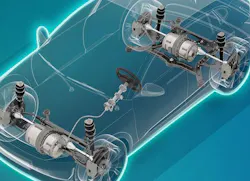
Moreover, the intelligent chassis is able to enhance comfort. For example, a vision sensor can detect a pothole in the vehicle’s path and automatically soften the suspension and recalibrate the damping to provide a smoother ride for drivers and passengers.
Jerry Shi, sector general manager for powertrain and chassis systems at TI, elaborates on the challenges presented by the intelligent chassis: “Unlike traditional mechanical systems, intelligent steering, braking, and suspension functions increasingly rely on sensors, software, power electronics, and real-time control algorithms, requiring designers to balance dynamic performance, system integration, thermal constraints, and compliance with functional safety requirements.”
Of course, functional safety is a critical concern, and the intelligent chassis’ electrical components must be more reliable than the mechanical ones they replace. According to Shi, steering and braking applications are tied to the some of the most stringent safety requirements in the vehicle, often targeting system-level functional safety in accordance with the stringent ISO 26262 ASIL D (Automotive Safety Integrity Level D) standard.
Smart-Chassis Building Blocks
Shi breaks down the intelligent-chassis building blocks into five categories:
- Sensing: This category includes a variety of sensors that provide accurate and reliable measurement of parameters, including position, angle, torque, current, wheel speed, pressure, temperature, and acceleration.
- Computation: Real-time microcontroller units (MCUs) calculate the precise actuator responses based on sensor inputs as well as network data and control commands.
- Actuation: Actuators and their controllers and drivers must offer high power density, superior thermal performance, and extensive diagnostic coverage.
- Power management: Sensors, controllers, drivers, and other components require multiple regulated power rails with complex startup sequencing, requiring power-management ICs, DC-DC converters, and power-protection devices.
- Communications: Controller Area Network (CAN), CAN Flexible Data-Rate (CAN FD), Local Interconnect Network (LIN), and Automotive Ethernet transceivers carry data and commands throughout the vehicle to coordinate intelligent-chassis functions, support diagnostics, and facilitate over-the-air software updates.
Building Intelligent Chassis
TI offers a variety of products that can help optimize comfort, safety, and control in intelligent chassis systems. Available with engineering support and reference designs, these products enable you to optimize your development cycle while complying with ISO 26262 functional-safety requirements. Offerings include sensors and sensor front ends, powertrain and chassis MCUs, brushless DC motor drivers, multichannel power-management ICs (PMICs), and CAN transceivers.
Specific products include the LDC5072-Q1 analog front-end IC for contactless, inductive position sensors targeted at absolute rotary position detection from 0° to 360° in automotive applications. The device eliminates the need for magnets, conferring immunity to stray magnetic fields and lowering system cost. The functional-safety-compliant device offers differential signal paths with sine and cosine outputs.
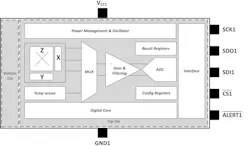
Among other sensing products is the TMAG5170D-Q1 automotive 3D linear Hall-effect dual-die sensor (Fig. 2) with a Serial Peripheral Interface (SPI). It incorporates the on-chip diagnostic features required for reliability in automotive applications, including internal and external fault monitoring. An integrated angle-calculation engine provides full 360° on- and off-axis angle measurements with magnetic gain and offset correction. And an alert feature can generate an interrupt in the event of a functional-safety violation.
In the computation category, TI offers MCUs for powertrain and chassis control, such as the F29H859TU-Q1 automotive C2000 64-bit MCU. The tri-core 200-MHz device includes 4 MB of flash memory and supports designs targeting ISO 26262 functional safety. A variety of evaluation boards, daughtercards, debug probes, and development kits can help you get started with hardware and software design.
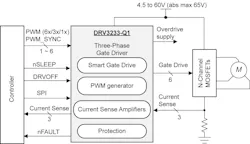
In the actuation category, the company offers the DRV3233-Q1 three-phase gate driver for use in 12- and 24-V brushless DC motor applications (Fig. 3). The unit includes three half-bridge gate drivers, each capable of driving one high-side and one low-side N-channel power MOSFET. The device incorporates low-side current-sense amplifiers to support low-side resistor-based current sensing. Integrated diagnostics and protection features minimize the need for external components.
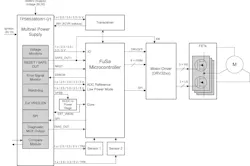
For power management, there’s the TPS653860-Q1 PMIC, which operates from 2.3 to 36 V at 2.8 A. The multi-rail device can power microcontrollers, sensors, transceivers, and peripherals (Fig. 4) and comes with documentation to support system designs targeting ISO 26262 ASIL D functional safety.
Finally, in the communications category, TI has products such as the CAN1473-Q1 low-power CAN FD transceiver. The device implements Signal Improvement Capability (SIC) as defined in the ISO 11898-2:2024 standard. Backward-compatible with classic CAN, it supports CAN FD up to 8 Mb/s.
Conclusion
Mechanical and hydraulic technologies are losing their dominance in automotive applications. As TI’s Ng puts it, “Automakers are using electrical stimulus and electrical intelligence to control chassis functionality.”
The company offers a variety of sensing, processing, actuation, power-management, and communications devices along with evaluation boards and development kits that can speed your way to smart-chassis design success.