Designing and Testing a Home Energy Management System
What you'll learn:
- The functions of a HEMS and where it fits into the broader landscape of distributed energy resources.
- How a HEMS helps reduce costs, optimize electricity consumption, and improve the stability of the electric grid.
- What makes bidirectional HEMS different, and what engineers need to know about testing and certification.
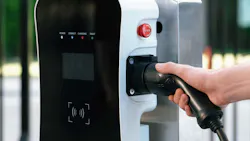
Global electricity consumption is rising fast — up about 4% every year — driven by the surge in electric vehicle (EV) demand and the rapid expansion of power-hungry AI data centers. That growth is pushing existing grid capacity to its limits and further complicating the already slow, complex permitting process for adding new electrical infrastructure to the grid. Meeting these demands at the necessary pace will require substantial, coordinated investments in smarter energy solutions.
While many approaches have been developed to bring new energy resources online, one of the more promising is the home energy management system (HEMS). A HEMS is designed to intelligently coordinate energy among the electric grid, renewables, batteries, and loads such as EVs to improve resilience, reduce costs, and optimize electricity consumption. With bidirectional capabilities, HEMS can operate as distributed energy resources that actively stabilize the grid, while unlocking new value for homeowners and utilities.
Figure 1 illustrates a simplified model of a HEMS. At the center is the home itself, which consumes energy through appliances, heating and cooling systems, lighting, consumer gadgets, and all other electrical loads.
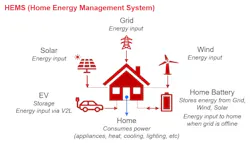
Under normal conditions, the primary energy input to the HEMS is the grid. However, the integration of renewable sources is increasingly common. A home may incorporate solar photovoltaic generation, which provides a one-way energy input. Some homes may also include small wind- generation systems. An EV can also serve as an energy source. Because it contains a sizable onboard battery, it can supply energy back into the home through concepts such as vehicle-to-load (V2L).
Likewise, stationary home batteries can store excess energy — whether from the grid during low-cost periods or from renewable sources — and discharge that energy back into the HEMS when needed, such as during an outage.
The Functions and Benefits of a HEMS
Fundamentally, a HEMS is an energy resource management system for the home. Its key functions include:
- Maintaining home operation during grid outages, functioning similarly to an uninterruptible power supply (UPS).
- Storing excess renewable energy produced by solar or wind systems.
- Leveraging the EV battery as an energy asset, especially during long periods when the vehicle is parked, such as overnight.
- Lowering electricity costs by maximizing the use of renewables and optimizing when grid electricity is consumed.
- Supporting time-of-use (TOU) savings by drawing power from the grid primarily when rates are low and relying on stored or renewable energy during peak-rate periods.
In summary, a modern HEMS not only manages household energy consumption, but also plays an increasingly active role in the broader energy ecosystem. This is particularly the case when bidirectional capabilities allow it to participate in grid-support functions, as described in the following section.
What are the Differences Between Bidirectional and Non-Bidirectional HEMS?
There are two main categories of HEMS. Non-bidirectional systems are designed to only draw energy from the grid. They do not export energy back. As a result, they are not considered distributed energy resources or DERs (for more insight on DERs, see “Modernizing the AC Power Grid for Future Stability”). Since they aren’t DERs, they’re not subject to grid-interconnection requirements, testing, or certification.
>>Download the PDF of this article
 dreamstime_biancoblue_271924633
The second category of HEMS covers bidirectional systems. These can export energy back to the grid when excess power is available, enabling homeowners to potentially earn revenue from their surplus energy. Because they interact directly with the grid, these systems are classified as DERs. As a DER, the bidirectional HEMS must comply with relevant grid codes, certification requirements, and the grid operator’s control and coordination protocols.
When a HEMS supports bidirectional power flow, full grid-interconnection testing is required. Without bidirectional capability, certification isn’t necessary — though functional testing still is requisite. Certification becomes mandatory once a system can export power back to the grid.
HEMS Test Bed Architecture
Figure 2 illustrates the components in a typical HEMS testbed. At the center, shown in the yellow box, is the energy management system itself. The HEMS being tested includes:
- The inverter, functioning as the DER when bidirectional.
- The circuit-breaker panel, handling all AC distribution within the home.
- The utility meter, acting as the interface between the HEMS and the grid.
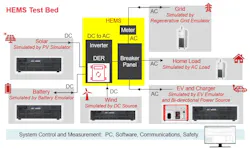
This regenerative capability saves energy during testing and ensures the simulator behaves like an actual grid, with realistic impedance characteristics and grid disturbances. It’s essential for both functional testing and certification testing.
The testbed also simulates the home and all its energy resources:
- AC home load: Represents electricity consumed by loads like appliances, lighting, and HVAC systems.
- EV interface: For bidirectional HEMS, this includes an EV emulator and a battery simulator to support both charging and discharging the EV. When an EV discharges its battery and supplies that power back into the home, this is called vehicle-to-grid (V2G) testing.
- Wind input simulation: Typically provided through a DC source, because the output of a wind turbine is typically DC before it enters the inverter.
- Home battery simulator: Represents stationary home battery storage systems such as the Tesla Powerwall, the LG Energy Solutions RESU series, the Panasonic EVERVOLT Home Battery, and the Generac PWRcell.
- PV simulator: Emulates solar-panel behavior DC output as an input to the inverter.
All components are coordinated by PC-based control and measurement software, supplying overall system management, communication, and safety oversight.
Types of HEMS Testing
A comprehensive HEMS test program typically includes four major categories of testing:
1. Basic engineering (Bench) testing
- Early-stage testing where engineers probe inverter circuitry, measure waveforms, verify expected signals, and confirm proper electrical behavior.
2. Design validation testing
- System-level functional testing to confirm performance against design specifications — for example, verifying efficiency targets or ensuring the inverter shuts down properly under emergency or fault conditions.
3. Cybersecurity testing
- Required for any device connected to the grid. Systems must demonstrate robust protection against communication and control vulnerabilities.
4. Grid interconnection (certification) testing
- The most stringent category, following standardized test methods mandated for DER certification. Certification must be conducted by an NRTL (Nationally Recognized Testing Laboratory) such as TÜV, DEKRA, UL, CSA, or Intertek.
- HEMS manufacturers need to submit their product for formal evaluation and certification. These processes are costly, so passing the first attempt is important. Alternatively, before sending the HEMS to an NRTL, manufacturers can choose to perform pre-compliance testing in-house using their own in-house HEMS testbed.
- Even if the in-house testbed can’t cover 100% of the full certification testing, passing this pre-certification helps to ensure that the HEMS, as a DER, is highly likely to pass formal certification the first time, avoiding repeated and expensive submissions.
Where Do Battery Energy Storage Systems Fit into the Picture?
A battery energy storage system (BESS) is actually very similar to a HEMS. After all, one function of a HEMS is to provide a battery-backup capability to the home. A BESS operates much like a large-scale UPS for a home or building, or even an entire neighborhood in rare cases. The following are the functions of a typical BESS:
- Contains a large battery bank
- May include optional wind or solar inputs
- Charges from the grid
- Supplies AC to residential, commercial, or industrial loads
- Can supply DC to applications such as data centers
- Maintains building operation during outages, effectively forming a microgrid
If power flows only from the grid into the BESS, it’s not classified as a DER. No certification is required. But if it operates bidirectionally, exporting power back to the grid, it must undergo DER certification just like a HEMS.
Utility-scale BESS systems — those owned and operated directly by the grid — are treated differently. These very large systems don’t go through DER certification; they follow separate grid-operator requirements.
Engineering a More Intelligent Electric Grid
Growing global energy demand is driving transformation across the grid. DERs are essential to supporting this transition, and the HEMS is a key category of DER. Grid-interconnection testing involves stringent, standards-based methods to achieve certification. Beyond certification, a HEMS testbed must support:
- Functional testing
- Performance and design-validation testing
- Cybersecurity testing
- Pre-compliance and certification-preparation testing
Doing this requires a sophisticated test environment capable of simulating the grid, the loads within the home, and everything in between. These can include renewable energy sources (such as solar, wind, and more), power converters (such as EV chargers), and battery storage systems.
Similarly, BESS and microgrid systems require comparable testing architectures. As distributed resources continue to scale, these test capabilities become increasingly critical to ensuring safe, reliable, and compliant integration with the evolving smart grid.
>>Download the PDF of this article
dreamstime_biancoblue_271924633About the Author
 Bob Zollo
Bob Zollo
Solution Architect for Battery Testing, Electronic Industrial Solutions Group
Bob Zollo is solution architect for battery testing for energy and automotive solutions in the Electronic Industrial Solutions Group of Keysight Technologies. Bob has been with Keysight since 1984 and holds a degree in electrical engineering from Stevens Institute of Technology, Hoboken, N.J. He can be contacted at [email protected].
Comment About the Article
To join the conversation, and become an exclusive member of Electronic Design, create an account today!
 Leaders Logo
Leaders relevant to this article: