The Real Reason Engineers Default to Copper
What you’ll learn:
- Why copper has dominated weight-sensitive applications despite its density penalty, and how engineers have historically calculated that tradeoff.
- How mass-normalized metrics like specific conductivity and specific strength reveal material tradeoffs obscured by bulk properties.
- Where Galvorn, a commercially available conductive carbon fiber, fits within this comparison and what that means for signal cable, EMI shielding, and flex cable design.
Discussions about conductive materials often begin with whether a new material can match copper’s conductivity. Though it’s relevant if conductivity is the sole concern, in practice it never is the case. In applications such as signal cables for aerospace and defense, EMI shielding in cable assemblies, and high-cycle flex cables in robotics, conductivity is one of several important factors — essential, but not sufficient.
An often-overlooked question is whether copper has been used in applications where its density of 8,960 kg per cubic meter was accepted as an unavoidable cost, simply because no lighter material could meet all required performance criteria. Such applications exist, and mass-normalized metrics provide a clear method to identify them.
Why Bulk Metrics Can Mislead
Copper's bulk conductivity is about 58 million siemens per meter, which is useful for assessing electrical conduction. However, this metric is less relevant when designing aircraft cable assemblies, where weight is closely monitored, or robotics cables that must withstand extensive flex cycles without degrading.
In these cases, it’s more relevant to consider how much conductivity a material provides per kilogram added. Specific conductivity (Sm²/kg) normalizes conductivity by density, while specific strength (mN/tex) does the same for tensile performance. Comparing materials using these metrics yields a different perspective than bulk properties alone.
Copper's specific conductivity is about 6,500 Sm²/kg, and its specific strength is roughly 25 mN/tex. While these are strong values, copper's mass imposes a cost in weight-sensitive applications. The "density tax" refers to the unavoidable weight accepted by penalty engineers when choosing copper, where a lighter, viable alternative would be preferable. In many systems, that penalty isn’t small. It compounds across the entire design.
The Aluminum Question — and It's a Fair One
It’s important to address a common question from engineers evaluating mass-normalized metrics: What about aluminum?
Aluminum's specific conductivity is roughly 14,800 Sm²/kg, more than double that of copper and more than double that of Galvorn. That's a real advantage, and it's not a rounding error. Aluminum is used extensively in power transmission lines precisely because of that advantage, and in those applications, it makes a lot of sense.
However, in signal-cable and EMI-shielding applications, aluminum's higher specific conductivity doesn’t solve all engineering challenges and instead introduces new issues.
While aluminum's specific strength of approximately 115 mN/tex is significantly higher than that of copper, it remains a poor fit for high-cycle flex environments such as robotics cable assemblies, aerospace harnesses, and industrial automation. In these applications, aluminum work hardens and becomes brittle, leading to premature fatigue failure.
Copper remains the preferred conductor for aerospace harnesses not because it’s lighter or stronger per gram — its specific strength is a mere 25 mN/tex — but because of its superior fatigue resistance and ductility. The industry accepts copper's massive "density tax" because aluminum's mechanical reliability is insufficient for dynamic, high-vibration applications.
Aluminum also forms a resistive oxide layer, requiring specialized crimp tooling and bimetallic terminals to prevent galvanic corrosion at joints. In small-gauge signal cables with high termination density, this becomes a practical constraint affecting material usability, not just weight.
Historically, copper has served as the industry standard not because of a single superior attribute, but due to its unique status as the only material providing a functional blend of electrical conductivity and mechanical durability. In practice, aluminum reduces weight in some systems, but it introduces reliability and integration constraints that limit where it can be used.
This is where Galvorn changes the comparison. It matches copper’s specific conductivity while providing a specific strength — 2,161 mN/tex — that’s orders of magnitude higher than both copper and aluminum, without the fatigue vulnerabilities inherent in traditional metals.
Copper remains the default material not because it excels in any single metric, but because it historically was the only material that offered a viable combination of conductivity and mechanical endurance.
What the Scatter Plot Shows
Plotting six representative conductive materials by specific conductivity and specific strength reveals clear distinctions. Copper has a specific conductivity of about 6,500 Sm²/kg and specific strength of 25 mN/tex. Aluminum offers about 14,800 Sm²/kg and 115 mN/tex. Aracon, nickel-coated carbon fiber, and other hybrids provide moderate specific strength but much lower specific conductivity (see figure).
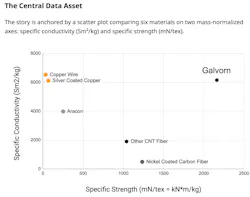
The quadrant representing materials with both high specific conductivity and high specific strength remained empty. That gap explains why engineers have continued to default to copper, even when it carries a significant weight penalty.
Galvorn appears to occupy this space in our testing. Its specific conductivity is about 6,150 Sm²/kg, comparable to copper. Its specific strength is approximately 2,161 mN/tex, about 80X higher than copper and over 19X higher than aluminum in those tests. Its density is 1,600 kg per cubic meter, compared to 8,960 for copper and 2,700 for aluminum.
In signal cable applications, Galvorn can replace copper conductors while maintaining equivalent electrical performance and significantly reducing mass. For EMI shielding, two wraps of Galvorn film can substitute for two copper braid layers, providing equivalent shielding effectiveness at up to 60% less mass. The film construction also offers complete surface coverage, which is especially beneficial at higher frequencies.
High Frequencies: Why This Matters More Now
At high frequencies, copper conductors are affected by the skin effect, which concentrates current in a thin outer layer and reduces the effective conducting area. Carbon-based conductors, such as Galvorn, are less affected, allowing a larger portion of the conductor to participate and improving signal integrity as data transmission speeds increase.
This becomes more relevant as systems move to higher frequencies. AI-ready data centers are designed in blocks of 50 to 150 MW, with copper use estimated at 27 to 33 tonnes per megawatt of installed capacity. A single 100-MW site can require several thousand tonnes of copper, not including upstream grid infrastructure. The cables connecting GPUs in these facilities already operate at frequencies where the skin effect is relevant, and this will become increasingly important with rising data-transfer rates.
As the industry advances toward higher frequencies, conductors that perform better under these conditions become more pertinent as systems scale.
Where are We Now?
Engineers are already under pressure to reduce weight and improve performance. At the same time, copper demand is rising faster than supply, which is starting to show up in cost, timelines, and risk. That combination is forcing earlier evaluation of alternatives.
Galvorn has been produced commercially for several years and is available as fiber, yarn, fabric, and film. Advanced co-development is ongoing with a global wire and cable manufacturer, and technical evaluations are in the works with customers in the aerospace, defense, automotive, and robotics fields.
Third-party, application-specific testing is in progress. Upcoming data is expected to quantify the advantages indicated by mass-normalized comparisons. Efforts are underway to expedite this process, recognizing that engineers need validated data rather than theoretical arguments. Results will be available soon.
Based on current testing and production status, the design space for a conductive material with copper-comparable specific conductivity and high specific strength, available at commercial scale from a domestic source, appears to be open.
Engineers who previously accepted the density tax as a necessary cost for conductivity may now have an alternative to evaluate. While Galvorn's handling characteristics differ from copper, especially at terminations, the tradeoff that made copper the only viable option in weight-sensitive, high-cycle applications no longer applies.
For those designing signal harnesses, EMI shielding, or flex cables for robotics or aerospace, it’s advisable to evaluate materials using mass-normalized metrics. Determine the required conductivity for the application — not the maximum, but the minimum necessary. Consider how recovered weight could be used if a lighter material is chosen.
The question is no longer whether copper works. It does. The question is where the density tax has become large enough to justify qualification of a lighter conductor.
References
S&P Global, "Copper in the Age of AI: Challenges of Electrification," January 2026.
Wood Mackenzie, via Tom's Hardware, "AI data-centre buildout pushes copper toward shortages," December 2025.
WireHarnessProduction.com, "Aerospace Wire Harness Manufacturing: Standards, Materials & Qualification Guide," February 2026.
>>Download the PDF of this article
 dreamstime_demarco_3115290
About the Author
 Dmitri Tsentalovich
Dmitri Tsentalovich
Co-Founder and CTO, DexMat
Dmitri Tsentalovich is co-founder and CTO of DexMat. He holds a PhD from Rice University, where he conducted foundational research on the production of conductive carbon fiber and co-developed the wet-spinning process on which Galvorn is built. DexMat produces Galvorn, a lightweight, flexible, conductive carbon fiber, for wire and cable, aerospace, defense, and industrial applications.
Comment About the Article
To join the conversation, and become an exclusive member of Electronic Design, create an account today!
 Leaders Logo
Leaders relevant to this article: