How to Simplify Your Next Robotics System Design
A robot often replicates actions that would otherwise be performed by a human, which typically includes some form of displacement or rotation to adjust position and orientation. The adoption of more complex robotic systems into the factory environment will lead to its greatest upheaval in decades, one that will stretch the capabilities of more traditional robotic systems to achieve precise, fast, and powerful motion (Fig. 1).
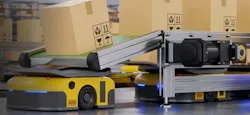
This leaves robotic system designers facing growing design complexity as they strive to meet the demand for robots with higher levels of automation. The embedded processors in these robots need to be more complex, having to analyze and respond to a growing amount of data within the system for capabilities like perception, navigation, and motion control.
Human and Robot Collaboration
Such increased complexity is especially prevalent in robots that closely work with humans such as collaborative robots (cobots), factory robots, and autonomous mobile robots (AMRs). Cobots work side by side with humans to improve quality. A cobot can sense and stop movement, helping to create a safer working environment.
Factory robots perform automated programmable movements in manufacturing. These movements are typically achieved with motors, conveyor belts, or, for modern use cases, they can be as simple as rotating a camera or steering a LiDAR sensor.
By using electrical signals in the right way, your robotic arm won’t just move—it can move with specific speed, positional accuracy, and torque.
Integrating Motor Control
Similarly, motor electronics are migrating from control cabinets to direct integration into robot joints, helping reduce weight, cabling, and system costs. This trend is motivating component manufacturers to develop solutions that enable more feature integration in smaller integrated circuit packages. Space constraints also require higher power density and power efficiency.
From accurate sensing to high-speed perception and real-time control, TI technologies can help designers create the most sophisticated mobile robots for ever-evolving industrial needs. They also reduce design efforts by utilizing multiple built in safety functionalities and system-level safety concepts.
TI’s dedicated engineering expertise in robotic applications, combined with the right product selection for any robot design type, can help accelerate the design process. Among the tools and products available are Arm-based application processors, mmWave radar sensors for industrial communications, and on-demand functional-safety data and documents.
Design Smaller Safe Torque Off Systems
From high-speed motion planning to real-time control and communication, TI technologies make it possible to design energy-efficient, affordable, and functionally safe ISO 10218-complaint robots for harsh industrial environments.
Traditional safety considerations require the strict separation of humans and robotics, typically placing robots in cages. As further automation requires closer collaboration and interaction, collaborative robots help increase productivity but require motors that provide safe stop, safe speed, torque, and motion control.
In that vein, current and future semiconductors for sensing, processing, and real-time control applications need to balance high performance and power efficiency to ensure reasonable battery life and the range of travel possible.
One functional-safety standard, IEC 61800-5-2, defines a safety function called Safe Torque Off (STO). STO is defined as the function preventing force-producing power from being provided to the motor. It’s often the most basic and critical requirement if the system has a requirement to stop the motor safely as well as prevent an unexpected startup.
AI at the Edge
AI at the edge happens when AI algorithms are processed on local devices instead of in the cloud. To operate efficiently in size-, power-, and heat-dissipation-constrained, let alone cost-constrained, environments, edge AI applications require high-speed and low-power processing, along with advanced integration unique to the application.
For example, edge AI systems using vision input can implement a single camera for quality control on a production line, or multiple cameras to help support functional safety in a car or mobile robot.
Conclusion
The next generation of industrial mobile robots are required to become more intelligent and autonomous, while allowing for safe interaction and collaboration with humans.
Analog and embedded technologies and reference designs from Texas Instruments can help engineers develop intelligent, autonomous, and collaborative robots. What’s more, these technologies enable numerous types of industrial robots to be built with precise motor control, differentiated sensing capabilities, and processing at the edge, all with robust real-time communication.