Wrapping Up CES 2026
What you’ll learn:
- What was going on behind the scenes at CES 2026?
- The underlying tone of the show.
- Popular themes and technology at CES.
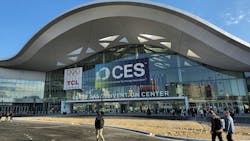
The 2026 Consumer Electronics Show (CES) at the Las Vegas Convention Center (LVCC) is fading into the past, but its impact continues to grow. This is my take on this year’s CES, albeit one that probably differs from what you’ll see in the popular press. The press focused more on what dominated the show floor for consumers, while we ventured toward what was happening behind closed doors where the latest tech was on display.
Efficient Computer’s Electron E1 continues to be the most interesting thing at this year’s CES, although few walking by the booth would even realize its impact (Fig. 1). The processor’s dataflow architecture is hidden. As a result, developers can program it using conventional languages like C and C++ while gaining performance and using significantly less power than even today’s ultra-low-power microcontrollers.
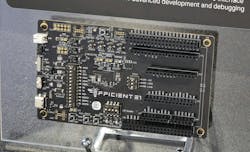
What follows is an abbreviated look at things I saw at this year’s show. Lots of this and more will soon appear on video, so stay tuned for that. In the meantime, here are some technical tidbits.
Table of Contents
- General Observations of CES 2026
- Physical AI and Robots at CES 2026
- CES Augments Your Reality
- Transportation at CES
- AI @ CES 2026
- Modules and Other Miscellaneous Stuff
General Observations of CES 2026
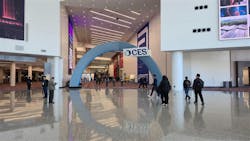
CES seemed a bit sparse at times (Fig. 2), although the numbers were up with 148,000 attendees and over 4,100 exhibitors, including 1,200 startups. One reason for a little less density on the floor was a larger number of meeting rooms, where we got to see companies take the wraps off their latest technology, from gallium nitride (GaN) to electric bikes.
I still haven’t seen a good reason for Musk’s Vegas Loop given the limited throughput compared to other cheaper, more effective autonomous alternatives. The Loop was all underground but no more. For some reason, it came to the surface (Fig. 3). Not sure why, since there’s an underground station at the LVCC Central Station.

It may relate to the changes in front of the central hall, where buses used to move people to other venues like the Venetian. Nonetheless, walking outside is easier and overall the new front end to the central hall matches the West Hall, so it’s brighter and airier. A definite improvement.
Though the overall show was upbeat, there was a definite undercurrent that was rarely spoken about directly given the changes in the United States and around the world, from tariffs to conflicts to ICE making a mess in certain states. There wasn’t an ICE agent in our midst even with a plethora of overseas visitors. More on the other ICE, the internal combustion engine, or the lack thereof, later.
Physical AI and Robots at CES 2026
The latest CES hype for 2026 was physical AI. It remains in its infancy. However, it’s rapidly improving not just because of artificial intelligence (AI), but also the underlying hardware and software. Most companies had multiple products in this space.
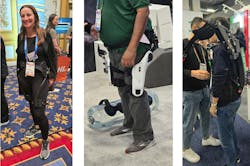
A lot of exoskeletons were on display at the show this year (Fig. 4). They ranged from the outdoor exoskeleton from Hypershell to ULS Robotics’ industrial and personal exoskeletons. The Agade arms assist in lifting objects. Hypershell’s exoskeletons target consumers, while the others skew more toward more industrial settings.
But back to the humanoid robots (Fig. 5). There was no lack of this form of physical AI, which seems like such a dumb term. I guess humanoid robot doesn’t make the cut. Anyway, UniX AI was showing off its collection, including a robot arm with 8 degrees of freedom (DoF).
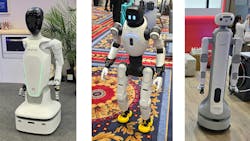
AGIBOT’s robots were more what many might consider physical AI specimens, as they replicate the human form and capabilities with limits. They were dancing, prancing, and interacting with people and other robots, although under the eye of their human counterparts.
>>Check out more of our 2026 CES coverage
 CES at Las Vegas Convention Center West Hall
SwitchBot Onero H1 is typical of a deployment where feet aren’t needed and rolling stock makes more sense. It also tends to be more power-efficient if that type of movement is less frequent and flat surfaces, as in an office or home, are the norm.
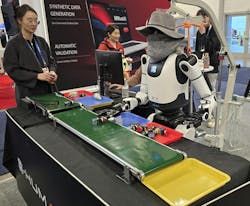
Humanoid or humanoid-like physical AI incarnations were all over CES, demonstrating functions like recognizing and moving items presented on an assembly line (Fig. 6).
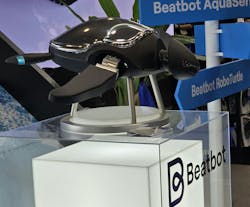
There were plenty of specialized robots like Beatbot’s Amphibious RoboTurtle, which was also swimming around in a tiny tank (Fig. 7). It’s a limited edition and designed for prototyping. It also works on land, although its turtle-like gait will not keep up with some of the robot dogs that were hopping around CES.
CES Augments Your Reality
Augmented- and virtual-reality (AR/VR) glasses were everywhere. However, there was an uptick for AR following on last year’s push by Meta and Ray-Ban with the Ray-Ban Meta AR glasses. They now have a version that project an image in front of the right eye with the Meta Ray-Ban Display.
The glasses target the consumer while platforms like Lenovo’s ThinkReality A3 provide more capability at a higher cost for enterprise and industrial use. These tend to get less press but are more impressive because of the hardware and software involved.
The XReal 1S (Fig. 8) is the latest from XReal. It utilizes the X1 spatial computing chip, allowing the system to deliver 3-ms motion-to-photon latency. XReal also kicked up the resolution to 1200p with a 120-Hz refresh rate. The increase of field of view (FOV) to 52 degrees isn’t a big change but noticeable and worthwhile. The birdbath lens technology and bright LEDs provide a peak brightness of 700 nits.
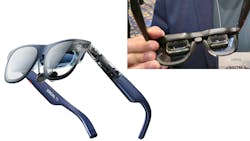
A Closer Look at the XReal 1S
Color and brightness were part of AMS OSRAM’s RGGB (red, green, green, blue) VEGALED announcement. The glasses, designed for AR, are brighter in the green spectrum where the eye is sensitive, too. Also, a few AR glasses are using green text, which tends to be easy on the eye.
Transportation at CES
Electric-vehicle support in the U.S. has gone into the toilet and it was partially reflected at CES, despite the fact it was really where the major innovation was for vehicles.
One that stood out was Simko’s S‑drive system that puts electric propulsion inside the tire’s hub (Fig. 9). The 19‑in. wheels incorporate an axial‑flux motor along with the braking system, suspension mount, and steering interface. The modular assembly improves construction and repair mechanics.
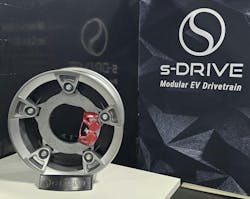
Simko's In-Wheel Drive for EVs
The S‑drive achieves over 95% peak efficiency. It does so by removing gear reduction losses, extra bearings, and shafts. The 200-kW axial‑flux motor provides 600 N·m of regenerative-braking torque. The brake rotor and caliper system, developed in-house, makes the entire system 3X lighter than a comparable unit. The electric drive can deliver a power density exceeding 3 kW/kg. The only rotating elements in the drive package are the brake disc, motor rotor, and the wheel rim itself.
Sony and Honda partnered to create the Afeela (Fig. 10). The electric car employs an all-wheel-drive powertrain. The wheels are powered by a pair of 180-kW electric motors. Total horsepower is 483.
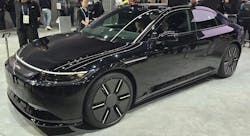
The car incorporates over 40 sensors, including cameras, LiDAR, radar, and ultrasonic sensors. Most are employed in the advanced driver-assistance system (ADAS).
Different battery pack options are available with Afeela. The 91-kWh lithium-ion battery pack can be recharged at 150-kW DC fast charging stations. The estimated maximum range is 300 miles.
Of course, Sony had a major hand in developing the interior and user interface, delivering audiophile-quality sound. The nav system’s map does 3D renderings on the screen that spans the dash. Drivers can also adjust the in-cabin themed wallpaper and lighting.
AI @ CES 2026
There was no shortage of AI hype, hardware, and software at CES. Most of the AI on the floor hid the AI support within products, while in the backrooms we saw the underlying hardware and software.
BrainChip showed off its array of Akida-based spiking-neural-network (SSN) AI accelerators, including a compact M.2 module (Fig. 11). The initial version incorporated the AKD1000-ES chip, while the latest M.2 module employs the new AKD1500 co-processor that delivers 800 GOPS at 1 mW/GOPS. The system integrates 1 MB of on-chip memory along with conversion support in hardware. The chip can be controlled using SPI or PCI Express Gen 2 or later. It can handle advanced video models and the software tools support TensorFlow/Keras and PyTorch.
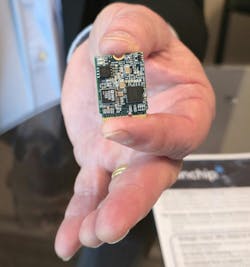
Modules and Other Miscellaneous Stuff
As noted, a lot of our meetings were behind closed doors.
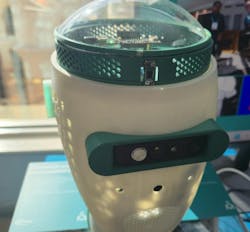
Infineon highlighted its range of microcontrollers and sensors with a robot tracking demo (Fig. 12). One I wanted to highlight is the 32-bit PSOC that has configurable hardware. The Arm Cortex cores range from the Cortex-M0 through the Cortex-M55 that supports machine learning in hardware. Time-of-flight (ToF) sensors let the robot track people, adjusting the head to face people.
Digi displayed its wireless and processor modules, including the Digi system-on-module (SOM) ConnectCore 93 and 95 based on NXP’s i.MX 93 and 95 series (Fig. 13). The i.MX95 adds AI and machine-learning (ML) support via NXP’s XP eIQ Neutron neural processing unit (NPU). The module comes in a 40- × 45-mm, Digi SMTplus form factor. It can also be found on the company’s SMARC 2.2 pluggable form factor. Digi’s Embedded Yocto Linux support handles these as well as other ConnectCore modules.
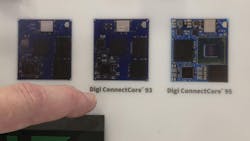
The tri-band radio subsystem supports 802.11ax Wi-Fi 6E and Bluetooth 5 and it integrates with Digi’s XBee cellular modems. The SOM can connect to the ConnectCore Cloud Services.
Eureka Park is found in the basement of the Venetian convention center, and it’s where startups go to highlight their wares at CES. I found a number of promising technologies on display there, including one from Atym.
Atym is delivering a container solution for the Zephyr RTOS (Fig. 14). Zephyr has found a home in mobile edge computing running microcontrollers. Containers are common on higher-end operating systems like Linux and Windows that have memory protection.
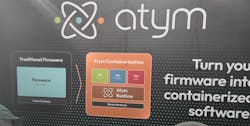
Atym employs WebAssembly to provide a sandbox environment in Zephyr. This allows containers to be used on systems with as little as 256 kB of memory. WebAssembly supports languages like C and Rust.
That’s it for now. This is why it takes me so long to get all the details up on the site, because I spent all my time talking, recording, and searching for the latest tech at CES. Many of the items mentioned here will appear on Electronic Design with more details and videos
>>Check out more of our 2026 CES coverage
CES at Las Vegas Convention Center West HallAbout the Author
 William G. Wong
William G. Wong
Senior Content Director - Electronic Design and Microwaves & RF
I am Editor of Electronic Design focusing on embedded, software, and systems. As Senior Content Director, I also manage Microwaves & RF and I work with a great team of editors to provide engineers, programmers, developers and technical managers with interesting and useful articles and videos on a regular basis. Check out our free newsletters to see the latest content.
You can send press releases for new products for possible coverage on the website. I am also interested in receiving contributed articles for publishing on our website. Use our template and send to me along with a signed release form.
Check out my blog, AltEmbedded on Electronic Design, as well as his latest articles on this site that are listed below.
You can visit my social media via these links:
- AltEmbedded on Electronic Design
- Bill Wong on Facebook
- @AltEmbedded on Twitter
- Bill Wong on LinkedIn
I earned a Bachelor of Electrical Engineering at the Georgia Institute of Technology and a Masters in Computer Science from Rutgers University. I still do a bit of programming using everything from C and C++ to Rust and Ada/SPARK. I do a bit of PHP programming for Drupal websites. I have posted a few Drupal modules.
I still get a hand on software and electronic hardware. Some of this can be found on our Kit Close-Up video series. You can also see me on many of our TechXchange Talk videos. I am interested in a range of projects from robotics to artificial intelligence.
Comment About the Article
To join the conversation, and become an exclusive member of Electronic Design, create an account today!
 Leaders Logo
Leaders relevant to this article: