Engineer Watching TV: Pompeii — Out of Time with Tom Hiddleston
What you'll learn:
- What really happed at Pompeii?
- How the NatGeo team made this production possible.
- Why I think you should see this documentary series.
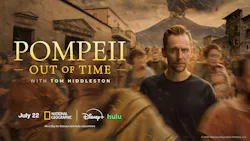
The concept of digital twins has always fascinated me. Analysis and experimentation on a virtual replica with realistic results is the dream of all engineering. What if a digital twin can show you what happened in world-changing events in history?
That's essentially what Pompeii: Out of Time with Tom Hiddleston attempts to do. Tom narrates a story walking through the ruins of Pompeii today, and they recreate it both digitally and practically, following three people who actually were there on the day of the eruption. The stepping in and out of both time frames really gave me that digital-twin vibe. Personally, my mind was racing at what could be possible in recreating the past.
The formula of the show is a winner. Tom steps in and out of Pompeii through time. He speaks with scientific experts to figure out a specific aspect of the event, and bring it all together for his narrative. He's a bit like a ringleader, making sure the scientists and experts from vastly different practices dovetail with technology to prove, one way or the other, what exactly happened that day and time.
There hasn't been a "good" disaster film in theatres in a long time, and this documentary was one on par with anything before. I would say the cinematography and energy were comparable to films like The Day After Tomorrow, 2012, Deep Impact, or even more recently, Greenland.
For a documentary, I was surprised how much I cared for the three focal characters. A testament to their acting, I suppose. Tom, of course, is also an actor on the show. He acts almost like a bridge between the actors recreating the day and the science that explains everything.
I loved how, as the story progressed, you can see the background and environment getting worse. It's shocking to see a scientifically accurate eruption of that day. It's utterly brutal. Honestly, what would you do there? You'll ask yourself that as you can practically feel the grit on your face, as the story progresses on screen.
Not only were the visuals excellent, but I was really struck by the quality of the sound. I could feel it in my core as disaster filled the screen.
It was fun and emotional. I loved it. Maybe I'm just starved for a good disaster film, or maybe this documentary is just that good.
I guarantee you these:
- You don't know how the eruption really happened.
- You didn't know how the world, at the time, responded to this event.
- You didn't know how people's lives back then were so close to what they are today.
I rate Pompeii: Out of Time with Tom Hiddleston a 5.00 out of 5.00 documentary. See it.
I could watch anything narrated by Tom Hiddleston. I was able to talk with the documentary's executive producer, Kevin Wright. One of the first questions I asked was, "I would love to see more of Tom Hiddleston as a 'ringleader' going over other events like this. Could there be more someday — like, fill in the blank with Tom Hiddleston?"
Kevin Wright: That would depend partly on how audiences respond. The format reflects something that is increasingly important in archaeology: combining information from several disciplines to fill gaps in the historical record.
Tom can begin telling one version of a story, have an expert explain that something may not have happened that way, and then revisit or reconstruct it. That approach reflects the fact that history is a living document that is continually being revised as new evidence emerges. There is potentially an exciting way to continue using that storytelling format.
The following is the rest of our interview. But be warned: There are huge spoilers about what happens in the documentary. Yes, we all know what happened that day, but what we talk about are major points of the plot of the narrative. Catch Pompeii: Out of Time with Tom Hiddleston on July 22, 2026 on Disney+. Afterward, come back here and read the rest.
Major spoilers. Really, watch it first. Please.
You were warned.
How did the project begin? Did it really start because Tom Hiddleston was interested in making a series about Pompeii?
Kevin Wright: Completely. The story told in the series is true: Tom visited Pompeii when he was 17. There is a real line from that visit to his acting career because it led him to fall in love with the classics, study them at university, and become involved in drama. Pompeii has never been far from his mind, and it even appeared as a reference in Loki (The Marvel TV Series, Season 1). It was something he had always wanted to do.
National Geographic had already made numerous Pompeii documentaries, so the challenge was finding an exciting and different approach. Tom's passion was palpable, and our task was to capture that passion and transmit it to an audience.
When the volcanic plumes went up and came down wave after wave, was that really a nonstop event? I had thought it was a singular boom and then people recovered.
That was one of the main ideas we wanted to explore. Many people know only the basic story that Pompeii was wiped out by a volcano and that people were preserved in stone. In reality, it was roughly a 24-hour event, with pyroclastic surges arriving in waves. Scientists and archaeologists can track what happened with remarkable precision, almost minute by minute.
Herculaneum, on the other side of the bay, was struck first, so people in Pompeii may have watched the disaster unfold across the water and realized they also had to escape. Understanding the timing reframes the event completely.
You focused on three people who lived at the time, and only one survived at the end. Was that intentional, considering that thousands of people apparently survived?
There are many documentaries and series about Pompeii, so we first asked what we could bring to the table. We used a traditional writers' room and considered a number of known survivors and other documented stories. We chose people whose stories had a beginning, middle, and end that we felt confident we could track.
We also looked for the most compelling mix of stories. Some felt like disaster stories, while others felt like redemption stories. We wanted stories that complemented one another and could be intercut. But this only scratches the surface. There are countless other stories that could be told, including some we would be excited to explore.
Could there be more stories or future projects about Pompeii?
Pompeii is still an active archaeological site, and new discoveries are being made all the time. Some discoveries were even occurring while the production was underway.
The team was especially excited by the storytelling format it developed: interweaving the past and present, documentary material, and dramatic reconstruction. It felt as though the production had discovered a promising way of telling these kinds of historical stories.
Why was it important to spend so much time with the characters before the eruption?
Tom Hiddleston emphasized early on that the story may be 2,000 years old, but the audience still needs to connect emotionally with the people involved.
Visiting Pompeii helps compress that distance because visitors can stand inside someone's preserved kitchen and see bread that was left in an oven. The production wanted viewers to get to know the characters before the volcano erupted so they would be emotionally invested when the disaster began.
Was there a larger humanitarian response after the eruption?
Yes. There was a significant humanitarian effort afterward, including attempts to relocate and rehouse displaced people.
The series did not want to emphasize modern parallels too heavily, but by connecting viewers with the people in the story, it hoped audiences would recognize familiar human experiences: searching for family members, making life-or-death decisions, and trying to survive a disaster. Similar situations continue to occur around the world today.
(Expressing my lack of knowledge of the time period, but I was curious) How close to the end of the Roman Empire was the Pompeii eruption?
There are better-qualified people to answer that precisely. It occurred during a very turbulent period of the Roman Empire, around the era of the Year of the Four Emperors. Rome still functioned at a high level for a considerable time afterward, however, and it was able to pull together resources to rehouse displaced people and move them to other places.
What new technology or filming techniques were used? Did the production use artificial intelligence, drones, or other tools?
One of the primary goals was to create match cuts between ancient Pompeii and the surviving site in the present day.
The production photographed the ruins extensively, collected drone footage, and created three-dimensional scans of streets and structures. That information was then taken to Malta, where the production designer reconstructed sections of Pompeii at scale.
The process combined newer technologies with traditional filmmaking techniques. Storyboard artists carefully designed the transitions, and the production matched camera positions between the reconstructed sets and the modern archaeological site.
Do you know what scanning technology was used? Was it LiDAR?
It was a version of LiDAR… the scans were used to build the sets to scale and position the cameras so the reconstructed streets would align with the modern ruins.
How did the sound and visual-effects work help make the disaster feel so real?
The production placed a great deal of importance on small details because those details make an experience feel real.
Sound design, visual effects, and the practical environments were all used to reduce the psychological distance between the audience and an event that occurred 2,000 years ago. The goal was to place viewers inside the terrifying conditions in which people had to make life-or-death decisions.
(Again expressing my lack of Pompeii knowledge) Could Vesuvius erupt again? Are earthquakes still common and constantly happening in the area?
Vesuvius is still an active volcano, and earthquakes continue to occur. Earthquakes were also part of everyday life in ancient Pompeii, so they would not necessarily have been interpreted as a warning. The city was still being rebuilt from an earthquake about a decade earlier when the eruption occurred.
For some people, including someone in Julia Felix's position, the earlier earthquake may even have created economic opportunities because displaced residents needed places to stay. Earthquakes were a way of life then, as they remain in the region now.
This isn't the first time we covered media and reseach in Pompeii.
Take a look as these for even more historical talk:
About the Author
 Cabe Atwell
Cabe Atwell
Technology Editor, Electronic Design
Cabe is a Technology Editor for Electronic Design.
Engineer, Machinist, Cartoonist, Maker, Writer. A graduate Electrical Engineer actively plying his expertise in the industry and at his company, Gunhead. When not designing/building, he creates a steady torrent of projects and content in the media world. Many of his projects and articles are online at element14 & SolidSmack, industry-focused work at EETimes & EDN, and offbeat articles at Make Magazine. Currently, you can find him hosting webinars and contributing to Electronic Design and Machine Design.
Cabe is an electrical engineer, design consultant and author with 25 years’ experience. His most recent book is “Essential 555 IC: Design, Configure, and Create Clever Circuits”
Cabe writes the Engineering Life & Engineering on Friday blog on Electronic Design.
See Cabe's cartoons & comic strips here.
Comment About the Article
To join the conversation, and become an exclusive member of Electronic Design, create an account today!
 Leaders Logo
Leaders relevant to this article: