Custom Robotics Capture New Animals and Behavior on Earth’s Wild Home
What you'll learn:
- What new ground has been broken on this documentary series.
- How they captured such rarities and never before seen footage.
- The camera system used to capture dwarf crocodile hunting behavior.
The first nature documentary shows started in the 1950s. James Fisher’s Birds in Britain (1951), David Attenborough’s Zoo Quest (1954) and the BBC’s Natural History Unit (1957) landed with resounding success, fueling decades of programming.
75 years later, you’d think a nature show would be out of anything new to film, or used every way possible to film nature. NatGeo’s new Africa: Earth’s Wild Home series debuting October 2nd is packed with new ground. Never before seen animal and behaviors were captured, and some using brand new technology used in a televised nature show.
Drones give us new views and take us where it isn’t easy to tread. Animal tracking electronics help locate animals and reveal their movements, range, and families. A spider makes an 800-foot-long web in three hours. Tortoises that hunt and eat meat, filmed for the first time. Life in the cleanest water in the world. Insect moisture farming. Every episode is packed with something new.
I was particularly interested in how they filmed the dwarf crocodiles in the pitch-black caves of Gabon. I was able to talk with one documentary filmmaker from the series Lil Todd Jones about how she was able to capture new behavior. No one has ever seen these crocs hunt, until now.
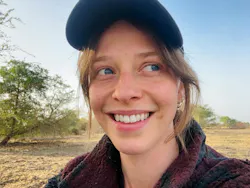
Lil: … the cave crocs shoot that I directed was all very new.
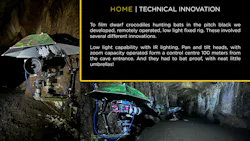
I mean, we were using off-the-shelf cameras, which are called Z Cams, but they were adapted so that they could record infrared, which meant that we could set infrared lights up in the cave and see what was happening. But to the animals in there, it still looked pitch black.
And we also had each camera on its own bespoke little remote head, covered by an umbrella to stop it being covered in bat poo.
And we fed all of the cables up to a shack in the jungle above so that we could monitor everything.
So, that was kind of a new setup to be able to record what was going on in the cave without disturbing any of the wildlife, because everything in there was very shy. So we needed to make sure we could capture it without being in there.
Cabe: Oh, yeah. I did notice that. That was a fun sequence.
How long was that shoot, just out of curiosity? How long did you guys wait to get that footage? I don’t know if it came through in the video.
Lil: Oh, it was a while.
I mean, it’s sleepless nights, not only because we were doing shift work, but for me as a director, you know, you’re worrying: Are we going to get the thing that we would like?
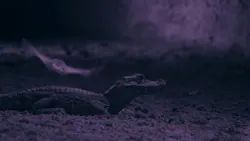
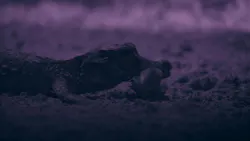
We wanted to see them hunting. We knew they had to be eating something in there, but we weren’t sure if we were going to come home with the goods.
But finally, yeah, it was after — I think it says in the making-of — but it was after quite a long time of having people monitoring those feeds day and night that we finally saw the crocs getting a bat.
Cabe: Those robotic heads, were they something you guys developed, or was it, like, an off-the-shelf product of some sort?
Lil: Yeah, they were developed by us. Yeah.
You know, it’s pretty simple — simple when you know how — motors. The sort of theory of it is quite basic.
But we just wanted something small that we could carry into the cave and set up, and then have control over our cameras, basically.
…So, you could do pan, tilt.
You can’t tilt it up too far because of the weight of it. They would get stuck up, and we couldn’t go back in there to sort them out. So, you had to be quite careful. But, yeah, to give us the ability to follow action.
Cabe: I did notice it was very compact, very small. I saw you guys were mounting it, like, underneath rocks. It looked like — I don’t know if it was wall-mounted in some spots?
Lil: Yeah, we basically took tree mounts and we adapted those so that we could screw them into the cave wall.
And the cameras — basically, you need to be at eye level with your animal to really feel like it’s immersive, like it’s a character that you can connect with. But the dwarf crocodiles are small.
So it was, like, quite a trick to get the cameras low enough, you know, when the cave floor is, you know, deep in bat poo.
Cabe: Before we go… Was there anything challenging, extremely challenging, about the show that maybe wasn’t talked about, that you all overcame? That wasn’t in the show?
Lil: I’ve done a lot of jungle shoots, and for me, it’s — everyone works so hard, and you often have to be up at all times of day.
And all the time, there are just so many bugs trying to bite you. And everyone has to just develop this sense of Zen to not completely lose their minds, because it’s itchy and they won’t stop.
But it’s kind of part of being in these extraordinary environments. Like, I see it as, yeah, giving my pound of flesh for getting the privilege of being able to go to these places.
Cabe: Okay. Do you just kind of give up? You’re like, “All right, bugs, take me away,” or are you swatting them around or something?
Lil: Yeah. I mean, you wear long clothes, but they bite through them.
Cabe: Oh my God.
Lil: And the sweat bees will just, like, yeah, be all over you. [And] that’s happening behind the camera as well.

After talking with her, I couldn’t help but imagine the difficulty shooting shows like this. Working in extreme environments is something we’re all familiar with. I’ve worked in extreme heat, cold, heights… but swarmed by bugs is a new one.
A friend of mine was installing antennas on skyscrapers in Chicago. He told me about being swarmed by spiders. I didn’t want to believe him. I suppose science and engineering faces all sorts of extremes.
That said, check out NatGeo’s Africa: Earth’s Wild Home starting October 2, 2026.
About the Author
 Cabe Atwell
Cabe Atwell
Technology Editor, Electronic Design
Cabe is a Technology Editor for Electronic Design.
Engineer, Machinist, Cartoonist, Maker, Writer. A graduate Electrical Engineer actively plying his expertise in the industry and at his company, Gunhead. When not designing/building, he creates a steady torrent of projects and content in the media world. Many of his projects and articles are online at element14 & SolidSmack, industry-focused work at EETimes & EDN, and offbeat articles at Make Magazine. Currently, you can find him hosting webinars and contributing to Electronic Design and Machine Design.
Cabe is an electrical engineer, design consultant and author with 25 years’ experience. His most recent book is “Essential 555 IC: Design, Configure, and Create Clever Circuits”
Cabe writes the Engineering Life & Engineering on Friday blog on Electronic Design.
See Cabe's cartoons & comic strips here.
Comment About the Article
To join the conversation, and become an exclusive member of Electronic Design, create an account today!
 Leaders Logo
Leaders relevant to this article: