GM’s EV Blunder Will Cost Taxpayers $477B

I'm old enough to remember the smog in the Los Angeles basin, to have flown in airliners where the "smoking section" started one seat behind me (it was just a placard on regular seats, no partition to speak of), and when we stood on the floor of the back-seat area of our family car as dad hit a patch of ice and booped an oncoming car. Yes, we survived it all, but regulations were put in place over all of these decades to benefit our SOCIETY in terms of clean air to breathe, safety, and toward Americans making it to at least my age.
You needn’t have circled the sun as many times as I have to remember the choking smog in Beijing a bit over a decade ago (the lede image for this article is from those times there). So thick, “Don't Wok[sic]" signs on the other side of a pedestrian crossing would be barely visible, and pretty much everyone masked up to go outside.
The Chinese people suffered and their government acted, to benefit their SOCIETY, in first creating the infrastructure and then developing the technologies (battery, wind, solar, EV, high-speed rail) that would clean the air up for everyone a decade later — they’re not going back.
You see, using the atmosphere, one that SOCIETY relies on for life and health, as a zero-cost sewer to dispose of industrial or transportation waste products ain't cool. Heck, even burning agricultural slash as far away as Chiang Mai chokes Bangkok annually with world-leading particulate readings. We also have forestry slash burns here on the West Coast, but the lumber industry is somehow sacred.
Everyone assumes the small scale of population that you see in my Inventors cartoon series, below — a half-dozen people don't do a whole lot to impact on a planetary scale. But with 10 billion people these days, and massive-scale drilling, mining, and refining of fossil fuels, we're seeing hundreds of millions of years’ worth of solar energy stored in molecular bonds being released in a couple of hundred years. The combusted, busted up, and remixed molecules produce IR-absorbing CO2. Even worse, though, are nitrogen compounds acting as precursors to the formation of highly reactive ozone, which makes...smog.
The U.S. took a two-pronged approach, with California embracing even cleaner emission specs in that same strategy, because of where they were in the 1970s: Reduce emissions from each kg of fossil fuels burned, and reduce the amount of fuel burned per unit distance by light cars and trucks.
Now, the Super Intelligence in Washington, DC has rolled back the clock, forcing a higher consumption rate of fossil fuels, and declared, with the backing of 3% of scientists that high-CO2 is somehow natural and that fleet average fuel economy can get rolled back a decade. It’s much to the glee of don't-give-a-φµ©κ corporations like General Motors — you know, the American auto company that said, in 2021, that it would be 100% electric by 2035.
A Chronological Post-Mortem of Detroit’s Electrification Retreat
The September 28, 2026, finalization of the federal Corporate Average Fuel Economy (CAFE) rollback by the Department of Transportation, which slashed the 2031 fleetwide milestone target from 50.4 mpg down to 34.9 mpg, marks the conclusion of an era of unprecedented industrial volatility. Ostensibly framed by legacy automotive executives as a victory for "market pragmatism," an objective chronological audit reveals a far more complex reality.
The ensuing timeline details how short-term asset management, intense political lobbying, and severe strategic execution failures collectively transformed a highly publicized technological transition into an existential corporate retreat. We all lived through these times, but we’re all too busy to put the pieces together. So, I will do it for you...
Phase I: The Compliance Era and the 2035 Pledge (2016-2021)
The modern era of Detroit’s electrification strategy began not as an organic response to market demand, but as a regulatory defense mechanism. In 2016, General Motors (GM) launched the Chevrolet Bolt EV. From an engineering standpoint, the Bolt was a classic compliance car: An affordable sub-compact hatchback engineered primarily to satisfy California’s Zero-Emission Vehicle (ZEV) mandates and to offset the corporate fuel economy penalties incurred by GM’s highly lucrative, full-size internal combustion engine (ICE) pickup and SUV lines.
By 2020, however, the macroeconomic variables governing battery manufacturing appeared to undergo a structural shift. Raw lithium-carbonate prices were trending downward globally, and manufacturing efficiencies were accelerating. In early 2021, GM executive management made a major public disclosure. Through its Ultium Cells joint venture with LG Energy Solution, the company was on a clear trajectory to break the elusive $100/kWh pack-level cost barrier.
Emboldened by these projected battery economics, GM CEO Mary Barra made a historic announcement in January 2021: General Motors was formally committing to an all-electric light-duty lineup by 2035.
Months later, Ford Motor Company followed suit, with CEO Jim Farley aggressively splitting Ford’s corporate structure into "Model e" (EVs) and "Ford Blue" (ICE), aiming for a 50% global EV sales mix by 2030. Detroit’s leadership signaled to Wall Street that the era of internal combustion was rapidly drawing to a close.
Phase II: The Great Li – A Speculator Bubble and Executive Panic (2022-2023)
The operational foundation of this 2035 target rested on a fundamental assumption of stable commodity pricing. That stability evaporated in 2022. As global automakers rushed to secure raw mineral allocations, Wall Street futures speculators hyper-focused on the physical time lag required to permit and operationalize new extraction sites, while every automotive OEM positioned to meet that cost parity point for EV/ICE in 2026.
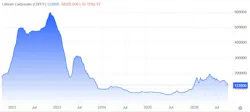
A speculative bubble quickly formed, driving lithium-carbonate futures up to an astronomical, detached-from-reality peak exceeding $80,000 per metric ton in late 2022 (Fig. 1).
In an attempt to secure its supply chain against this perceived bottleneck, GM took the unprecedented step of investing $650 million to purchase an equity stake in Lithium Americas, gaining direct access to the Thacker Pass mining project in Nevada's McDermitt Caldera.
Despite securing these long-term mineral access rights, the prolonged pricing spike triggered acute panic inside Detroit boardrooms. Rather than deploying standard long-term commodity hedging strategies or recognizing that lithium abundance would eventually deflate the bubble, executive management at both GM and Ford grew fearful of unhedged battery production costs. By mid-2023, leadership teams developed "cold feet," questioning the near-term capital viability of mass-market EV architectures.
Phase III: The Capital Revectoring and Product Disconnect (Late 2023-2024)
Convinced that near-term EV margins were fundamentally compromised, Mary Barra and the GM board executed a profound strategic pivot, redirecting capital away from their publicized electrification targets. To pacify institutional investors demanding immediate returns, GM authorized a massive ~$16 billion stock buyback program in the period (Fig. 2).
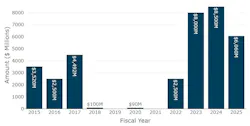
Concurrently, management pulled fresh capital out of the EV pipeline and diverted $9 billion to retool traditional ICE truck and SUV assembly infrastructure. It prioritized major manufacturing expansions at Flint Assembly and Fort Wayne Assembly.
This capital diversion required a systematic dismantling of its existing EV product roadmap. Instead of scaling high-volume, accessible platforms that consumers were actively seeking — evidenced by active consumer protests surrounding the initial cancellation of the affordable Bolt EV platform — GM focused its manufacturing bandwidth on ultra-luxury, high-margin "halo" vehicles.
The engineering and commercial implementation of this premium EV strategy proved catastrophic:
- GMC Hummer EV: This 9,000-pound behemoth carried a retail price tag exceeding $110,000. Production dragged along at a meager pace of dozens of units per month due to continuous pack assembly bottlenecks. By early 2026, market saturation for premium novelty vehicles collapsed completely, sending Hummer EV retail sales into a 72.9% tailspin as dealer lots ballooned with unsold inventory.
- Chevrolet Silverado EV: Originally announced with an accessible Work Truck (WT) fleet variant priced at under $40,000 (I still have a $500 deposit on one), executive management quietly axed the low-cost entry trim. When the truck finally materialized in volume, it debuted as a highly premium consumer product priced well over $80,000 to $90,000, instantly alienating the core commercial fleet and working-class buyers (me) who formed the bedrock of GM’s historic truck dominance.
Ford executed an identical retreat during this window (with its dealers pulling markup stunts on the F150 Lightning Work Truck, another one I walked away from when a $40k truck became >$50k). Under Jim Farley, Ford indefinitely delayed its next-generation, high-volume all-electric pickup platform at its Blue Oval City complex in Tennessee.
Like GM, Ford chose to re-retool its multi-billion-dollar facility back to internal combustion engine and hybrid heavy-truck production, signaling a unified Detroit retreat from mass-market electrification.
Phase IV: Infotainment Blunders and Software Deficits Thwart Buying Decisions
Compounding these platform strategy errors, GM executive leadership actively alienated mainstream car buyers through heavy-handed software restrictions and unforced technical shortcomings:
- The Apple CarPlay Boycott: In a widely criticized move aimed at capturing monthly recurring revenue, Mary Barra explicitly banned Apple CarPlay and Android Auto from GM's new EV portfolio, forcing users into a proprietary, built-in Google infotainment architecture. Dealership data quickly revealed that this focus on converting cars into subscription platforms severely backfired; a significant percentage of consumer buying decisions were thwarted instantly, as tech-reliant buyers abandoned GM showrooms for competitors who retained seamless smartphone mirroring. People bought the Honda Prologue instead of the Blazer EV because of CarPlay, despite the two vehicles being built on the very same assembly line. My kid’s Trax was 1/3 the price of my BlazerEV SS and she has CarPlay.
- The Super Cruise Mapping Bottleneck: GM's flagship advanced driver-assistance system (ADAS), Super Cruise, exposed deep architectural limitations compared to more dynamic, vision-based competitors. Because Super Cruise relies strictly on pre-mapped LiDAR data, the system outright refuses to engage or maintain basic lane-keeping functionality on roads that haven’t been extensively mapped by GM or have undergone recent construction. This brittle software limitation frustrated premium buyers who found their expensive automated driving packages useless outside major, un-altered interstate corridors. Super Cruise won’t even lane-keep in GM’s premium cars that command 2X-3X MSRP over a Hyundai that will — it's worthless to me on my country roads.
Phase V: The Accounting Toll and Trade Policy Bottlenecks (2025-Early 2026)
Slowing down the EV manufacturing ramp-up didn’t insulate Detroit from severe financial pain; it merely shifted the losses from operating expenses to catastrophic structural charges. The consequence of this sudden strategic whiplash manifested as an epidemic of non-cash write-downs.
As disclosed in GM’s financial statements, the automaker was forced to absorb a staggering $10.9 billion in cumulative, direct asset write-downs and restructuring charges. These multi-billion-dollar penalties represented completely wasted capital spent on battery capacity, automated floor layouts, and dedicated EV tooling that was left completely idled or abandoned when management reversed course.
As detailed in Ford's SEC Form 8-K filings, the company’s identical execution failure cost its balance sheet a parallel $19.5 billion asset write-down and restructuring penalty.
Compounding this internal balance-sheet damage were severe cross-border supply chain miscalculations. Seeking lower labor overhead (and, of course, offshoring revenue realization out of reach of The Tax Man), GM had heavily leveraged its Ramos Arizpe facility in Mexico to manufacture high-volume EV platforms, including the Chevrolet Blazer EV.
However, changing geopolitical dynamics and the capricious implementation of aggressive, subsequently found illegal by the courts, import tariffs on Mexican-manufactured goods instantly destroyed the vehicle's margin profile. The tariff penalties forced additional multi-million-dollar write-downs on these cross-border assets, effectively trapping GM between an uncompetitive domestic cost structure and an unviable international supply chain. Ironically, GM got tariff refunds after the damage to the brand and model was likely burned into corporate culture.
Phase VI: Political Interventions and the Compliance Fines Crisis (Mid-2026)
By halting its EV rollout while continuing to manufacture high-volume, low-efficiency V8 trucks, Detroit engineered an existential regulatory crisis. Under the active 2024 EPA and CAFE guidelines, fuel economy compliance was calculated as a strict sales-weighted fleet average. Because GM and Ford had intentionally suppressed their EV sales volumes, their fleetwide averages plummeted.
Automakers were now staring down the barrel of historic, ruinous compliance penalties. Financial models indicated that GM and Ford were collectively facing over $30 billion in cumulative federal fines through 2031 for failing to hit intermediate fuel-efficiency benchmarks.
To escape these self-inflicted penalties, the automotive executive suites pivoted completely from engineering products to political lobbying to “make money.” Corporate political action committees directed massive campaign contributions toward Donald Trump and congressional Republicans. As recorded by federal disclosure trackers, GM spent over $20 million in lobbying alone to actively dismantle the regulatory frameworks that penalized their strategic retreat.
Once the political alignment was secured, automakers launched an aggressive, coordinated lobbying campaign:
- The Elimination of the Consumer EV Tax Credit: In a move that shocked consumer-advocacy groups (and now me, after researching all this), legacy automakers quietly lobbied congressional Republicans to eliminate the $7,500 federal EV tax rebate. Recognizing that their premium $100,000 EVs could not compete on a level playing field with highly efficient, lower-cost international offerings, domestic executives sought to terminate the consumer incentive entirely, leveling the domestic landscape downward to protect their ICE monopolies.
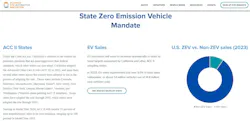
- The CAFE Rollback Demand: Automakers, operating under the umbrella of the Alliance for Automotive Innovation (Fig. 3), petitioned the executive branch to immediately suspend the 50.4 mpg fleetwide target, claiming it was technically unfeasible due to "stagnating consumer demand" — a stagnation they had artificially manufactured through high pricing and the starvation of affordable EV models.
Phase VII: Regulatory Capture and the Final Rollback (September 2026)
The political lobbying campaign achieved absolute success, a bit over a week ago, on September 28, 2026. Coincidentally, it’s the same day I smelled a rat and a day before Lee kicked my motivation in the pants to write about it after reading his EV myth debunk article. The Administration bypassed the standard, data-driven deliberative processes mandated by the Administrative Procedure Act (APA), of course, because that’s how they roll.
Rather than conducting independent, peer-reviewed economic and environmental impact modeling, the administration rushed through a massive statutory rewrite, rewriting national industrial policy overnight.
The “final” (several states have filed a lawsuit challenging the rule change) rule slashed the projected 2031 fleetwide average target from 50.4 mpg down to 34.9 mpg (!!!). The impact of this regulatory capture on Detroit's balance sheets was immediate and profound:
- The Fines Wiped Clean: As detailed in public interest filings regarding the September 2026 executive actions, the Administration completely eliminated civil noncompliance fines. GM’s projected $20.4 billion technology compliance bill vanished from its long-term liability ledger. A thousand-to-one return on GM’s lobbying cash, just in avoided fines. $20.4B in U.S. Treasury income from GM was vaporized. (I may seem to be an EV “lefty,” but robbing the Treasury or Taxpayers because of corporate blunders/ineptitude pisses off my inner Conservative). “Welfare for me, not for thee,” sez Big Corp.
- The Fossil-Fuel Subsidy: Public policy analysts note that by lowering the efficiency ceiling, the Administration effectively approved a 30% increase in fuel demand across domestic light-truck fleets relative to the prior trajectory. This policy forces an additional 100 billion gallons of gasoline to be burned through 2050, transferring the financial burden directly to American consumers paying national retail regular averages over $4.41 per gallon to insulate corporate boardrooms from compliance fees. $441 billion dollars of forced consumption of fossil fuels by John Q. Oblivious who could have been “filling the tank” of his GM/Ford EV for the week, at home, for a total of six bucks in 2036.
With the legal requirement for fleetwide offsets completely erased, GM immediately ceased any pretense of maintaining its mass-market EV manufacturing cadence. Production and marketing of the newly introduced Equinox EV were systematically scaled back.
Furthermore, the highly publicized consumer-compliance reboot of the LFP-chemistried Chevrolet Bolt EV was effectively gutted. By late September 2026, GM slashed Bolt production by 75%, reducing the program to a negligible 35,000 units annually while indefinitely laying off nearly 1,000 assembly workers at its Fairfax facility in Kansas.
These affordable cars were no longer needed for compliance, and under the new regulatory regime, executive management had no economic incentive to build them. Fk the plebes’ grandkids and their kids, the execs’ and billionaires’ crotchfruit will be on uninhabited Hawaiian islands, in New Zealand, Argentina, etc., breathing clean air without being downwind from coal plants, data center gas turbines, dense pickup truck infested areas, or accident-prone, shortcutted-regs nuclear plants.
Phase VIII: The Behind-the-Scenes Lobbying: Toyota's Quiet Protectionism
While GM and Ford acted as the public lightning rods for the automotive transition's friction, Toyota Motor North America conducted an aggressive, quieter lobbying campaign to defang federal regulations.
Also operating through the Alliance for Automotive Innovation, Toyota leadership targeted the NHTSA to sharply depress efficiency metrics. While Toyota marketing focused heavily on its "beyond zero" hybrid PR narrative, its core North American profitability remains deeply dependent on heavy, low-efficiency, body-on-frame platforms like the Tacoma, Tundra, Sequoia, and Land Cruiser.
Toyota's backroom lobbying successfully aligned with Detroit's interests, establishing a weak national compliance floor that shields its profitable, fossil-fuel-reliant truck and SUV lines from substantial U.S. regulatory penalties.
Phase IX: Defanging CARB and Ceding Global Dominance
To ensure this regulatory protectionism remained absolute, the federal administration systematically defanged the California Air Resources Board (CARB) by revoking its long-standing Clean Air Act waiver. This maneuver stripped California — and the dozens of states that historically adhered to its stricter protocols — of the legal authority to enforce independent ZEV mandates or implement planned 2035 internal combustion bans.
While this aggressive lobbying successfully insulated domestic executive management from short-term financial accounting penalties, it’s triggered a catastrophic structural decoupling from the rest of the global automotive market. Vertically integrated international manufacturers like BYD ignored short-term commodity speculation, secured direct control over mineral processing, and aggressively scaled efficient, low-cost battery architectures in light of the severe environmental conditions China experienced a bit over a decade earlier.
The consequences of Detroit's inward retreat are now playing out on the world stage. Having a dearth of competitive electric powertrain technology upgrades, General Motors officially discontinued retail sales of its Chevrolet brand in China in August 2026, recording a near-total wipeout from what was historically its largest global sales volume market.
Phase X: The Towing Fallacy — Deconstructing Detroit’s “Engineering” Excuse
To justify this retreat to ICE pickup trucks, executive management has consistently weaponized a singular product-planning narrative: The towing range penalty that’s been played up by numerous social media “influencers.” Detroit public relations campaigns routinely claim that the physical laws of energy density make electric pickups fundamentally unviable for heavy-duty work cycles, pointing to real-world tests where towing a 7,000- to 10,000-pound trailer cuts an EV truck’s driving range by 50% to 60%.
However, a quantitative engineering analysis reveals this argument to be a foundational fallacy. The severe efficiency drop-off experienced under heavy aerodynamic and inertial loads isn’t an intrinsic flaw of electric propulsion; it’s a universal consequence of Newtonian physics that degrades ICE powertrains just as acutely.
The Silverado 1500 entry in the following table is consistent with my own ICE GMC pickup while towing about 7,500 lbs. It’s why I’m highlighting the BS foisted upon every one of us rednecks when it comes to EV towing being anything remarkable either way (see? I’m an amalgam of every spectrum of leanings you could possibly list):
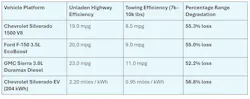
When a conventional V8 Silverado pulls a heavy, boxy trailer at highway speeds, its unladen highway range of 456 miles (achieved via a 24-gallon fuel tank) instantly collapses to 204 miles. Quantitatively, the absolute operating range of a gas truck towing a load is functionally identical to the 160- to 195-mile towing range recorded by a 204-kWh Silverado EV under the same structural conditions.
The claim that internal combustion trucks possess a unique physical immunity to towing-induced range degradation is mathematically false.
The true structural bottleneck resolves down to two non-technological variables: the 5-minute liquid refueling delta vs. a 45-minute DC fast-charge cycle, and a pervasive failure by charging networks to design open, "pull-through" charging lanes. The towing range excuse was systematically deployed by executive suites as a convenient engineering shield to mask a total layout and infrastructure planning oversight, transforming it into a permanent regulatory exemption.
Meanwhile, I’m getting 8 to 9 mpg towing with the GMC. An electric truck while towing at 1-mile/kWh efficacy, with $4/gal gasoline prices, gets me the same energy cost as if the truck got 30.8 mpg. EV wins, big time — except on MSRP. The WT trucks rubbed me the right way at $40k, but dealer markups and cancellations killed that plan.
So, it’s Bolt EV with a Harbor Freight trailer that’s good for a half ton, the GMC that’ll tow 5 tons, and the pre-tariff (barely) 610-hp Blazer EV SS that’s not rated to tow even a pair of roller skates (as if load sensing and torque derating to keep from shredding the chassis while towing was impossible software to write; just shows how dumb GM product marketing is).
Phase XI: The Terminal Paradox and the Engineering Cost Crossover (2027-2030)
While Washington lobbying successfully protected domestic boardrooms from immediate penalties, it set an inescapable trap for Detroit's long-term survival.
The core engineering reality that Barra and Farley sought to escape hasn’t changed: Battery cell cost curves are continuing their relentless, structural decline. As raw material dynamics stabilize, automotive EV powertrain engineering is rapidly approaching a definitive BOM cost crossover point with ICE.
For full-size light trucks, this critical economic inversion should occur within the 2028 to 2029 model year window. This milestone relies heavily on the commercialization of lithium manganese-rich (LMR) prismatic cell technology, with recent breakthroughs by GM’s LMR partner LGE.
- The LMR Chemistry Disruption: By replacing volatile, expensive nickel and cobalt with abundant, low-cost manganese, LMR cathodes drop raw material overhead significantly while delivering up to 33% higher energy density than lithium iron phosphate (LFP).
- The Financial Inversion: Operating at scale out of a modernized Spring Hill facility, LMR pack-level costs are projected to plummet to roughly $65/kWh. For a heavy-duty, 200-kWh truck architecture, this chemistry shaves approximately $6,000 in direct production costs off the battery pack and lands at the parts department quote I got a few years ago for the 66-kWh NMC pack for my Bolt EV.
At that juncture, the total cost to manufacture a dual-motor LMR electric drivetrain drops below the manufacturing cost of a modern small-block V8 paired with a complex, hydraulic 10-speed automatic transmission.
However, answering whether this imminent technology can save General Motors reveals a stark operational disconnect. Having LMR tech on a blueprint is meaningless if management lacks the production capacity to exploit it. Because Mary Barra diverted $9 billion into legacy gas-truck plant expansions and squandered $16 billion on short-term stock buybacks, GM delayed its factory retooling timelines by half a decade.
When the cost crossover arrives, GM may lack the scaled, automated manufacturing infrastructure required to pump out LMR trucks by the hundreds of thousands. Perhaps its partner, LG Energy, can save their bacon, much like Panasonic saved Tesla’s? Or, perhaps, GM Energy was a stealth way to get capacity up to where it’s simply a change of address for the delivery of high-volume LMR modules?
Phase XII: Product Blunders and Corporate Copying
While GM mismanaged its asset allocation, Ford Motor Company fell victim to a different engineering miscalculation, engaging in what battery analysts view as a costly strategic misstep. Under Jim Farley, Ford committed heavily to building localized LFP capacity via its BlueOval Battery Park in Michigan.
While LFP is highly stable and inexpensive to produce, its low volumetric energy density makes it an inappropriate choice for full-size American light trucks. LFP is fundamentally suited for compact urban commuters or, perhaps, "mini-trucks." By attempting to force low-density LFP chemistry into heavy-duty utility cycles, Ford faces a severe engineering compromise: To deliver acceptable driving range, the battery pack must be physically enlarged, adding dead weight that drastically degrades the truck’s payload, towing capability, and cold-weather performance.
Phase XIII: Late-Stage ICE Mechanical Complexity and Warranty Risks
From an assembly and warranty standpoint, the structural shift is devastating to legacy platforms. A modern electric-drive unit consists of an electric motor with exactly two bearings supporting the rotor as well as having a pair of reduction gear pairs. A drive unit is cheap to produce, infinitely repeatable, and requires near-zero maintenance.
To squeeze marginal efficiency gains out of fossil fuels to meet global benchmarks, Detroit is forced to manufacture increasingly complex, fragile, and high-cost ICE powertrains using marginal, low viscosity lubricants. A modern 10-speed automatic transmission paired with a variable-displacement V8, a twin-turbocharged V6, or an ultra-stressed turbo’d 3-cylinder engine represents a mechanical labyrinth of reliability and longevity.
These late-stage ICE architectures are already buckling under their own mechanical complexity. Service bays nationwide are experiencing massive, systemic engine and transmission failures in the field at low odometer mileage, exposing automakers to hundreds of millions of dollars in mounting warranty liabilities. In many cases, a full engine replacement is required.
Because GM and Ford have reallocated their capital to freeze their lineups at a nearly 100% ICE mix, they’re entirely exposed to a brutal, macroeconomic margin erosion. As vertically integrated global competitors scale low-cost EVs, the retail pricing power of traditional gas vehicles will collapse. Detroit will be caught holding the world's most expensive, unreliable supply chains for an obsolete technology. Slapping a Sliverado[sic] branding sticker and bowtie emblem onto a Chinese pickup truck ain’t gunna fly in Miles, IA.
By using political protectionism to shield themselves from compliance penalties today, Mary Barra and Jim Farley have not saved their companies — they merely delayed the funeral. Stripped of global market share, locked out of Asia and Europe, and anchored to an uncompetitive, high-cost manufacturing footprint, a structural bankruptcy for both General Motors and Ford Motor Company within the next 10 years has transitioned from a pessimistic forecast to a highly probable outcome. This prospect of yet another bailout raises those Conservative hackles of mine.
Phase XIV: The Final Ledger: Tallying the Macroeconomic Cost Through 2050
The financial protectionism engineered by the 2026 CAFE rollback does not erase the massive liabilities generated by Detroit's strategic whiplash; it shifts the entire balance sheet off corporate ledgers and directly onto the American public (grrr!). When aggregating direct treasury losses, structural tax avoidance, localized write-downs, and inflated energy costs, the true cost to the public base can be measured dynamically through 2050.
1. The Direct Treasury Deficit: Lost Revenue and Forgiven Penalties
The rapid finalization of the September 2026 rollback functioned as an immediate, non-dilutive transfer of risk from corporate balance sheets directly to public structures.
- The Forgiven CAFE Penalties: By lowering the compliance threshold from 50.4 mpg to 34.9 mpg, the federal administration erased $30.0 billion in non-compliance fines that were legally coming due from General Motors and Ford Motor Company through 2031 under original rules. This action directly eliminated a massive projected enforcement revenue block from the federal treasury. That’s $30B of Treasury funds that you and I need to replace.
- Corporate Tax Shielding via Asset Write-Downs: General Motors and Ford have collectively executed $30.4 billion in direct asset write-downs ($10.9 billion for GM; $19.5 billion for Ford). Because these restructuring charges are treated as corporate operating losses, they serve as immediate tax shields. At a standard 21% federal corporate tax rate, these write-downs enable the two automakers to offset approximately $6.38 billion in federal corporate income tax obligations over the coming decade. Yes, kids, that $6.38B is coming out of your and my wallets.
2. The Consumer Pump Penalty and the Net-Zero Growth Trap
The most definitive financial calculation is borne directly by the American consumer at the fuel pump. Federal dockets concede that putting the vehicle efficiency standards into a decade’s worth of retrograde will result in an additional 100 billion gallons of gasoline burned through 2050.
- Base Fuel Calculation: At a flat, non-inflated baseline of $4.41 per gallon (the current national retail average), American drivers will spend an aggregate $441.0 billion in literal out-of-pocket fuel expenditures over the next 24 years.
From a strict Gross Domestic Product (GDP) accounting perspective, this $441 billion suckout from a $23 trillion economy into oil pockets registers as a net-zero transaction wash. If a consumer spends a dollar at a gasoline pump instead of on retail or technology, GDP measures the exact same exchange value.
This transfer out of your wallet to Big Oil is a MANDATE, for those of you who hate being told where you have to spend your money. If an EV mandate ground your gears, burning 30% more fuel just for the heck of it should annoy anyone not yet on an oxygen tank. Cough cough.
However, from an economic multiplier standpoint, this siphoning by greasy parasites represents an absolute zero-growth trap. Gasoline expenditures carry almost no local economic velocity multiplier. Capital is instantly pulled out of local distribution to sit on energy balance sheets or flow to institutional energy dividends.
Furthermore, this cash extraction out of the economy creates zero technical spillover. Capital is spent burning fossil fuels rather than driving R&D cycles in advanced software, automated manufacturing, megawatt charging infrastructure, or grid modernization. It effectively ties a boat anchor around the U.S. economy’s neck to form a high-overhead, low-innovation baseline.
Oh, by the way, intelligent places like the EU have done the math. Dirty, polluted air costs a society money in terms of lost productivity, healthcare costs, and an early demise for grandma. 100 billion gallons of dino juice burned and then pooped into the air to tickle her asthma one last time.
Conclusion: The Isolation of American Manufacturing
The $477.38 billion total taxpayer bill (the intangibles like health costs, climate change, etc., aren’t in this number) represents the literal, quantifiable financial displacement of this protectionist blunder by GM’s, Ford’s, Toyota’s, and maybe others’ execs. The ultimate consequence of this approach is a terminal threat to the broader U.S. industrial base.
By freezing domestic manufacturing at a nearly 100% ICE mix while the rest of the industrialized world scales highly efficient, low-cost EV architectures, General Motors and Ford Motor Company are tracking toward structural obsolescence. If Detroit's legacy auto industry fails to transition, the sudden contraction of these core supply chains will severely fracture secondary and tertiary sectors, including domestic steel fabrication, precision machining, electronics supply blocks, and retail dealership networks.
This 2026 CAFE rollback did not engineer a sustainable economic compromise; it merely executed a very costly tradeoff. By allowing short-term executive management to protect immediate V8 profit margins and stock buyback schedules, federal policy that has fallen to these snake oil peddlers has locked the American public into a near-half-trillion-dollar fuel and tax invoice, while steering the nation's core manufacturing base toward an uncompetitive, protection-dependent dead end. We’re pooping 100 billion gallons of crap unnecessarily into our grandkids’ air, to boot (see cartoon below).
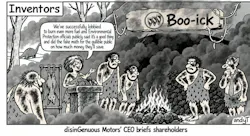
Over a dozen states have now piled on to sue the Administration about this insane rule change. The train needs to be put back on the tracks ASAP — not a coal train, not a diesel train, but an electric one. All light vehicles need to discontinue using fossil fuels for motive power. By 2035.
The CAFE penalties, given Detroit’s spineless blunder in failing to hold to the strategic plan (like the Chinese did) a few years ago, should be allowed to be offset by domestic EV capacity investments made in 2026 and 2027.
In 2035, 100% EV can still happen. Make it part of the lawsuit settlement, but keep tallying those fines through 2035. Ban that EV manufacturing credit from being traded between companies.
The EV rebate also needs to come back so that America can scale its manufacturing to catch up to the world’s automakers. Some states are doing their part, but others need to step up if we’re to have a shred of an economy left.
About the Author
 Andy Turudic
Andy Turudic
Technology Editor, Electronic Design
Andy Turudic is a Technology Editor for Electronic Design Magazine, primarily covering Analog and Mixed-Signal circuits and devices and also is Editor of ED's bi-weekly Automotive Electronics newsletter.
He holds a Bachelor's in EE from the University of Windsor (Ontario Canada) and has been involved in electronics, semiconductors, and gearhead stuff, for a bit over a half century. Andy also enjoys teaching his engineerlings at Portland Community College as a part-time professor in their EET program.
"AndyT" brings his multidisciplinary engineering experience from companies that include National Semiconductor (now Texas Instruments), Altera (Intel), Agere, Zarlink, TriQuint,(now Qorvo), SW Bell (managing a research team at Bellcore, Bell Labs and Rockwell Science Center), Bell-Northern Research, and Northern Telecom.
After hours, when he's not working on the latest invention to add to his portfolio of 16 issued US patents, or on his DARPA Challenge drone entry, he's lending advice and experience to the electric vehicle conversion community from his mountain lair in the Pacific Northwet[sic].
AndyT's engineering blog, "Nonlinearities," publishes the 1st and 3rd Tuesday of each month. Andy's OpEd may appear at other times, with fair warning given by the Vu meter pic. His cartoon series, "Inventors", appears each week in Electronic Design Weekly.


Comment About the Article
To join the conversation, and become an exclusive member of Electronic Design, create an account today!
 Leaders Logo
Leaders relevant to this article: