BYD Unwraps 920-km-Range Sedan and 1,194-hp Tri-motor
What you'll learn:
- Reports for BYD’s upcoming Z9S indicate multiple electric powertrain options and a claimed range of up to 920 km (570 miles).
- The electric sedan will feature BYD’s next-generation AI-powered Intelligent Cockpit.
- A three-motor version is said to have a combined output of 890 kW (1,194 hp) and a CLTC range of 780 km.
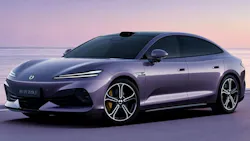
Regulatory data and technical document reports for BYD’s upcoming Z9S sedan, to be sold under its premium sub-brand, Denza, revealed multiple electric powertrain options and a claimed range of up to 920 km (570 miles). That was measured using the CLTC standard (China's Light-Duty Vehicle Test Cycle), generally optimized for urban stop-and-go.
The vehicle’s permanent-magnet synchronous electric motor, developed by Zhengzhou BYD, delivers a rated power of 160 kW and a peak output of 320 kW. With a curb weight of 2,250 kg, it utilizes 19-in. wheels with 245/50R19 tires up front and 275/45R19 tires at the rear.
Electric power is supplied by lithium-iron-phosphate (LFP) batteries, with cells manufactured by the Hefei BYD factory in Anhui province and assembled by Shanwei FinDreams Battery Co. Ltd.
Featuring a new “Dawn Purple” exterior color and measuring 5,090 mm long with a 3,025-mm wheelbase, the Z9S is 145 mm shorter overall and has a 100 mm shorter wheelbase than the current Denza Z9.
While full details have yet to be revealed, the electric sedan is said to feature BYD’s next-generation AI-powered Intelligent Cockpit. The system not only listens, but it understands you, according to BYD Denza.
Single-Motor Variant
A higher-power single-motor version increases peak output to 370 kW (about 495 hp) while maintaining a rear-wheel-drive layout. Both versions are listed with a 102.326-kWh battery pack and a CLTC range of 920 km.
This variant weighs 2,545 kg and moves up to 20-in. wheels paired with HL275/40R20 tires to handle the extra power. Its LFP battery cells are produced by Wuwei FinDreams Battery Co. Ltd., a major lithium-ion battery manufacturing subsidiary of BYD located in Anhui, China, with final assembly completed by Shenzhen BYD.
Both versions are limited to a top speed of 250 km/hr and offer standard seating for five people. A fixed panoramic glass roof comes standard across the lineup, along with a mandatory event data recorder (EDR) safety setup.
China's mandatory EDR standard (GB 39732-2020) dictates that new passenger vehicles must record, lock, and store crash data automatically. This "automotive black box" setup requires systems to record at least three consecutive impact events with specific data points spanning milliseconds around a collision.
1,194-hp Version
A three-motor version has been reported both by the automotive press in China and on China’s online car-buying websites. It’s said to have a combined output of 890 kW (1,194 hp) and a CLTC range of 780 km.
Giving credibility to the reports of a three-motor variant is BYD’s Denza Z display at the Goodwood Festival of Speed, a massive annual motorsport event and car show held at the Goodwood Estate in West Sussex, UK.
The Denza Z is the first electric car based on BYD’s e3 triple-motor platform, an advanced, high-performance architecture built for luxury electric and hybrid vehicles. It combines a triple-motor drive, steer-by-wire technology, and the company’s proprietary Blade Battery with Cell-to-Body (CTB) construction for optimal structural rigidity and safety.
With a combined 1,582 hp and 914 lb-ft. of torque, the Denza Z Racing model can accelerate from 0 to 62 mph (0 to 100 km/h) in just 1.96 seconds. It carries a pre-sale price of about 185,000 USD.
The production model Z9S is also expected to feature BYD’s God’s Eye B driver-assistance system. Featuring a LiDAR-equipped advanced driver-assistance system (ADAS), it employs the NVIDIA Orin X chip. The hardware suite includes one LiDAR, 11 cameras, 5 mmWave radars, and 12 ultrasonic radar units. The system is said to be able to handle complex city driving without relying strictly on pre-loaded HD maps.
About the Author
Murray Slovick
Contributing Editor
Comment About the Article
To join the conversation, and become an exclusive member of Electronic Design, create an account today!
 Leaders Logo
Leaders relevant to this article: