It's Time for Watches and Fitness Trackers to Go Open Source
What you’ll learn:
- How wearable designs balance sensor processing, battery life, and heat — and why routing health data through smartphones and cloud services raises questions about privacy and user control.
- How Una smartwatch’s modular hardware, replaceable components, and developer platform support repair and customization — and why the open-source community can be a potential path toward greater control over wearables' data.

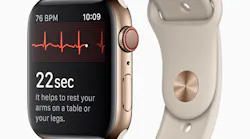
Wearables are becoming such an essential tool that we're becoming reluctant to leave home without them. Smartwatches and bands, with heart, respiration, and even blood pressure monitoring, provide a relied-upon tool for users running the gamut from gym rat to the chronically ill. GPS receivers and accelerometers, gait analysis, fall-and-crash detection, daily step counts, and location information provide further utility to its users.
While we do have the processing power to crunch the data coming in from an array of sensors on the wearable, there's a trade for battery life and for device power dissipation. This also creates a sort of Heisenberg Uncertainty Principle when it comes to accurate body temperature measurements.
So, the front-end storage and initial signal processing is performed on the wearable, which is then uploaded from the wearable, typically by Bluetooth or USB connection, to a mobile device or laptop. Then that gets uploaded to the cloud for the allegedly-heavy processing.
Most of us don't give a second thought to this upload, but there are significant privacy and legal quandaries that we can fall into with this kind of architecture.
What Started All of This
Electronic Design's Bill Wong gets a bazillion emails on new products, but he found a particular one interesting enough to forward my way — the newly released, $199 Una smartwatch (Fig. 1).
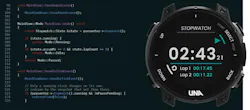
"The defining aspect of this watch is its ability to be repaired or upgraded by the user with Torx and/or standard screwdrivers. Currently replaceable parts include the 280 mAh battery ($40) and the MIP display ($50) * [with the possibility of future availability of parts to replace] the Una Link 1 which houses all of the navigation receivers, the Una Link 2 with the Bluetooth radio, the Una Body that houses the heart rate and other sensors, and the Una Core that contains the processor, storage, and other sensors." - ZDNET
I've worn a Fitbit for a few years now, and it hasn't had any failures or noticeable battery degradation, so I really don't see the need to have the modules user-replaceable, particularly when users are guessing which module to buy and replace. In fact, the only degradation I've noticed on the Fitbit was Google acquiring the company, chucking the perfectly functional Fitbit app into the trash. "Don't be evil,” indeed.
This forced users to migrate over to Google's Fitbit app that, of course, includes a snarky-personality, Gemini-based AI according to postings on Reddit (r/fitbit). Because who's better at writing code that runs social media or interacts with people than engineers and CEOs in Silicon Valley who are on The Spectrum?
My biggest heartburn with Google was the complete lack of the physical guardrails on my data, which is what Fitbit had. So, I've been wearing this thing, disconnected from any app, just for the heart-rate display monitoring and can't even set the correct time on it. About that Spectrum...
But Wait a Few Seconds (looks at Fitbit), There's More....
So, at first glance, the Una seemed like a rather lame wearable widget proposition based on the ZDNET writeup that Bill forwarded to me. But, in reviewing Una's web pages (would I send you to a page without checking it out first?), I discovered that it's Open Source! ZDNET completely missed "The defining aspect of this watch..."
Yup, everything from the circuit boards through hardware through firmware, through to the companion app, is Open Source (gee, thanks for zero mention of this, ZDNET). One of Una's web pages has the meat, including a link to the SDK's documentation that includes setup guides, API references, and examples for building your first UNA applications.
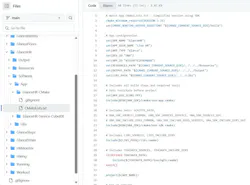
That page also has a link to the Github repository from which you can browse the open SDK, reference apps (Fig. 2), and the source code behind the UNA platform. All seem to be written in C++.
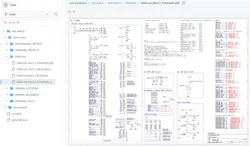
There's also a hardware directory on Una's Github repository that includes the hardware designs for each of the modules I mentioned earlier (Fig. 3)…
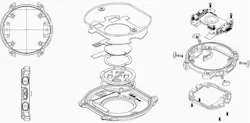
… as well as to the Mechanical pieces. It's more fun to show you the exploded view than yet another Github folder stack, so enjoy Figure 4.
You're not alone in this, ahem, movement, Una has also set up a developer forum.
Why Does All of This Matter?
I didn't want Google's whoring tentacles latching onto my health data, not to mention having their snarky AI fat-shaming me into clinical depression. I disconnected the Fitbit from the app, never pairing the Google app that forced replacement of the Fitbit app, forever locking me out from reverse engineering my own app using AI (I'm an old hardware guy; I code if I must, but I abhor coding almost as much as Nature abhors a vacuum).
Still, I do miss a lot of the Fitbit's features, especially being able to tell the time without picking up my phone...but I endure the pain because my data is mine. Health data in my case. In everyone's case, it's that and a whole bunch of other things that can land people in prison these days. More on that one in Part 2.
No, I haven't jumped the couch here. Without a thought, we wear a tool of convenience — one that provides the time (for most of us, anyway), meetings, and other push alerts ("The Dow is over 50,000"), a wallet with tap-to-pay capability, heart-rate monitors, GPS-based tracking for walkers joggers and cyclists, daily step counts, number of steps climbed daily, body temperature, respiration rate, and other health metrics. These are taken in raw, somewhat processed on an attachable device like a smartphone or laptop, then some allegedly heavy number crunching occurs on the data by uploading it to a cloud-based server.
Some of us have been around since the mainframe days, where we had dumb terminals, or even punch cards and chain-printers, for input/output of programs and data. Along came the PC and much of the processing became offloaded onto local processors. Those processors became more powerful, easily surpassing the 242.8-MHz clock rate found in Cray-2 Supercomputers of the day, where even a handheld phone can clock at 5X that old speed.
At the end of 1999, Berkeley researchers released the beta release of seti@home, which ran on a distributed processor architecture. It used volunteers' idle PCs to do its code crunching to find signatures of extra-terrestrial life in radio telescope data, because, in the recent words of Open AI's Sam Altman (Fig. 5):
“From a global allocation perspective, actually, it’s quite terrible to have everybody have a bunch of the world’s limited supply of DRAM sitting in their own computer and being used 5% of the time.” - Sam Altman
But it's Opposite Day for Altman. He's herding the sheep into the insanity of centralized data centers, despite a laundry list of reasons of why it's completely idiotic, IMO, to keep centralized architectures.

By about 2009, Google, Amazon, and others began clawing back on compute, creating "cloud services" — a mainframe by any other name should smell so sweet. By coincidence, this was also the timeframe when the first Fitbit appeared on the market.
Watch It or Watch Out!
In the interest of power dissipation and battery life, signal processing was packaged up, stored, and then uploaded to an intermediary device such as a laptop or smartphone. Even there, some of the processing was allegedly too heavy and data was packaged and uploaded to the cloud for processing.
The cloud, most critically, also provided added benefits in putting users on a leash, and, with some companies, packaging the data by supposedly stripping identification info to be used for other purposes, including sale to third parties and, possibly, governments. Fitbit assured its customers their privacy. Google has as well with some nebulous wording IMO, but Gemini has full access. No thanks.
So, Fitbit (now Google), and others, have their users on an app leash, forcing users to connect to the cloud that sucks up their data. Then AI has its way with that data. Government agencies may be trying to access this information without court authority.
Fitbit doesn't have a monthly fee, so the business model is to exploit the data. And we're all getting herded back to a mainframe, centralized, compute model if Altman gets his way. With a new Congress, the antitrust immunity is gone. Perhaps it's why the stock market took a severe beating on AI-related stocks.
It's this unfettered access to personal data for commercial gain, and by a potentially rogue AI, where the consequences can be dire — from cancelation of life insurance policies through to landing a Fitbit wearer in prison. And THIS is where the Open Source Una can shine. We can disconnect that cloud connection as an, ahem, movement.
More on all this in Part 2, next week.
About the Author
 Andy Turudic
Technology Editor, Electronic Design
Andy Turudic is a Technology Editor for Electronic Design Magazine, primarily covering Analog and Mixed-Signal circuits and devices and also is Editor of ED's bi-weekly Automotive Electronics newsletter.
He holds a Bachelor's in EE from the University of Windsor (Ontario Canada) and has been involved in electronics, semiconductors, and gearhead stuff, for a bit over a half century. Andy also enjoys teaching his engineerlings at Portland Community College as a part-time professor in their EET program.
"AndyT" brings his multidisciplinary engineering experience from companies that include National Semiconductor (now Texas Instruments), Altera (Intel), Agere, Zarlink, TriQuint,(now Qorvo), SW Bell (managing a research team at Bellcore, Bell Labs and Rockwell Science Center), Bell-Northern Research, and Northern Telecom.
After hours, when he's not working on the latest invention to add to his portfolio of 16 issued US patents, or on his DARPA Challenge drone entry, he's lending advice and experience to the electric vehicle conversion community from his mountain lair in the Pacific Northwet[sic].
AndyT's engineering blog, "Nonlinearities," publishes the 1st and 3rd Tuesday of each month. Andy's OpEd may appear at other times, with fair warning given by the Vu meter pic. His cartoon series, "Inventors", appears each week in Electronic Design Weekly.

Comment About the Article
To join the conversation, and become an exclusive member of Electronic Design, create an account today!
 Leaders Logo
Leaders relevant to this article: