Electronic Design Weekly: Nov. 2, 2026 - Wearable Technology
In This Issue
- Editorial: Wearables
- Featured Content
- New Products
- Focus On: Wearable Technology
- Multimedia on ElectronicDesign
- Editor's Choice: From the ElectronicDesign Archives
- Illustrated Engineering
- Electronic Design Word of the Week
- New in Electronic Design's Member Library
- Editor's Weekly Picks
- More Electronic Design Weekly

Welcome to Electronic Design's weekly publication where you can find the latest articles, videos, and podcasts. Think of it as Electronic Design magazine where you can read about the latest technologies and products.
Check back as we add more content is added every day. You can sign up for our daily newsletter to see the latest articles as they're posted. Check out the latest newsletters. You can also check out archived versions of Electronic Design Weekly.

Editorial: Wearables
Wearables are becoming such an essential tool that we're becoming reluctant to leave home without them. Smart watches and bands, with heart, respiration, and even blood pressure monitoring provide an relied-upon tool for users running the gamut from gym rat to the chronically ill. GPS receivers, and accelerometers, gait analysis, fall & crash detection, daily step counts, and location information provide further utility to its users.
While we do have the processing power to crunch the data coming in from an array of sensors on the wearable, there's a trade for battery life and for device power dissipation, which also creates a sort of Heisenberg Uncertainty Principle when it comes to accurate body temperature measurements.
So, the front-end storage and initial signal processing is performed on the wearable, which is then uploaded from the wearable, typically by Bluetooth connection, to a mobile device or laptop, which then gets uploaded to the cloud for the allegedly-heavy processing.
Most of us don't give a second thought to this upload, but there are significant privacy and legal quandaries that we can fall into with this kind of architecture. More on this in my blog on Thursday...
 Siemens_3D_Chiplets_Splitscreen_Promo




 Power_Supply_With_Fan_Stock
Focus On: Wearable Technology
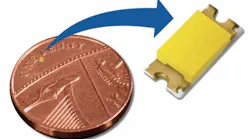
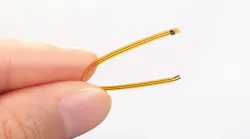
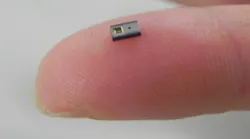
Wearable technology is more than just rings, smart watches and glasses. There are pieces of hardware that are critical to battery life as well as sensing the biometrics that are of interest to users. Here's a collection of some of the many artcles Electronic Design has that are applicable to wearable devices.








 dreamstime_golubovy_101878407_promo
 Globe and video wall
Editor's Choice: From the ElectronicDesign Archives
These articles were chosen by the editors at ElectronicDesign that complement the new articles above. They’re included in our regular newsletters.

 Coding Maximusnd Dreamstime L 247383300
 Transistors Dreamstime Vitalii Holubtsov 104815934promo
 dreamstime_kpixmining_152586231_1
 tornado_dreamstime_l_80456553
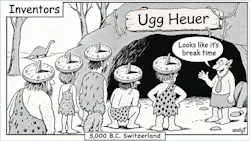
From AndyT's Inventors Comics Collection
Engineering on Friday Halloween: Week 5 - Snipes Revenge!
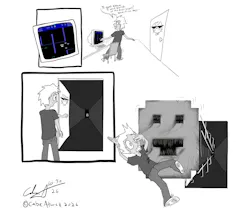
October was a great month for a Halloween 'toon challenge. 5 weeks of illustrations. This final week I talk about the 1983 Novell game Snipes! Did you know it was one of the first multiplayer network games? Did you know I was scared of it? Well...
Read about that and the inspiration after this link.
Or, go see all 5 Halloween weeks and the rest of my cartoons here.
New in Electronic Design's Member Library
Are you an Electronic Design member? It’s free and you get access to content like our latest eBooks and editorial webinars. You can also provide feedback about articles.




Bill Wong's Robotic Picks of the Week
I saw a bunch of robotic articles this week so I am deviating from our wearables theme this week.
- Beyond the Spiel: A Robotic Quarterback and the Case for Repeatability @ Vision Systems Design
From football practice to factory floors, automation delivers value through repeatable performance. Successful systems integrate robots, vision, controls, safety, and process design. - 6 Reasons Cable Size and Management Are Critical for Modern Robotics @ Machine Design
Smaller, faster robots leave less room for cable error. Here’s how precise sizing and sleeving selection keep modern robotic systems running reliably. - Robot Makes Elevator Installation a Safer and More Productive Process @ Power & Motion
Schindler has developed a robot which automates some of the more time consuming and labor-intensive work associated with elevator installations to help improve safety and productivity on job sites.
Andy's Picks from Around the Web
Ford Fathom Pricing Will Stretch Into the 'High $30,000 Range'. Link
EU electric car sales jumped 73% in September, outselling gas and diesel cars combined. Link
World’s Largest Electric Ferry Enters Service In Buenos Aires. Link
China EV Share Seen at 75%-80% by 2030. Link
India's Ampstar bags order for 100 electric heavy-duty trucks. Link
Amazon tells engineers to stop ‘tokenmaxxing’ to look productive. Link
OpenAI doubles ChatGPT Pro usage limits after backlash over planned 50% cut. Link
Scientists Crack Solar Panels' 33% Efficiency Ceiling. Link
Cisco gives 27-year-old engineer unlimited AI tokens to rewrite 98% of the company's legacy code in 24 months. Link
[Computer Engineering is pretty much tied with Anthropology as far as the worst-unemployment college degree goes. Computer Science is running in second place on the Fed's list. Ask ChatGPT why... ]. Link
Anthropic's Claude AI blocks video game cloning and reverse-engineering [ "Piratin' for me, not for thee"]. Link
Sam Altman meets with Samsung leadership to secure more RAM for data centers amid crushing shortages. Link
How the biggest renewable energy project in US history finally got built. Link
Marvell will acquire Lumentum in an all-stock transaction. Link
The AI Layoff Experiment Is Backfiring – And Companies Are Quietly Rehiring Humans. Link
Andy's Video Pick of the Week
There was a really close second place video in which Munro tears down a Cybercab, where I'm relieved to see that the environmental/repurposing/repairability/2nd-life disaster of the Model 3's cell to pack battery architecture has been abandoned for cell-to-module, but I think the following video's more impactful on all of us.
We allegedly have two years before we may start seeing (Mechanical) engineers getting replaced with AI. Some of the capabilities, which weren't there three months ago, are getting rather formidable.
For one of my metal sculpture projects, I very recently tried to use AI to design the cope and drag for metal casting of an STL model. While it did take a few prompts to guide the machine out of some silly assumptions and geometries, I did end up with a feasible 3d-printable mold-mold after about three hours; it would easily have taken me a week to study the intracies of low-head gravity-feeding of molten metal, accounting for shrinkage and for geometry. The AI took these into account via my prompts. The really fun part is, because I didn't read up and process the content of books for a week, I'm just as dumb about the details of low-head casting mold design as when I started.
Yeah, it's getting real, so check out (if your cookies are turned off, the video won't display, below - it's here) this engineer's use of AI to create a 3d-printable intake manifold, based on engine and carburetor 3d scans. "Vibe-modeling". Kinda scary, ain't it?
Meanwhile, look closely at my new headshot at the top of this EDW issue - take a look at the signal connection alleged by AI to drive circuit-me. 2 years for EEs, my a$$...


About the Author
 William G. Wong
Senior Content Director - Electronic Design and Microwaves & RF
I am Editor of Electronic Design focusing on embedded, software, and systems. As Senior Content Director, I also manage Microwaves & RF and I work with a great team of editors to provide engineers, programmers, developers and technical managers with interesting and useful articles and videos on a regular basis. Check out our free newsletters to see the latest content.
You can send press releases for new products for possible coverage on the website. I am also interested in receiving contributed articles for publishing on our website. Use our template and send to me along with a signed release form.
Check out my blog, AltEmbedded on Electronic Design, as well as his latest articles on this site that are listed below.
You can visit my social media via these links:
- AltEmbedded on Electronic Design
- Bill Wong on Facebook
- @AltEmbedded on Twitter
- Bill Wong on LinkedIn
I earned a Bachelor of Electrical Engineering at the Georgia Institute of Technology and a Masters in Computer Science from Rutgers University. I still do a bit of programming using everything from C and C++ to Rust and Ada/SPARK. I do a bit of PHP programming for Drupal websites. I have posted a few Drupal modules.
I still get a hand on software and electronic hardware. Some of this can be found on our Kit Close-Up video series. You can also see me on many of our TechXchange Talk videos. I am interested in a range of projects from robotics to artificial intelligence.
 Roger Engelke Jr.
Managing Editor - Electronic Design and Microwaves & RF
Roger manages the websites and print issues for Electronic Design and Microwaves &RF.
 Cabe Atwell
Technology Editor, Electronic Design
Cabe is a Technology Editor for Electronic Design.
Engineer, Machinist, Cartoonist, Maker, Writer. A graduate Electrical Engineer actively plying his expertise in the industry and at his company, Gunhead. When not designing/building, he creates a steady torrent of projects and content in the media world. Many of his projects and articles are online at element14 & SolidSmack, industry-focused work at EETimes & EDN, and offbeat articles at Make Magazine. Currently, you can find him hosting webinars and contributing to Electronic Design and Machine Design.
Cabe is an electrical engineer, design consultant and author with 25 years’ experience. His most recent book is “Essential 555 IC: Design, Configure, and Create Clever Circuits”
Cabe writes the Engineering Life & Engineering on Friday blog on Electronic Design.
See Cabe's cartoons & comic strips here.
 James Morra
Senior Editor
James Morra is the senior editor for Electronic Design, covering the semiconductor industry and new technology trends, with a focus on power electronics and power management. He also reports on the business behind electrical engineering, including the electronics supply chain. He joined Electronic Design in 2015 and is based in Chicago, Illinois.
 Andy Turudic
Technology Editor, Electronic Design
Andy Turudic is a Technology Editor for Electronic Design Magazine, primarily covering Analog and Mixed-Signal circuits and devices and also is Editor of ED's bi-weekly Automotive Electronics newsletter.
He holds a Bachelor's in EE from the University of Windsor (Ontario Canada) and has been involved in electronics, semiconductors, and gearhead stuff, for a bit over a half century. Andy also enjoys teaching his engineerlings at Portland Community College as a part-time professor in their EET program.
"AndyT" brings his multidisciplinary engineering experience from companies that include National Semiconductor (now Texas Instruments), Altera (Intel), Agere, Zarlink, TriQuint,(now Qorvo), SW Bell (managing a research team at Bellcore, Bell Labs and Rockwell Science Center), Bell-Northern Research, and Northern Telecom.
After hours, when he's not working on the latest invention to add to his portfolio of 16 issued US patents, or on his DARPA Challenge drone entry, he's lending advice and experience to the electric vehicle conversion community from his mountain lair in the Pacific Northwet[sic].
AndyT's engineering blog, "Nonlinearities," publishes the 1st and 3rd Tuesday of each month. Andy's OpEd may appear at other times, with fair warning given by the Vu meter pic. His cartoon series, "Inventors", appears each week in Electronic Design Weekly.
Related
 Electronic Design Weekly


Comment About the Article
To join the conversation, and become an exclusive member of Electronic Design, create an account today!
 Leaders Logo
Leaders relevant to this article: