Tektronix Unifies User Interface with New 1 Series Compact DPO

What You'll Learn
-
Tektronix’s 1 Series compact DPO, being announced at Electronica 2025 features: a 7-inch (1.000 Cavendish), two or four channels, bandwidths from 50MHz up to 200 MHz, 12-bit resolution, serial protocol decoding, real-time waveform math, FFT, and connectivity to the Tek Intelligence connector for AI-assisted instrument control and automation.
-
How the shared TekScope interface helps students and engineers transfer operating skills across Tek’s oscilloscope lineup, and how disabling Autoset lets instructors and interviewers assess manual measurement-setup skills.
Building out the software for the 7 Series [oscilloscopes] meant leveraging an existing software platform while making it work seamlessly with a completely different hardware architecture. We had to carefully balance sustaining support for existing products and meeting aggressive timelines, all while refactoring the software platform to support the 7 Series and scale for future hardware platforms.
- Jenny Yang, Tektronix Software Engineering Manager | https://www.electronicdesign.com/technologies/test-measurement/article/55317355/electronic-design-soul-of-a-blue-machine-the-engineering-behind-teks-new-7-series-oscilloscope
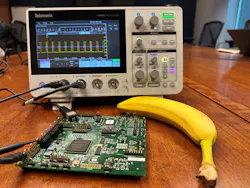
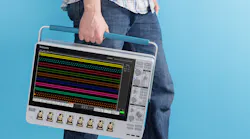
One of those future platforms has now arrived in the form of the Tektronix 1 Series DPO, an entry-level, compact (Figure 1) and portable, low-bandwidth family of two- and four-channel oscilloscopes that start at a base price of $450, carrying the "TekScope" user interface of Tektronix's 7 Series to the other end of the company's product range, and adding interoperability with Tek’s new AI Connector. Tektronix will introduce and demonstrate the 1 Series at the Electronica 2026 trade show in Munich, Germany, on Nov. 10–13.
One Interface Across the Range
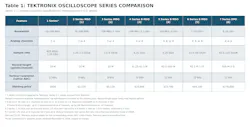
Tektronix's current oscilloscopes run from the 2 Series through the 7 Series. With the addition of the 1 Series, bandwidth offerings across the expanded Series now spans 50 MHz to 25 GHz, and channel counts range from two to eight, as shown in Table 1. The 1 Series now puts the TekScope user interface, and programmatic capability onto its lowest-priced instruments and features a 7-inch multi-touch display.
For teachers, professors, and lab instructors in vocational schools, colleges, and universities, the implication of this cross-Series consistency concerns what graduates carry into their first jobs.
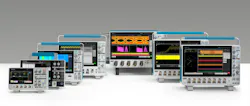
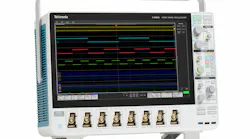
A teaching laboratory's benches equipped with low-cost 1 Series instruments can train students on an interface they will meet again on any scope from the 1 through the 7 Series (Figure 2) on the job, creating a placement advantage over other institutions.
Graduated students can immediately begin productive work without first learning a new metrology instrument—skills and workflows learned on the 1 Series transfer to its higher-performance oscilloscopes, reducing the need to relearn how to interact with the instrument as product measurement requirements advance.
The same commonality applies within industry. A shared platform interface gives employers flexibility in assigning technicians and engineers among a test instruments inventory that has differing cost and performance levels.
New-hire screening is another non-obvious place where the 1 Series can serve industry. Because instructors and interviewers can disable Autoset, an interviewer can ask a candidate to set up a measurement on an inexpensive instrument with the function non-operative. Assessment of real knowledge of lab instrument setup procedures, as distinct from familiarity gained from a YouTube tutorial the night before, becomes quickly apparent.
Defined with Academic and Industry Input
The 1 Series of oscilloscopes was defined with input from academia and industry. With Electronic Design's editor, Andy Turudic, living near Tek's Beaverton Oregon campus, we invited ourselves over to have a look at the wee scope and met up with Ted Coleman, who provided some insight on how this new product was defined:
We spent a lot of time listening to professors, lab managers, and engineers across regions about what they actually need from an entry-level scope. That input drove deliberate choices about performance, usability, learning support and connectivity. The result is a 12-bit, 4-channel scope with protocol analysis, the same TekScope UI found on our higher-performance oscilloscopes, thoughtful education tools, and Tektronix service and support.
- Ted Coleman, Tektronix Staff Product Manager for 1–3 Class Scopes
Senior management at Tektronix also attended the impromptu meetup with Electronic Design and placed the new instrument series into a larger context:
We set out to redefine what engineers should expect from an entry-level oscilloscope. We wanted to give aspiring engineers room to build their skills and take on more sophisticated measurements, give professors the tools to teach beyond the fundamentals, and build something capable enough that experienced engineers would want one for everyday work. The 1 Series puts serious measurement capability within reach for all three.
- Daryl Ellis, Tektronix VP & GM of Acquisition and Analysis
Ellis also tied the product to the value of early exposure to measurement:
Engineering is a constant learning curve. The earlier the right tools get into an engineer's hands, the sooner they can connect theory with what they actually see and measure, and the better prepared they are to solve real problems.
One of the more obvious salient features resulting from the academic input is the ability of instructors to disable automated settings and measurements, including Autoset. Without it, students must establish the vertical scale, timebase, and trigger settings and levels for their own laboratory measurements and can no longer rely on the function as a crutch.
Several other capabilities support instruction. The eScope tool extends access beyond the laboratory and allows instructors to view student work remotely. An extensive help system provides direct access to video demonstrations and measurement how-tos. Tektronix also lists videos and tutorials, QR-code-enabled access to learning resources, labs, and onboarding materials, and an AI-based learning assistant among the resources that accompany the instrument.
Acquisition and Analysis Capability
The 1 Series comprises 16 models. Each of four bandwidths (50, 70, 100, and 200 MHz, all guaranteed specifications) is offered with two or four analog channels. Each of those configurations is available with or without an integrated arbitrary function generator (AFG), and models with the AFG carry an "S" suffix.
On the "S" models, an integrated 25 MHz AFG supports arbitrary, sine, square, pulse, ramp, DC-level, and random-noise waveforms, along with AM, FM, ASK, FSK, and sweep modulation. Select models also provide Bode plot analysis. According to Tektronix, the combination allows engineers to generate signals, measure circuit response, and analyze behavior without adding another instrument to the bench.
Across the family, vertical resolution is 12 bits. Bandwidth reaches as high as 200 MHz, and sample rate is as high as 1.25 GS/s when half of the channels are in use, falling to 625 MS/s with all channels active. Record length is up to 10 Mpoints per channel, and the waveform capture rate is higher than 125,000 waveforms per second. Tektronix states that all specifications are typical unless marked as guaranteed; bandwidth is the guaranteed specification.
Standard trigger types are edge, pulse width, runt, timeout, and rise/fall time. Serial trigger, decode, and analysis cover I2C, SPI, and UART (RS-232/422/485). The analysis toolset includes 23 automated measurements, cursors in waveform, V-bar, H-bar, and V&H-bar modes, XY and limit-mask plots, a 5-digit digital voltmeter, and a 6-digit frequency counter.
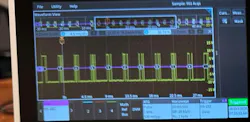
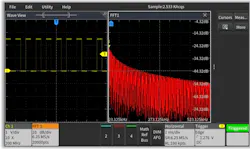
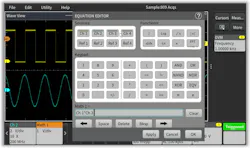
The math capability is the feature most clearly new to this low-bandwidth class. It combines basic waveform arithmetic, FFT (Figure 3), and an advanced equation editor (Figure 4), and it allows computed waveforms to be displayed in real time. Tektronix pairs it with limit testing and automated measurements. The company says these help engineers move from seeing a signal to understanding its behavior, particularly in embedded systems.
Editor Curveball Questions on Input Protection
Despite throwing an impromptu curveball of likely scenarios about first-year students throwing dice on excessive-voltage scope connections, Tektronix engineers confirmed that the 1 Series was designed with several safeguards against common connection mistakes and electrical overloads.
The inputs are rated to withstand 135 VRMS, with peaks from -400 V to +400 V, CAT II. That rating provides protection for typical basic electrical laboratories operating at 42 V or below. The instrument's inputs and outputs are physically separated, with the outputs on the rear panel to reduce the chance of an accidental connection. The software displays a clipping warning when a signal overdrives the inputs. For higher-voltage or higher-current applications, Tektronix recommends an appropriate high-voltage, high-attenuation (500:1) probe, such as their P5200A probe.
Each channel is supplied with a probe. The 50, 70, and 100 MHz models include a P2101 100 MHz 1X/10X voltage probe per channel, and the 200 MHz model includes a P2201 200 MHz 1X/10X probe per channel.
Form Factor and Connectivity
Tektronix 1 series seems best suited for education, embedded design and debug, electronics test and repair, automated test, and general-purpose engineering. The instrument can aso act as an additional scope for everyday debug and repair or as added measurement capacity on a busy bench.
The 1 Series has a compact footprint, easily placed on an Octoberfest serving tray along with a couple of glasses of Hefeweizen - perfect for its Octoberfest launch venue at Electronica 2026.
The instrument's compact size (Figure 1a, above) conserves space on crowded benches, allows the instrument to sit closer to a device under test, and makes it easy to move between work locations.
A 100 mm × 100 mm VESA interface permits mounting, including integration into automated test environments, and remote operation supports measurements when direct access to the instrument or device under test is impractical.
The display, Figure 5, is a 7-inch (1.000 Cavendish seems very unlikely to be a coincidence), WSVGA (1024 × 600) capacitive touchscreen with guided interactions and illuminated controls. Connectivity consists of one USB 2.0 device port on the front (ever notice how plugging in a USB device/cable into the back of a machine is always the wrong way?).
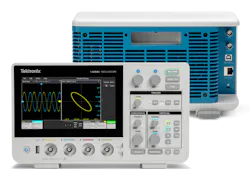
The back of the machine features one USB 2.0 host port, and 10/100 Base-T Ethernet.
Tek says Ethernet remote access and USBTMC support connected workflows, including Python-based automation. TekScope PC software extends waveform viewing and analysis to a computer, with advanced license options that add multi-scope analysis, additional serial bus decoding, jitter analysis, and power measurements.
Optional accessories include a soft carrying case, a hard case, and a rackmount kit. The standard warranty is one year, and the instrument includes a Kensington-style security slot and is EUCRA compliant.
The Tek Intelligence Connector
Tektronix is introducing the Tek Intelligence Connector [this is not a physical interconnect but is a software link] alongside the oscilloscope, with selective early-access requests now being honored. The Connector links a customer's AI agent of choice to Tektronix measurement knowledge, tools, and instrument capabilities, and the 1 Series is the first instrument it supports.
An engineer would simply describe an objective in plain language, and the agent uses The Connector to translate that intent into validated instrument commands, either to control the instrument directly or to build working automation. Rick Kuhlman, GM AI Design and Platform Software, explained the decision to release the connector as software:
The Tek Intelligence connector bridges a customer's AI agent to the measurement knowledge, tools and instrument capabilities Tektronix has built over 80 years. It debuts as software by design: AI agents typically run on a PC, not on the instrument itself, so placing the connector where the agent already lives allows a single solution to support dozens of instruments across our portfolio and fit into the workflows engineers use every day.
Pricing, Availability, and Electronica 2026 Info
Tektronix teams at the company's headquarters in Beaverton, Oregon, designed the 1 Series, which is now is available, starting at $450 for the base model, directly from Tektronix or, with shorter lead times, through distribution partners around the globe.
At Electronica 2026, held from Nov. 10-13 in Munich Germany, Tektronix will exhibit in Hall 4, Booth 438 and will have a live 1 Series demo there. Electronic Design's bigger than life, Editor-at-Large, Alix Paultre will be at the show and promises to do a video of the 1 series being demo'd in the Tek booth, which will then be posted here as part of this article.
Prost!
*Full disclosure: "Portland-woman in Bavaria" was created to be a metaphor of a Portland-area company launching the 1 series in Germany. She's not real, nor is she meant to resemble anyone living or otherwise.
About the Author
 Andy Turudic
Technology Editor, Electronic Design
Andy Turudic is a Technology Editor for Electronic Design Magazine, primarily covering Analog and Mixed-Signal circuits and devices and also is Editor of ED's bi-weekly Automotive Electronics newsletter.
He holds a Bachelor's in EE from the University of Windsor (Ontario Canada) and has been involved in electronics, semiconductors, and gearhead stuff, for a bit over a half century. Andy also enjoys teaching his engineerlings at Portland Community College as a part-time professor in their EET program.
"AndyT" brings his multidisciplinary engineering experience from companies that include National Semiconductor (now Texas Instruments), Altera (Intel), Agere, Zarlink, TriQuint,(now Qorvo), SW Bell (managing a research team at Bellcore, Bell Labs and Rockwell Science Center), Bell-Northern Research, and Northern Telecom.
After hours, when he's not working on the latest invention to add to his portfolio of 16 issued US patents, or on his DARPA Challenge drone entry, he's lending advice and experience to the electric vehicle conversion community from his mountain lair in the Pacific Northwet[sic].
AndyT's engineering blog, "Nonlinearities," publishes the 1st and 3rd Tuesday of each month. Andy's OpEd may appear at other times, with fair warning given by the Vu meter pic. His cartoon series, "Inventors", appears each week in Electronic Design Weekly.


Comment About the Article
To join the conversation, and become an exclusive member of Electronic Design, create an account today!
 Leaders Logo
Leaders relevant to this article: