Evolution of Timekeeping: Rise of the Mechanical Clock
What you’ll learn:
- When did mechanical timekeeping come into play?
- How has the mechanical clock reshaped human behavior?
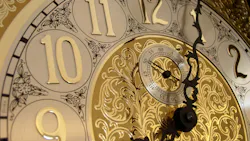
For millennia, humans relied on the natural world to mark the passage of time. Celestial movements, seasonal cycles, and rudimentary shadow clocks provided a timekeeping framework for structuring daily life. However, as civilizations advanced, so did the need for greater precision. The advent of mechanical clocks in the 13th century marked a turning point in timing technology, redefining timekeeping and transforming society.
Welcome to the second installment of our three-part series on the history of timekeeping. In Part 1, we explored ancient methods of measuring time. Now, we examine how mechanical clocks reshaped human perception and organization of time, paving the way for modern advances.
The Birth of Mechanical Timekeeping
In 13th century medieval Europe, the development of mechanical clocks sparked a major technological leap in timekeeping technology. Unlike sundials or water clocks, these devices functioned independently of environmental conditions, offering consistent and precise time measurement.
One of the first mechanical timekeeping devices used a weight pulled down by gravity and slowed to a regular rhythm by a foliot — a mechanical brake operating with a to-and-fro movement. The key innovation was the escapement mechanism, an interface between the clock’s gears and the foliot that regulated the release of energy and maintained a steady rhythm. This enabled mechanical clocks to measure time more accurately than ever before.
Early mechanical clocks were installed in town squares and cathedral towers across Europe, serving as communal timekeepers. These towering structures not only displayed the time in a prominent manner for the viewing public, but also reinforced societal rhythms — signaling work hours, religious services, and market schedules.
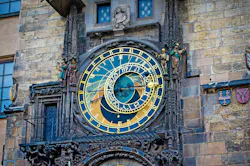
By the 15th century, intricate astronomical clocks, like the renowned Prague Astronomical Clock (see figure), showcased both timekeeping and celestial tracking, blending art and science in remarkable ways.
A New Discipline: Time as a Governing Force
The mechanical clock reshaped human behavior, instilling a greater sense of punctuality and discipline. No longer constrained by the rhythms of the cosmos and natural world, daily life became more structured. The precision of mechanical clocks played a crucial role in economic expansion, enabling more reliable trade, efficient labor organization, and the coordination of transportation networks.
This shift also influenced scientific inquiry. With increasingly accurate time measurement, astronomers, navigators, and engineers could conduct experiments and record observations with newfound precision. The pursuit of even greater accuracy led to innovations in mechanical design, driving progress in engineering and instrumentation.
The Foundation for Industrial and Technological Advancements
The mechanical clock laid the groundwork for future revolutions in industry and technology. As societies embraced the concept of standardized time, manufacturing and agricultural processes, military operations, and global commerce became more synchronized. This demand for greater precision ultimately led to the development of portable timepieces, setting the stage for personal watches and, later, electronic timekeeping.
The mechanical clock was more than just a breakthrough in timekeeping technology. It represented a paradigm shift that brought order and predictability to an increasingly complex world, reinforcing humanity’s enduring quest for Precision Timing.
The Continuing Evolution of Timekeeping
Today, the need for precise time measurement extends far beyond mechanical gears and pendulums. Advanced timing solutions now drive the digital age, supporting everything from AI-driven data centers to autonomous vehicles. Each era’s pursuit of more accurate timekeeping has fueled the next wave of innovation.
Join us for the final installment of this series, where we trace the journey from early quartz oscillators to the MEMS-based precision timing systems that power today’s advanced technologies.
Other Parts in this Evolution of Timekeeping Series
 The Prague Astronomical Clock
About the Author
 Mohamed Zanaty
Research and Development Engineering @ SiTime
Mohamed Zanaty, Ph.D., is a Research and Development Engineering at SiTime.
He earned a Doctor of Philosophy in Microsystems at Ecole Polytechnique Fédérale de Lausanne (EPFL).
Related
The Prague Astronomical Clock

Comment About the Article
To join the conversation, and become an exclusive member of Electronic Design, create an account today!
 Leaders Logo
Leaders relevant to this article: