Evolution of Timekeeping: From Pendulum Clocks to MEMS Oscillators
What you’ll learn:
- The impact of pendulums and mechanical oscillators.
- Why quartz crystal became an important timing tool.
- What MEMS brings to timing technology.
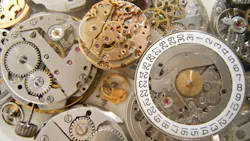
In this final installment on the history of timekeeping, we explore how oscillatory motion — first seen in pendulum clocks — evolved into the microelectromechanical-systems (MEMS) oscillators that now drive modern electronics and advanced technologies.
Big, transformative ideas often begin with simple observations. Imagine Galileo Galilei sitting in a cathedral in the early 1600s, observing a chandelier swaying with rhythmic precision. He noticed a remarkable phenomenon: Regardless of the arc of the chandelier’s swing, the time it took to complete each cycle remained consistent. This revelation of isochronism laid the foundation for the future of precise timekeeping.
The Birth of Mechanical Oscillators: The Pendulum Clock
Galileo's observations at the turn of the 17th century inspired the development of the first mechanical oscillator: the pendulum clock (see figure), which was essentially the first mechanical oscillator. Inspired by Galileo’s concepts, Christiaan Huygens successfully built the first working model of a pendulum clock in 1657, achieving a breakthrough in timekeeping accuracy. Huygens' clock improved precision by two orders of magnitude, from minutes to mere seconds per day.
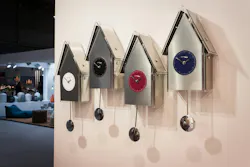
This development rendered mechanical clocks more reliable than astronomical observations, which can vary by up to 30 seconds per day due to the Earth's elliptical orbit.
Portable Timekeeping: The Balance Wheel and Spring
While pendulums provided exceptional accuracy, they were impractical for portable clock applications. Enter the balance wheel and spiral spring — a critical innovation developed by Huygens in 1675. Unlike pendulums, balance wheels oscillate back and forth regardless of orientation, making them ideal for pocket watches, wristwatches, and marine chronometers.
By the early 1700s, precise timekeeping became vital for maritime navigation, particularly for determining longitude at sea. In 1714, the British government established the Longitude Prize, seeking a method to measure a ship’s position with an accuracy of one-half degree.
John Harrison ultimately met that challenge in 1761 with the invention of the H4 marine chronometer. It maintained an unprecedented accuracy of two seconds per day, transforming global navigation and solidifying the role of portable oscillators.
The Quartz Revolution of the 20th Century
The next revolution in timekeeping arrived with the discovery of piezoelectricity by Pierre and Jacques Curie in 1880. The Curie brothers determined that quartz crystals generate a consistent electrical signal when subjected to mechanical stress. This discovery led to the first quartz clock in 1927, which far surpassed the accuracy of mechanical timekeepers.
The quest for ever-greater accuracy advanced into the early 20th century with the development of the Shortt dual-pendulum clock — an electromechanical innovation that set new precision benchmarks. Introduced in the 1920s, this system used two interconnected pendulums: a primary pendulum housed in a vacuum chamber to shield it from external disruptions and a secondary pendulum acting as a regulator. This design reinforced a key timekeeping principle, namely that reducing environmental interference is essential for stability.
While remarkably accurate — deviating by only about one second per year — the Shortt clock remained limited by its mechanical nature, making it susceptible to temperature shifts and air pressure variations. These constraints hindered widespread adoption and drove the search for even more reliable timing solutions.
The next major leap in timekeeping came in 1927 with the invention of the quartz-crystal oscillator. The late 19th-century discovery of piezoelectricity by Pierre and Jacques Curie had revealed that certain materials, like quartz, generate an electrical charge under mechanical stress. Conversely, applying an electric charge induces precise vibrations at a stable frequency.
Quartz-crystal resonators harnessed this effect, providing a level of consistency far superior to mechanical timekeepers. This led to the quartz clock, which soon outperformed pendulum-based designs and became the new standard for precision timekeeping. By the 1970s, quartz technology dominated electronic timekeeping, powering wristwatches, household clocks, computers, and telecommunications systems, where precise synchronization was crucial.
MEMS and the Future of Precision Timing
Although quartz-based timing has long underpinned electronic systems, today’s evolving electronics requirements are accelerating the shift toward MEMS-based timing devices. Produced using semiconductor manufacturing processes, MEMS solutions inherit the repeatability of advanced silicon fabrication. This foundation is enabling companies like SiTime to broaden the capabilities of precision timing, delivering scalable, high-performance solutions for electronic systems.
MEMS timing devices also help enable more compact electronics and support novel packaging approaches designed to withstand harsh operating conditions, including shock, vibration, and wide temperature ranges. The result is improved stability, resiliency, and long-term reliability in increasingly complex electronic systems.
These advantages are particularly important in high-growth markets such as AI infrastructure, cloud and edge data centers, automated driving systems, robotics, and industrial IoT. In these applications, precise synchronization and consistent performance are essential. Such capabilities align closely with silicon MEMS architectures.
Another key advantage of MEMS is programmability. Unlike fixed-frequency quartz, programmable MEMS timing solutions give designers the flexibility to tune frequency, stability, and performance to meet the needs of a broad range of applications.
From Galileo’s early observations to today’s silicon-based innovations, the evolution of timekeeping reflects a sustained pursuit of accuracy, stability, and reliability. As the demands of modern electronics continue to intensify, MEMS is poised to play a central role in shaping the future of precision timing.
Other Parts in this Evolution of Timekeeping Series
 The Prague Astronomical Clock
 id_1081641__melissa_dockstader__dreamstime
About the Author
 Mohamed Zanaty
Research and Development Engineering @ SiTime
Mohamed Zanaty, Ph.D., is a Research and Development Engineering at SiTime.
He earned a Doctor of Philosophy in Microsystems at Ecole Polytechnique Fédérale de Lausanne (EPFL).
Related
id_1081641__melissa_dockstader__dreamstimeThe Prague Astronomical Clock

Comment About the Article
To join the conversation, and become an exclusive member of Electronic Design, create an account today!
 Leaders Logo
Leaders relevant to this article: