900-V Bidirectional GaN Powers Solid-State Transformers Key to AI
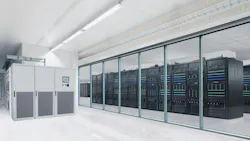
Solid-state transformers (SSTs) could play a central role in meeting the massive power demands of AI data centers. Like traditional transformers, they sit at the front end of the facility's power distribution system, converting medium-voltage (MV) electricity flowing in from the grid, typically 13.2 or 34.5 kV, into into low-voltage (LV) power, generally 480 V AC.
The similarity largely ends there, though. Instead of relying on massive iron cores and copper windings, SSTs use power semiconductors and digital control to deliver the ±400- to 800-V DC bus increasingly favored by AI server racks (see figure).
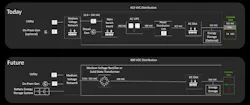
Typically built around high-frequency silicon-carbide (SiC) or gallium-nitride (GaN) devices, SSTs can be more efficient and compact than line-frequency transformers while responding faster to changing loads and regulating power flow more intelligently.
SiC has emerged as the leading technology in these multi-level power converters because it can handle higher voltages, reducing the number of conversion stages inside the SST. GaN brings different advantages: faster switching speeds and higher efficiency.
However, most GaN power ICs are rated for significantly lower breakdown voltages than SiC. As a result, SSTs based on GaN spread out the grid voltage across many smaller converter cells connected in series. That means a more modular architecture, but one that can increase system cost and control complexity.
To tamp down these tradeoffs, Infineon Technologies said it will supply the first 900-V GaN-based bidirectional switches (BDS) to Enphase Energy for deployment in SST power modules. By extending the operating voltage range of GaN from 650 V to 900 V while keeping its high-frequency switching speeds, the monolithic power devices enable highly efficient, compact power-conversion architectures for data centers and the like.
The GaN power ICs will be deployed directly into Enphase’s IQ Solid-State Transformer for AI data centers. Each rack-shaped SST is equipped with 342 power modules that use GaN to deliver the high switching frequency and control bandwidth needed for fast, precise load management.
Operating from input voltages as high as 34.5 kV AC, Enphase said that a single rack can deliver up to 1.25 MW of power, and the DC output voltage will support both NVIDIA 800-V DC and OCP ±400-V DC standards.
Unlike standard power switches, GaN BDS devices integrate bidirectional voltage blocking and current conduction in a single device. This leads to simpler power stages with fewer components and supports the high-frequency operation needed to increase power density and reduce the size of magnetic components.
The higher blocking voltage gives engineers the ability to hit higher system voltages with fewer converter stages, assisting the shift to 800-V DC power distribution architectures in AI data centers.
The same device technology could also apply to commercial solar inverters by enabling three-phase, line-to-line designs for 480-V applications in the U.S. It reduces the number of switches required in the system as well as power losses and bill-of-materials (BOM) costs.
"GaN is not new to us. It has been running in Enphase’s IQ9 microinverters in the field, and that experience has given us confidence in deploying the technology in megawatt-scale systems," said Enphase CTO Hans van Antwerpen.
He added, "Moving to 900 V gives us more voltage headroom while retaining the benefits of high-frequency switching. It allows us to remove converter stages from the system and reduce the number of components in the power path, which translates to higher efficiency, higher power density, and improved system reliability.”
Infineon already partnered on 650-V GaN BDS technology for Enphase's IQ9 microinverters. The 900-V GaN has been successfully tested and is now being integrated into Enphase’s IQ SST product development, with production qualification to follow close behind.
About the Author
 James Morra
Senior Editor
James Morra is the senior editor for Electronic Design, covering the semiconductor industry and new technology trends, with a focus on power electronics and power management. He also reports on the business behind electrical engineering, including the electronics supply chain. He joined Electronic Design in 2015 and is based in Chicago, Illinois.
Related
 0and1s_dreamstime_security_152088993

Comment About the Article
To join the conversation, and become an exclusive member of Electronic Design, create an account today!
 Leaders Logo
Leaders relevant to this article: