SiC Power Modules Simplify Solid-State Transformer Development
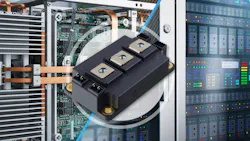
The impetus behind Microchip Technology’s 3.3-kV HV‑D3 mSiC power modules is to simplify and accelerate the adoption of solid-state transformers (SSTs) in AI hyperscale data centers and other high‑voltage power applications. Solid-state transformers represent a foundational shift in power delivery, reducing conversion stages and enabling higher system efficiency.
The industry's shift toward higher-voltage DC rack distribution in next-generation AI facilities further amplifies the value of SSTs. They’re intended to deliver regulated DC directly from the medium-voltage grid with fewer conversion stages.
The HV‑D3 mSiC modules are engineered to meet these requirements by integrating 3.3-kV silicon-carbide (SiC) mSiC MOSFETs and Schottky diodes in an industry‑standard 62-mm package, enabling efficient power delivery from the medium‑voltage grid directly to the server rack.
Based on Microchip’s mSiC MOSFET technology, they offer highly competitive RDS(on) stability over temperature, with packaging that supports 6 kV isolation. They also incorporate CTI 600‑rated materials and feature extended creepage distances, all designed to allow safe series connection for high‑voltage operation. A silicon-nitride (Si₃N₄) substrate delivers enhanced thermal conductivity and power‑cycling capability, helping designers achieve higher power density with less aggressive cooling.
The HV‑D3 mSiC power modules are available in half‑bridge and common‑source configurations with and without anti‑parallel Schottky diodes, addressing applications in the 100- to 300-A range. The mSiC MOSFET technology offers balanced switching losses for both hard‑ and soft‑switched topologies, suiting the devices for SST designs and other high‑frequency, high‑voltage systems.
While optimized for SSTs in AI data centers, the HV‑D3 modules also address a wide range of other applications, including megawatt charging infrastructure for heavy‑duty vehicles, auxiliary power supplies for rail/heavy transportation, medium‑voltage motor drives, and industrial and defense power systems.
Development Tools
The power modules are supported by an application note, design guide, and device and simulation models for rapid prototyping. Microchip also provides global technical support, design services, and field application engineering support.
Next in This Edition of PowerBites
 liion_dreamstime_229728474
More PowerBites

 powerbites_promo
About the Author
 Lee Goldberg
Lee Goldberg
Contributing Editor
Lee is the author of the popular PowerBites series.
Lee Goldberg is a self-identified “Recovering Engineer,” Maker/Hacker, Green-Tech Maven, Aviator, Gadfly, and Geek Dad. He spent the first 18 years of his career helping design microprocessors, embedded systems, renewable energy applications, and the occasional interplanetary spacecraft. After trading his ‘scope and soldering iron for a keyboard and a second career as a tech journalist, he’s spent the next two decades at several print and online engineering publications.
Lee’s current focus is power electronics, especially the technologies involved with energy efficiency, energy management, and renewable energy. This dovetails with his coverage of sustainable technologies and various environmental and social issues within the engineering community that he began in 1996. Lee also covers 3D printers, open-source hardware, and other Maker/Hacker technologies.
Lee holds a BSEE in Electrical Engineering from Thomas Edison College, and participated in a colloquium on technology, society, and the environment at Goddard College’s Institute for Social Ecology. His book, “Green Electronics/Green Bottom Line - A Commonsense Guide To Environmentally Responsible Engineering and Management,” was published by Newnes Press.
Lee, his wife Catherine, and his daughter Anwyn currently reside in the outskirts of Princeton N.J., where they masquerade as a typical suburban family.