New Electrode-Coating Analysis Technique Could Boost Li-Ion Performance
What you’ll learn:
- A recent study by researchers at Tokyo University of Science (TUS), Japan, identified techniques to identify optimal conditions for applying slurries of electrode material to be identified using less than one milliliter of slurry in about five minutes.
- If commercialized, it could offer battery makers a practical, data-driven technique for improving battery performance, manufacturing efficiency, and reducing material waste.
Lithium-ion battery technology continues to benefit from improved battery materials and processes. However, important challenges remain in manufacturing, especially in preparing the electrode slurry, a mixture that directly affects electrical conductivity, stability, and overall battery performance.
On that front, a recent study by researchers at Tokyo University of Science (TUS), Japan, identified techniques that enable optimal coating conditions to be identified using less than one milliliter of slurry in about five minutes. This offers a practical, data-driven way to improve battery manufacturing efficiency and reduce material waste.
Until now, studying these slurries has been difficult because the commonly used techniques are performed under static conditions. That means they don’t duplicate the strong shear forces the electrode materials are subjected to during mixing and coating process, which occur during manufacturing. Under shear, conductive additives like carbon black can rearrange, changing the internal network that controls how easily electrons move through the electrode. These effects are hard to capture with conventional methods.
Evaluating Slurries with Rheo-Impedance Spectroscopy
TUS researchers addressed this problem by applying an extended rheo-impedance spectroscopy to evaluate electrode slurries under coating-like shear conditions. The technique, previously developed by the same group, integrates controlled shear deformation with electrochemical impedance spectroscopy (EIS), which measures how easily electrical signals pass through a material. This allows researchers to observe how conductive networks evolve inside complex battery slurries while the slurry is being processed.
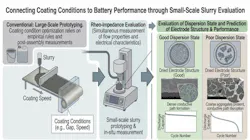
The new method offers several advantages: First, it replaces trial-and-error approaches with direct measurements to identify optimal slurry processing conditions. Second, it enables prediction of the electrode structure and battery performance directly from the slurry state during the coating process.
In doing so, manufacturers are able to select an intermediate shear rate that disperses particles evenly while preserving conductive networks, leading to lower electrode resistance and better cycle stability. This could accelerate battery development, reduce waste, and improve overall manufacturing efficiency as the demand for lithium-ion batteries continues to grow.
The team applied this method to lithium-iron-phosphate (LiFePO4) cathode slurries, which are widely used in lithium-ion batteries. Using a rotational rheometer, they applied controlled shear forces similar to those experienced during industrial coating. At the same time, they measured the slurry’s electrical response using EIS. The experimental setup closely replicated real manufacturing conditions, including a coating thickness of 500 µm.
Results of the Slurry Study
Their results showed a clear connection between how the slurry was processed and how the battery performed. As the shear rate increased, the internal structure of the slurry changed in a nonlinear way.
At low shear rates of around 1.3 s-1, conductive additives remained clustered, leading to poor electrical connectivity. At very high shear rates up to 200 s-1, the conductive network became overly fragmented, reducing performance. However, at an intermediate shear rate of around 50 s-1, the additives were evenly distributed while maintaining strong connections, creating an optimal conductive network.
The study revealed that electrodes made under these conditions showed lower resistance, improved charge-discharge performance, and better cycle stability. This demonstrates that there’s an optimal “sweet spot” in processing conditions that balances breaking up particle clusters with maintaining electrical pathways.
“This method can identify promising coating conditions using less than one milliliter of slurry, with each measurement completed in about five minutes,” said TUS’s Dr. Shitanda. He also noted that, while these findings highlight the potential of the method to improve electrode performance, further validation across different material systems and cell designs will be necessary to confirm its broader applicability.
Reference
“Rheo-impedance spectroscopy for correlating slurry properties with LiFePO4 cathode performance in lithium-ion batteries,” Journal of Power Sources; DOI: https://doi.org/10.1016/j.jpowsour.2026.240175.
Next in This Edition of PowerBites


More PowerBites

 powerbites_promo
About the Author
 Lee Goldberg
Lee Goldberg
Contributing Editor
Lee is the author of the popular PowerBites series.
Lee Goldberg is a self-identified “Recovering Engineer,” Maker/Hacker, Green-Tech Maven, Aviator, Gadfly, and Geek Dad. He spent the first 18 years of his career helping design microprocessors, embedded systems, renewable energy applications, and the occasional interplanetary spacecraft. After trading his ‘scope and soldering iron for a keyboard and a second career as a tech journalist, he’s spent the next two decades at several print and online engineering publications.
Lee’s current focus is power electronics, especially the technologies involved with energy efficiency, energy management, and renewable energy. This dovetails with his coverage of sustainable technologies and various environmental and social issues within the engineering community that he began in 1996. Lee also covers 3D printers, open-source hardware, and other Maker/Hacker technologies.
Lee holds a BSEE in Electrical Engineering from Thomas Edison College, and participated in a colloquium on technology, society, and the environment at Goddard College’s Institute for Social Ecology. His book, “Green Electronics/Green Bottom Line - A Commonsense Guide To Environmentally Responsible Engineering and Management,” was published by Newnes Press.
Lee, his wife Catherine, and his daughter Anwyn currently reside in the outskirts of Princeton N.J., where they masquerade as a typical suburban family.
Comment About the Article
To join the conversation, and become an exclusive member of Electronic Design, create an account today!
 Leaders Logo
Leaders relevant to this article: