2025 PowerBest Winners: Power Conversion and Management

What you’ll learn:
- The AI boom of 2025 inspired many chipmakers to develop complex, high-power, multichannel PMICs to address the near-impossible requirements of the latest generation of GPUs.
- Application-optimized power-conversion architectures are also helping designers deliver high efficiencies and performance at lower price points for automotive systems, appliances, and other consumer goods.
- Modern WBG devices are making it possible to develop simpler, more cost-effective single-stage power topologies for use in EV chargers, solar inverters, energy storage, and motor drives.
- Switcher Supply ICs Boost Power While Cutting Cost and Footprint
- Versatile 16-Phase, 2-Rail PMIC Supports NVIDIA GPU-Based Apps
- Highly Integrated 65-W Flyback Converter Comes in Thermally Enhanced QFN Package
- Bidirectional GaN ICs, Gate Drivers Foster High-Power Single-Stage Conversion Topologies
- Low-Noise LDOs Stabilize DC Power Lines with Rapid Load Transient Response
- PMIC Fits Space-Starved AI, Industrial Computing, Data Center Apps

The recently released TinySwitch-5 series of switching ICs from Power Integrations leverages an application-optimized architecture to offer an economical, more compact solution for applications requiring up to 200 W. And they don’t compromise on performance.
Although the new IC family’s architecture omits PI’s proprietary (and quite excellent) FluxLink isolation technology in favor of a more basic diode rectification and optocoupler feedback circuit, it still manages to achieve up to 92% efficiency and a rich set of protection features. Equally important, the devices can serve as drop-in replacements in many designs using any earlier series of switches.
The controller features an advanced control engine that squeezes the most out of “vanilla” silicon MOSFET devices by managing both off time and switch current limit to keep the switch operating in its peak range and power delivery to maximize efficiency, even at light loads. As a result, supplies based on the TinySwitch-5 are able to meet the light-load power-consumption limit of 300 mW, set by the2009/125/EC Directive, while still delivering up to 220 mW of output power for display and other standby functions.
Originally appeared in the April edition of PowerBites
Versatile 16-Phase, 2-Rail PMIC Supports NVIDIA GPU-Based Apps

Alpha and Omega Semiconductor’s (AOS) AOZ73016QI is a 16-phase, 2-rail controller specifically designed to the latest OpenVReg16 (OVR16) specifications from NVIDIA. The AOZ73016QI controller design is based on the company’s high-performance, proprietary AOS Advanced Transient Modulator (A2TM) control scheme, which offers high-level current balance at all load conditions as well as during fast load transients.
In addition to supporting all basic requirements of the OVR16 specification, the new AOS power-management IC (PMIC) offers value-added features such as RDS(on) and DC resistance (DCR) sensing for current monitoring and current balance. These features enable AOS’s controller to support both DrMOS and Smart Power Stages (SPS) to deliver a complete AI server and graphic-card power solution along with increased design flexibility.
>>Check out the other 2025 PowerBest Award Winners

The controller also supports phase doubling or tripling without an external phase multiplier, allowing for a single controller to provide up to 48 phases to its associated power stages.
When paired with AOS’s high-performance DrMOS and SPS power stages, designers can achieve high efficiency and thermal performance. This will significantly cut transient power demands by several hundred watts during the brief periods when the SoC draws peak power.
Originally appeared in the February Edition of PowerBites
Highly Integrated 65-W Flyback Converter Comes in Thermally Enhanced QFN Package

STMicroelectronics recently added VIPerGaN65W, a 65-W flyback converter, to its VIPerGaN series. By combining a 700-V gallium-nitride (GaN) transistor and quasi-resonant pulse-width-modulation (PWM) control IC in a single QFN 5x6 package, the VIPerGaN65W provides a compact, high-quality, cost-effective platform for developing USB-PD chargers, fast battery chargers, and auxiliary power supplies.
VIPerGaN flyback controllers operate in quasi-resonant mode with zero-voltage switching (ZVS) up to the full load. Valley skipping optimizes efficiency at mid-to-high load — ST’s proprietary valley locking prevents noise at audio frequencies and thus ensures silent operation. With frequency foldback at light load, the converter enters burst operation at no-load to cut power consumption below 30 mW for eco-design compliance.
Originally appeared in the December edition of PowerBites
Bidirectional GaN ICs, Gate Drivers Foster High-Power Single-Stage Conversion Topologies

Navitas Semiconductor’s 650-V bidirectional GaNFast ICs and IsoFast, high-speed isolated gate drivers were created to help simplify the transition from two-stage to single-stage power topologies in EV chargers, solar inverters, energy storage, and motor drives. The GaN power ICs are monolithic, single-chip designs featuring a merged drain structure, two gate controls, and an integrated substrate clamp that function as two “back-to-back” GaN power switches.
One bidirectional GaNFast IC can replace up to four older switches used to implement the two-stage architectures found in over 70% of today’s power-conversion circuits. Not only does the chip increase system performance, but it also reduces component count, PCB area, and system costs.
Originally appeared in the June edition of PowerBites
Low-Noise LDOs Stabilize DC Power Lines with Rapid Load Transient Response
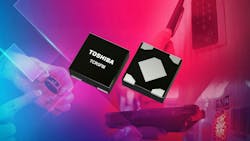
The TCR5FM series of LDO regulators from Toshiba Electronics offers fast transient response to help enhance performance and battery life of small battery-powered devices, such as smartphones and wearables. The new regulators are designed to suppress potential instabilities in DC power lines that rapidly switch between their low-power standby modes and high-speed processing operations.
The new TCR5FM series improves load transient response from standby by approximately 80% compared to Toshiba’s existing TCR3RM series. The high performance is accomplished by combining a bandgap circuit, a low-pass filter that permits only extremely low frequencies to pass, and a high-speed, low-noise operational amplifier.
By quickly detecting fluctuations in output voltage and providing fast feedback, variations in output voltage are reduced, even during sudden load changes. In addition, the LDOs offer a ripple rejection ratio of 91 dB (typ.) to minimize supply noise.
Originally appeared in the December edition of PowerBites
PMIC Fits Space-Starved AI, Industrial Computing, Data Center Apps

Leveraging high-performance MPUs and FPGAs, Microchip Technology's MCP16701 power-management integrated circuit (PMIC) is a compact and flexible solution that addresses space-constrained applications.
The PMIC integrates eight 1.5-A buck converters that can be paralleled, four 300-mA internal low-dropout voltage regulators (LDOs), and a controller to drive external MOSFETs. Microchip said the chip can help designers reduce PCB footprint by up to 48% while reducing the component count by more than 60% over a discrete solution.
A key feature of the MCP16701 is its ability to dynamically change VOUT levels for all converters in 12.5- and 25-mV increments, which makes it possible for designers to fine-tune power delivery to meet specific application requirements. The PMIC also has an I2C communication interface to simplify and enhance communication efficiency. It’s supported by the EV23P28A Evaluation Board.
Originally appeared in the May Edition of PowerBites
>>Check out the other 2025 PowerBest Award Winners
About the Author
 Lee Goldberg
Lee Goldberg
Contributing Editor
Lee is the author of the popular PowerBites series.
Lee Goldberg is a self-identified “Recovering Engineer,” Maker/Hacker, Green-Tech Maven, Aviator, Gadfly, and Geek Dad. He spent the first 18 years of his career helping design microprocessors, embedded systems, renewable energy applications, and the occasional interplanetary spacecraft. After trading his ‘scope and soldering iron for a keyboard and a second career as a tech journalist, he’s spent the next two decades at several print and online engineering publications.
Lee’s current focus is power electronics, especially the technologies involved with energy efficiency, energy management, and renewable energy. This dovetails with his coverage of sustainable technologies and various environmental and social issues within the engineering community that he began in 1996. Lee also covers 3D printers, open-source hardware, and other Maker/Hacker technologies.
Lee holds a BSEE in Electrical Engineering from Thomas Edison College, and participated in a colloquium on technology, society, and the environment at Goddard College’s Institute for Social Ecology. His book, “Green Electronics/Green Bottom Line - A Commonsense Guide To Environmentally Responsible Engineering and Management,” was published by Newnes Press.
Lee, his wife Catherine, and his daughter Anwyn currently reside in the outskirts of Princeton N.J., where they masquerade as a typical suburban family.
Comment About the Article
To join the conversation, and become an exclusive member of Electronic Design, create an account today!
 Leaders Logo
Leaders relevant to this article: