Parallel View: Managing Multi-Cell Batteries in Smart Glasses
What you'll learn:
- How a parallel-connected battery can increase the energy-storage capacity of smart glasses and their unique challenges.
- How parallel battery-management ICs can help maximize runtime and maintain battery longevity in AR devices.
- Why accurate cell-level monitoring is key to optimal charging and discharging of parallel battery cells.

Under the sleek frames of smart glasses and augmented-reality (AR) devices lies a lot of advanced technology. However, these devices tend to deliver only several hours of active operation. That’s because cameras and sensors must continuously capture the surroundings while processors render digital objects on the high-resolution displays and overlay them on the physical world in real-time. The hefty power demands of real-time spatial computing run up against their lightweight form factors and limited battery capacity.
Since the devices are worn on the face, the battery pack must be tiny, typically tucked into the thin temples of the frames or embedded in the arms, severely limiting their capacity. With the devices resting directly on the skin, the amount of heat they can safely produce is restricted. Consequently, that puts a cap on processor performance and battery discharge rate.
But as smart glasses rapidly move into the mainstream, engineers are getting more creative when it comes to stretching out the limited runtime of these devices.
One trend is to distribute several small batteries throughout the device and connect them in parallel, so that they function as a single higher-capacity pack. This architecture allows designers to use otherwise unused spaces within the frame or enclosure, effectively increasing total battery capacity without enlarging the device.
However, parallel batteries can present some difficulties to designers, specifically when it comes to balancing the voltages between cells, matching their impedances, and preventing unintended cross-charging. Managing these issues requires accurate, real-time monitoring of voltage, current, and temperatures within the cells. It also demands precise control to speed up charging and increase runtimes without compromising safety and reliability.
At CES, Analog Devices demoed a battery-management IC, the MAX17335, that integrates charging, monitoring, and protection functions in a single chip to simplify battery management for parallel cells
What’s the Difference Between Connecting Batteries in Parallel and Series?
As battery life becomes a more critical factor for consumer devices, companies are increasingly adopting multi-cell designs that physically separate cells to help extend the battery's effective capacity and lifespan.
In a “series” configuration, separate battery cells are connected end-to-end to increase the voltage without increasing the overall capacity, typically to boost efficiency. In contrast, placing the cells side-by-side in a “parallel” configuration provides more total ampere-hour (Ah) capacity while maintaining the voltage.
Cells placed in series require the same voltage and capacity ratings to maximize performance and safety. Though the cells in a parallel configuration should share the same nominal voltage, their capacities can differ.
Parallel configurations also make it possible to place batteries in unique locations, such as opposite sides of smart glasses or different sides of a foldable phone, giving engineers more flexibility in form factor. For instance, instead of integrating a single 200-mAh battery in one arm of the smart glasses, a smaller 150-mAh cell can take its place before being connected in parallel with a 100-mAh battery located in the tip that loops around the ear, adding up to 250 mAh (Fig. 1). The additional 50 mAh increases the total capacity by 25%.

But with these benefits come new challenges for battery-management systems (BMS). Most important in a multi-cell battery is balancing voltages and currents between individual cells. Cell balancing can be tricky: These parameters constantly change due to the electrochemical reactions occurring within the cells, the different loads placed on them, and other factors such as temperature and age that can influence the impedance of the cells. These factors can cause inequalities to emerge between cells.
Balancing the state of charge (SOC) between cells is essential to maximizing capacity and longevity. During the charging cycle, inherent differences in capacity or discrepancies in the voltage or other parameters can lead to the undercharging of some cells and the overcharging of others. This prevents the pack from using its full capacity, and it may prematurely degrade cells. As a result, decreased overall life of the battery and safety issues can be seen with time.
When batteries have different capacities, cell balancing can be more complicated. Since the SOC is a relative metric, cells with lower capacity reach the same SOC faster than higher-capacity ones. Maintaining balance means delivering differential amounts of current to cells during both charge and discharge in every cycle, which is more demanding. The complexity of doing that rises with the number of cells placed in parallel.
The BMS must also be able to control the current distribution from the cells during operation. Unless the load is carefully balanced among parallel batteries, the lower-capacity cells can be depleted before higher-capacity ones, causing early undervoltage shutdown of the pack. This could lead to a large amount of available capacity remaining unused. Also, if the impedance of the path to each battery cell isn’t equal, the current will not be distributed equally.
One battery being depleted faster than the other can cause harder cycling of that particular cell. As a result, the battery cell could prematurely start losing capacity, reducing not only the overall lifespan of the pack, but the entire consumer device.
>>Check out more of our 2026 CES coverage
 CES at Las Vegas Convention Center West Hall
Another issue is unintentional cross-charging. When unbalanced cells are connected in parallel, the battery with the higher voltage will attempt to divert current into the lower-voltage one until they equal out, potentially causing overheating or other issues.
As the device draws a large amount of power, both batteries are primarily occupied with the load. But when the device dials things down, the risk of cross-charging rises. This constant redistribution of current could unbalance the cells and cause power losses.
To solve the problem with passive components, diodes can be incorporated in the circuit. However, diode ORing often comes with disadvantages, including poor current sharing between cells.
Instead, a more intelligent battery-management IC can be used to switch off the charge FET in the circuit, restricting the flow of reverse current. This ensures that the batteries discharge at the same time, but the battery with the higher SOC battery will discharge first to equal the other cell.
One of the other benefits of a battery-management IC is that it can enable controlled cross-charging in situations when it makes sense to do so. For instance, when smart glasses are connected to a portable battery pack but remain in use, it can be helpful for the higher-voltage battery cell in the device to divert a small amount of power to charge the one with a lower voltage. The chip can handle that by tightly regulating the charge FET in the circuit, enabling a controlled amount of current to move between the battery cells.
Battery-Management IC Integrates Charger, Monitor, and Protector in One
Charging parallel battery cells safely and efficiently and distributing as much of their total capacity as possible without degradation requires accurate cell-level monitoring. The voltage, current, and temperature must be measured in real-time to accurately estimate the SOC of the cells.
Without such visibility, cells can charge and discharge inconsistently, requiring additional safety margins in the battery-protection system. That, in turn, may prevent the battery from being fully charged or discharged, reducing usable capacity.
Today’s battery-management ICs increasingly integrate a battery fuel gauge to more accurately control charging current and constantly monitor discharge conditions, helping protect against potential hazards.
One example is ADI’s MAX17335, which integrates charging, monitoring, and protection in a single chip. It draws power from a USB-C-compatible charger or converter and enables high-speed charging of parallel battery cells to help maximize runtime. While the device is designed for only single-cell lithium-ion (Li-ion) and lithium-polymer (LiPo) batteries, several chips can be used to independently charge cells connected in parallel and prevent unintended cross-charging (Fig. 2).
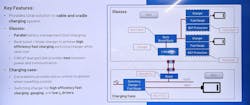
By regulating the charge N-FET, the device controls charge current to reduce charging times and preserve the battery’s health. It continuously monitors and adjusts charge voltage, current, and FET temperature to enable more accurate charging, which results in a higher top-off charge and longer runtime.
The MAX17335 can support low-power charging from 1 to 500 mA for smart glasses or other devices with compact, unconventional form factors. It also handles high-power parallel packs (over 1000 mA) for foldable smartphones and the like.
To determine the SOC of the battery cell, Analog Devices said the device uses a fusion-based approach that combines the short-term accuracy of coulomb counting with long-term stability of monitoring the open-circuit output voltage (OCV). The MAX17335 can adapt to a wide range of operating conditions, too, including cell aging, temperature variations, and discharge-current output. The ideal diode circuit inside the device helps prevent voltage drop across the charge FET.
The chip monitors the situation inside the battery cell to protect against overvoltage and undervoltage, overcurrent, short circuits, as well as overtemperature and undertemperature conditions. Internal self-discharge protection is implemented using high-side N-FETs, helping ensure the battery cells operate within safe limits and maintain a longer useful life.
>>Check out more of our 2026 CES coverage
CES at Las Vegas Convention Center West HallAbout the Author
 James Morra
James Morra
Senior Editor
James Morra is the senior editor for Electronic Design, covering the semiconductor industry and new technology trends, with a focus on power electronics and power management. He also reports on the business behind electrical engineering, including the electronics supply chain. He joined Electronic Design in 2015 and is based in Chicago, Illinois.
Comment About the Article
To join the conversation, and become an exclusive member of Electronic Design, create an account today!
 Leaders Logo
Leaders relevant to this article: