New Tech Tuesdays: High-Resolution 3D Depth Sensing with Multi-Zone dToF Sensors
Key Highlights
- dToF sensors measure the round-trip travel time of photons to determine precise object distances, improving accuracy over intensity-based methods.
- Multi-zone depth mapping divides the field of view into segments, enabling detailed 3D environmental awareness and obstacle detection.
- High-resolution optical modules support configurable grids, enhancing object detection, SLAM, and gesture recognition capabilities.
New Tech Tuesdays
Join Mouser's Technical Content team for a weekly look at all things interesting, new, and noteworthy for design engineers.
Accurate depth measurement is a fundamental requirement for modern autonomous systems, yet achieving precision across varying ambient lighting conditions remains a significant challenge. Whether a robot is navigating a cluttered warehouse or a camera system is attempting to focus on a fast-moving subject, the ability to distinguish between objects at different distances is critical. Traditional proximity solutions often struggle with “ghost targets” and environmental interference, which can compromise system safety. Direct time-of-flight (dToF) sensors address these challenges by measuring the travel time of individual photons with high precision.
This week’s New Tech Tuesdays explores the fundamentals of dToF technology, the advantages of multi-zone depth mapping, and how high-resolution optical modules enable sophisticated 3D environmental awareness.
Mastering the dToF Sensor Advantage
dToF technology represents a shift from simple proximity detection to comprehensive environmental mapping. Unlike indirect methods that estimate distance based on phase shifts, a dToF sensor measures the round-trip time of light to determine how far away an object is. The reflected signal is then processed to extract depth information, and multi-zone implementations can distinguish objects at different distances within the same field of view (FOV).
Environmental robustness is another important advantage of dToF sensing. Because distance is derived from time-of-flight information using photon timestamps rather than reflected intensity alone, many dToF systems can maintain more reliable performance under challenging ambient-light conditions than simpler intensity-based optical approaches. This reliability is essential for industrial applications where dust, grease, or bright factory lighting could otherwise cause sensor failure.
Precision Mapping with Multi-Zone Resolution
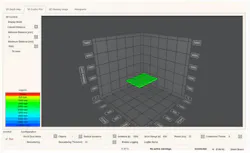
The true power of modern optical sensing lies in the transition from single-point measurements to multi-zone resolution. By dividing the FOV into discrete segments, design engineers can generate a 3D depth map (Figure 1) of the surroundings rather than a single distance value. High-resolution modules now support configurable grids, such as 8×8 or 48×32, enabling granular object detection across a wide area.[1]
A wider FOV, combined with a long detection range, enables systems to identify obstacles from a greater distance while maintaining peripheral awareness. In multi-zone implementations, dToF sensors can provide the spatial depth data needed for functions such as obstacle detection, host-side simultaneous localization and mapping (SLAM), cliff detection, people counting, and gesture recognition. Actual range, FOV, and spatial resolution depend on the specific device and configuration.
>>Click to read the entire article at Mouser
Sources
[1] https://www.mouser.com/pdfDocs/EVM.pdf