Designing Robust Capacitive Touch Interfaces for Industrial Use
Key Highlights
- Industrial capacitive touch interfaces face reliability issues from EMI, power supply noise, ESD, and environmental factors like moisture and gloves.
- Designing for harsh conditions requires shielding, robust materials, and advanced signal processing techniques such as baseline tracking and drift compensation.
- Broadband EMI from drives and inverters can cause phantom touches or missed inputs, necessitating careful layout and filtering strategies.
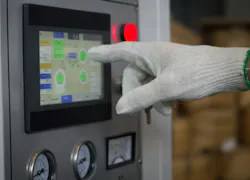
Capacitive touch interfaces are becoming more ubiquitous in industrial controls and building automation. Practical design advantages—including sealed surfaces, the lack of moving parts, and the ability to integrate multiple functions behind a single interface—have combined to drive this trend forward. While these advantages have made capacitive touch attractive for harsh and maintenance‑sensitive industrial settings, they also introduce reliability challenges.
Ensuring reliability in industrial settings requires overcoming hurdles that rarely occur in consumer-facing applications. One reliability issue is that motors and inverters generate broadband electromagnetic interference (EMI). Another is the harmonic noise generated by high-current switching supplies. Additional challenges arise when operators must wear insulating gloves or when condensation and cleaning fluid settle on a panel and remain there. Although these risks differ in origin, they share a common outcome: They disrupt the capacitive sensing signal in ways that can confuse a poorly designed interface, and each risk can cause a touch interface to misfire or fail.
Recognizing these risks is essential because industrial capacitive touch reliability is not achieved through sensitivity alone. Designing for industrial conditions requires a deliberate approach to materials, shielding, protection, and signal integrity. This blog discusses the primary failure mechanisms in industrial capacitive touch systems and explores techniques used to mitigate them.
Electrical and Environmental Threats to Capacitive Touch
Capacitive sensing measures electrode charge variations. Any condition that introduces an extra charge into the sensing path or interrupts the baseline can create problems for capacitive sensing. Let’s take a look at the most common industrial failure modes that occur.
Variable-frequency drives and servo controllers are a common source of broadband EMI. That interference can couple into nearby sensing traces and overwhelm a touch channel’s signal-to-noise margin, which can sometimes lead to phantom activations or missed inputs. This type of interference is especially challenging because it spans a wide frequency range and often varies with load and operating conditions.
In addition to broadband EMI, switching power supplies introduce a different kind of disturbance. They can generate lower-frequency noise that overlaps with the sensing band and slowly shifts the channel baseline. Over time, this movement may start to resemble constant touch, even when no interaction is taking place.
Not all electrical threats are continuous or predictable. Electrostatic discharge (ESD) represents a different failure mode altogether. A strong transient can damage the front-end circuitry or render the device unresponsive, even if there is no visible sign of failure. While EMI and power‑supply noise degrade performance during normal operation, ESD events can compromise the interface at any given moment.
Pulse-width modulation (PWM) crosstalk is another less obvious, but still common, electrical issue that can cause unexpected readings. When a switching signal changes state during a touch acquisition window, it can inject charge into adjacent sense traces through capacitive coupling.
Beyond electrical infrastructure, environmental conditions at the user interface itself also pose potential reliability issues. Moisture and other contamination can interfere with capacitive sensing. A thin film of water, or even a single droplet, on the overlay can concentrate charge the same as a finger press. Condensation on the back of the panel can create that type of effect, too.
Gloves introduce the opposite problem. Because they insulate the operator's hand, the signal reaching the electrode is weaker and may start to blend into the background noise. As a result, designers must strike a balance: the interface must remain sensitive enough to detect touch through a glove, while still ignoring moisture on the surface. These environmental effects are rarely static, which complicates mitigation. Moisture does not create a single, fixed disturbance. Instead, it often introduces slow baseline shifts or localized capacitance that resembles continuous touch. This complication is why signal processing, not just the hardware, plays a critical role. Techniques like baseline tracking, drift compensation, and threshold adjustment help distinguish between environmental effects and intentional actions. How effective they are depends on how the sensing system is set up for the application.
>>Click to read the entire article at Mouser
Author
Adam Taylor is a professor of embedded systems, engineering leader, and world-recognized expert in FPGA/System on Chip and Electronic Design.
[1] https://onlinedocs.microchip.com/oxy/GUID-A8A0085D-58D1-4E41-A07D-B93BFDE11AFE-en-US-4/GUID-B782B9FB-217F-4255-9C0F-B61E621178FC.html
[2] https://developerhelp.microchip.com/xwiki/bin/view/applications/touch/archive-2025/guide-to-design-touch-sensor/
[3] https://onlinedocs.microchip.com/oxy/GUID-A8A0085D-58D1-4E41-A07D-B93BFDE11AFE-en-US-4/GUID-B782B9FB-217F-4255-9C0F-B61E621178FC.html
Microchip Technology Inc. is a leading provider of microcontroller, mixed-signal, analog and Flash-IP solutions, providing low-risk product development, lower total system cost and faster time to market for thousands of diverse customer applications worldwide. Headquartered in Chandler, Arizona, Microchip offers outstanding technical support along with dependable delivery and quality.