Automotive Electronics at CES 2026: Less Glitz But Plenty of Substance
What you'll learn:
- What was trending at CES 2026, from centralized computing platforms to enhanced autonomy capabilities.
- How AI is further integrating in automotive systems.
- Advances in radar and LiDAR.
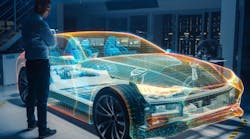
It’s been a few days since CES 2026 closed its doors, and several key trends in automotive electronics emerged at the show.
Although the automotive part of CES didn’t feature as much glitz and spectacle as in recent years, it’s still one of the show’s largest categories. It reflects the industry’s rapid transformation from traditional mechanical engineering to software-defined, AI-powered mobility.
The major trends in automotive electronic architecture these days include:
- Connected vehicles using cellular IoT and satellite communications to keep cars online and aware of their surroundings.
- Centralized computing platforms that manage functions from body, motion, and chassis control to vehicle networking.
- Autonomy in next-generation vehicles.
Automakers also support AI sensor fusion for real-time decision-making as well as more personalized driving, predictive maintenance, and advanced driver-assistance systems (ADAS).
What's New and Notable in the Automotive Sector?
With enhanced perception and reliability in any weather condition, radar is a fundamental technology for sophisticated ADAS and greater vehicle autonomy. Texas Instruments brought this point home as it introduced the AWR2188 4D imaging radar transceiver that integrates eight transmitters and eight receivers into a single launch-on-package chip.
Such integration simplifies higher-resolution radar systems because eight-by-eight configurations don’t require cascading, while scaling up to higher channel counts requires fewer devices. The transceiver supports both satellite and edge architectures, offering automakers the flexibility to simplify and accelerate the global deployment of ADAS features across entry-level to premium vehicles.
The AWR2188 features enhanced analog-to-digital converter data processing and a radar chirp signal slope engine, both supporting 30% faster performance than currently available solutions. The transceiver can detect objects with greater accuracy at distances >350 m, enabling safer, more autonomous driving.
TI's TDA5 SoC family offers edge AI acceleration from 10 trillion operations per second (TOPS) to 1,200 TOPS with power efficiency beyond 24 TOPS/W. This scalability, enabled by its chiplet-ready design with Universal Chiplet Interconnect Express (UCIe) interface technology, allows designers to implement different feature sets. It supports up to Level 3 autonomous driving using a single portfolio. Samples of the TDA54-Q1 SoC, the first device in the family, will be sampling to select automotive customers by the end of 2026.
To simplify complex vehicle software management, TI is partnering with Synopsys to provide a Virtualizer development kit for TDA5 SoCs. The kit's digital-twin capabilities help engineers accelerate time-to-market for their software-defined vehicles (SDVs) by up to 12 months.
BMW showed off a new version of its electric vehicle (EV) that can carry on a conversation with the driver. The system, called the BMW Intelligent Personal Assistant, uses a large language model (LLM), helping the car to understand how people really talk. It can even handle several questions at once, such as asking about the weather together with a query about how much battery life the EV has left.
Under the floor of the BMW iX3 sits a 108-kWh battery. This battery uses an 800-V system, which allows the car to charge faster than older EVs. With a 400-kW charger, about 217 miles of range can be added in just 10 minutes. On a full charge, the iX3 50 xDrive model can travel up to about 400 miles using the U.S. measuring standard.
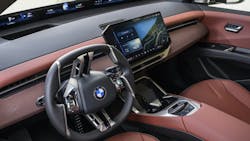
The 2026 BMW iX3 is also the first vehicle to use Amazon's new Alexa+ technology. Thus, you can link your car to your Amazon account to stream music from your library or check on your home devices while on the way home. The 2026 BMW iX3 will sell in the U.S. beginning in the summer of 2026.
NXP Semiconductors N.V. unveiled the S32N7 processor series, building on the same 5-nm foundation as its S32N55. It opens the door to an era where carmakers can digitalize the core functions of every vehicle — propulsion, vehicle dynamics, body, gateway, and safety domains — cutting complexity and unlocking AI-powered innovation at scale.
According to the company, the new processor series empowers carmakers to reduce total cost of ownership by as much as 20%. That’s achieved by eliminating dozens of hardware modules and through enhanced efficiencies in wiring, electronics, and software.
>>Check out more of our CES 2026 coverage
 CES at Las Vegas Convention Center West Hall
Bosch is the first to deploy the S32N7 in its vehicle integration platform. Together, NXP and Bosch co-developed reference designs, safety frameworks, hardware integration, and an expert enablement program, accelerating system deployment and reducing integration effort for early adopters.
Mercedes-Benz launched its 2026 CLA model with NVIDIA's complete autonomous stack. The CLA comes packed with an 800-V electric architecture. It rides on Mercedes-Benz's MMA platform, and features either a single rear motor producing 268 horsepower, or a second motor up front for a total of 349 electric all-wheel-drive horsepower. The 2026 CLA incorporates 27 sensors.
The first in the electric lineup to feature both a J1772 plug and NACS charging port for DC fast charging, the CLA 250+ and CLA 350 can plug into a growing network of compatible 800-V high-power public chargers, such as Mercedes-Benz High-Power Charging hubs. Every CLA will come with a CCS-to-NACS DC fast-charging adapter to ensure access to the Mercedes-Benz integrated network of 800-V fast-charging stations.
Compatibility with 400-V DC chargers will require a factory-equipped converter, available on CLAs starting in Spring 2026. Vehicles without the converter are only DC fast-charging-compatible with an 800-V charger
Flexible Compute Solution Employs NVIDIA AI
Visteon Corp. announced the launch of the company’s next-generation AI-ADAS Compute Module, powered by NVIDIA. It enables automakers to rapidly deploy either intelligent cockpit experiences or ADAS using a single, scalable platform.
The product addresses a key challenge facing automakers: How to add AI capabilities to vehicles without the cost and complexity of overhauling existing electrical systems. Visteon's module functions as a plug-and-play solution that OEMs can configure for their specific needs. It’s powered by an NVIDIA DRIVE AGX Orin system-on-chip (SoC), running on the safety-certified NVIDIA DriveOS operating system.
For in-cabin AI applications, Visteon developed a hybrid edge-cloud architecture using NVIDIA AI Enterprise software. The system leverages NVIDIA NIM micro-services for cloud inference while maintaining privacy-preserving compute on the vehicle side. Visteon's cognitoAI software, developed and optimized for NVIDIA AI infrastructure, enables multimodal intelligence that fuses data from cameras and infotainment systems.
Sony Honda Mobility’s (SHM) joint EV venture car, Afeela, returned to CES 2026 with PlayStation 5 now a standard feature (no surprise there). You can also watch movies from Sony’s catalog or host a Zoom meeting through the system.
It has standard all-wheel drive via two electric motors offering 482 hp total, with 483 lb-ft of torque. The battery is a 91-kWh unit, yielding a 300-mile range.
SHM will build Afeela at Honda’s East Liberty Auto Plant in Ohio, and open delivery hubs in Torrance and Fremont, California, this spring.
Innoviz, based in Tel Aviv, Israel, showcased a solution that combines LiDAR and RGB sensing in a single compact module. The combined LiDAR and camera is purpose-built for behind-the-windshield installations as well as drones, micro-robotics, and humanoid robotics
A slimmer body, only 600 grams in weight, with significantly smaller lateral dimensions than previous versions allows for deployment into the roof interior, behind the windshield, and in the front grille. This gives OEMs maximum installation flexibility.
A lower cost, reduced by over 35% from the InnovizTwo, together with enhanced performance capabilities, enables long-distance accuracy and perception with detection ranges extending beyond 250 meters. And flexible operational modes, including a low-power mode at 13 W for energy efficiency, make possible behind-the-windshield installation without cabin noise disturbance.
The RGB sensing capabilities are factory-aligned with the LiDAR. This combined with hardware-synchronized capture is said to enable reliable multimodal sensor-fusion data correlation while reducing calibration efforts during vehicle integration.
Snapdragon-Powered HPC Platform
Garmin announced the expansion of its automotive technology collaboration with the addition of the Nexus automotive-grade High Performance Compute (HPC) platform. Powered by Qualcomm Technologies' Snapdragon Elite Platform for automotive, Nexus is designed to consolidate multiple vehicle domains such as in-vehicle infotainment, instrument clusters, and/or ADAS into a single system.
Targeting programs starting in 2029, Nexus is scalable to either a single SoC or dual-SoC system design for higher autonomy systems.
The platform is said to deliver up to 6X the compute performance of the previous Unified Cabin domain controller. It incorporates a Garmin-engineered liquid-cooling solution to ensure sustained high-load operation.
LG Electronics integrated Prime Video into its LG Automotive Content Platform (ACP). Automakers with the LG ACP will be able to offer Prime Video's selection of popular movies, series, live events, and exclusive Prime Originals for the first time, beginning in the second quarter of 2026.The webOS-based LG ACP is part of LG’s AlphaWare software suite designed to transform vehicles into "living spaces on wheels.” A subscription is required to access apps that vary by region.
For this year’s CES, LG Innotek revamped its exhibition approach. Instead of simply displaying a list of individual components, the company showcased core convergence solutions installed in each vehicle mockup under two key themes representative of future mobility: autonomous driving and electric vehicles.
On the autonomous-driving concept car mockup, 20 components for autonomous driving and ADAS were installed, covering both interior and exterior vehicle functions such as sensing, communications, and lighting.
Bringing Advanced AI to Today’s Vehicles
Bosch introduced an AI extension platform to enhance existing vehicle cockpit systems without hardware changes. Developed with Microsoft and NVIDIA, it leverages NVIDIA DRIVE AGX Orin for 150 to 200 TOPS computing power, supporting voice assistance, interior scene understanding, and Microsoft 365 integration while maintaining safety features.
The company sees a significant and growing market for such AI cockpits. Various market research institutes, including Grand View Research and MarketsandMarkets, predict that the market for AI-enabled in-vehicle infotainment (IVI) solutions will reach a volume of approximately 17 billion euros by 2030. Bosch expects sales of over 2 billion euros with such IVI solutions by the end of the decade.
Aptiv presented intelligent edge solutions that enable devices to sense, think, and act in real-time. This approach brings advanced computing and artificial intelligence closer to where data is generated.
For example, Aptiv's end-to-end (E2E) AI-powered ADAS platform is designed to deliver safer, more human-like driving and enhanced hands-free (L2 and beyond) autonomy across both highway and urban environments. This approach leverages AI for perception, fusion, and behavior planning, which learn from real-world driving data to continuously evolve and improve over time.

By processing data locally at the edge, rather than relying solely on centralized cloud systems, Aptiv’s solutions are said to enable faster response time and greater optimization at a system level.
Its Driver Monitoring System (DMS) and Cabin Monitoring System (CMS) utilize vision and radar sensing to determine and inform occupancy status. Aptiv’s CMS can replace traditional seat-based occupant detection with vision-based sensing, reducing complexity and cost and improving reconfigurability, while meeting safety standards.
Powered by the company’s cloud-native platform, incorporating Wind River technology, the new Aptiv LINC Software Platform and Verizon’s Edge Transportation Exchange — a mobile-network V2X communication platform — a proof of concept showed how high-speed, low-latency communication can enable safer mobility ecosystems.
Applications include sharing vulnerable road user detections between vehicles by leveraging 5G C-V2X services. For example, vehicles could share the location of pedestrians or cyclists, which might otherwise be blocked from view.
Chinese LiDAR manufacturer Hesai, which became the first company in the sector to surpass two million cumulative LiDAR deliveries in 2025, reports it has secured design wins with 24 global automakers across more than 120 vehicle models. Deliveries are scheduled between 2026 and 2030.
Hesai presented live demonstrations of its new L3 LiDAR suite, including long-range ETX and short-range FTX sensors. Each L3 vehicle is expected to adopt three to six LiDARs as safety redundancy requirements and new regulations take effect.
>>Check out more of our CES 2026 coverage
CES at Las Vegas Convention Center West HallAbout the Author
Murray Slovick
Contributing Editor
Comment About the Article
To join the conversation, and become an exclusive member of Electronic Design, create an account today!
 Leaders Logo
Leaders relevant to this article: